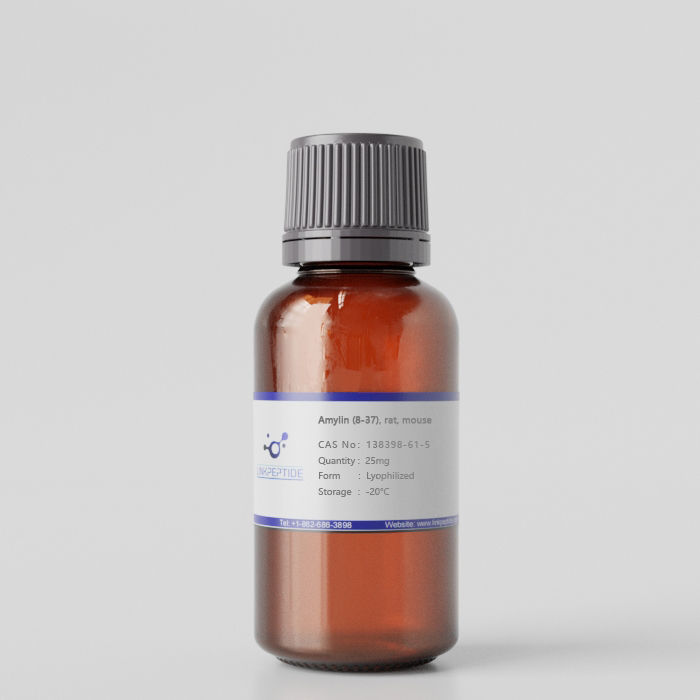
Product Name: Exendin (5-39)
Sequence One Letter Code: TFTSDLSKQMEEEAVRLFIEWLKNGGPSSGAPPPS-NH2
Sequence Three Letter Code: H-Thr-Phe-Thr-Ser-Asp-Leu-Ser-Lys-Gln-Met-Glu-Glu-Glu-Ala-Val-Arg-Leu-Phe-Ile-Glu-Trp-Leu-Lys-Asn-Gly-Gly-Pro-Ser-Ser-Gly-Ala-Pro-Pro-Pro-Ser-NH2
Chemical Formula:C169H262N44O54S
Molecular Weight: 3806.5
Purity: 95%
Form: Lyophilized
Storage Conditions: - 20 °C
Research Area: Diabetes and Metabolic Syndrome
Source / Species: Gila
Conjugation: Unconjugated
Code Nacres: NA.26
Application: Exendin (5–39) is a truncated peptide derived from Exendin-4 that acts as a potent antagonist of the glucagon-like peptide-1 receptor (GLP-1R). While the full-length Exendin-4 peptide functions as a GLP-1 receptor agonist that stimulates insulin secretion and improves glucose regulation, removal of the N-terminal residues converts the molecule into a competitive inhibitor of GLP-1 signaling. Exendin (5–39) binds to the GLP-1 receptor but does not activate downstream signaling, thereby blocking GLP-1–mediated insulin secretion and related metabolic responses. This peptide is widely used in metabolic and endocrine research to investigate GLP-1 receptor function, hormone-regulated insulin secretion, and pancreatic β-cell signaling pathways. It is particularly valuable in studies of glucose homeostasis, incretin biology, and diabetes pathophysiology, where it helps distinguish GLP-1–dependent effects from other metabolic signaling mechanisms.
Current Research: The regulation of glucose homeostasis relies on complex hormonal networks that coordinate insulin secretion, nutrient metabolism, and energy balance. Among the most important regulators of postprandial glucose control are incretin hormones, which enhance insulin secretion in response to nutrient intake. One of the key incretin hormones is glucagon-like peptide-1 (GLP-1), a peptide produced by intestinal L cells that stimulates insulin release, inhibits glucagon secretion, slows gastric emptying, and promotes satiety. Because GLP-1 signaling plays a major role in metabolic regulation, tools that allow selective modulation of this pathway are essential for understanding endocrine physiology and diabetes pathogenesis. Exendin (5–39) is a well-established peptide antagonist of the GLP-1 receptor (GLP-1R) that is widely used to dissect incretin signaling mechanisms in metabolic research. The GLP-1 Receptor and Incretin Biology The GLP-1 receptor belongs to the class B family of G protein–coupled receptors (GPCRs) and is expressed in multiple tissues, including pancreatic β-cells, gastrointestinal tissues, the brain, and cardiovascular systems. Activation of GLP-1R by endogenous GLP-1 triggers intracellular signaling cascades that increase cyclic AMP (cAMP) levels and activate protein kinase A (PKA) and Epac pathways. These signaling events enhance glucose-dependent insulin secretion, improve β-cell survival, and regulate metabolic responses after food intake. The incretin effect refers to the observation that oral glucose intake stimulates greater insulin secretion than intravenous glucose administration, largely due to hormones such as GLP-1 and glucose-dependent insulinotropic polypeptide (GIP). Understanding how GLP-1 regulates insulin secretion has therefore been a major focus of research aimed at developing treatments for type 2 diabetes and metabolic disorders. Exendin-4 and GLP-1 Receptor Activation One of the most important tools for studying GLP-1 signaling is Exendin-4, a peptide originally isolated from the venom of the Gila monster (Heloderma suspectum). Exendin-4 shares structural similarity with GLP-1 and acts as a potent GLP-1 receptor agonist, stimulating insulin secretion and improving glycemic control. Because of its strong and prolonged GLP-1 receptor activity, Exendin-4 has been used both in basic research and as the basis for therapeutic agents used in diabetes treatment. Activation of GLP-1R by Exendin-4 reproduces many of the beneficial metabolic effects of endogenous GLP-1, including enhanced insulin secretion and reduced blood glucose levels. Conversion to an Antagonist: Exendin (5–39) The functional properties of Exendin peptides are highly dependent on their N-terminal sequence, which is critical for receptor activation. When the first four amino acids of Exendin-4 are removed, the resulting peptide—Exendin (5–39)—retains the ability to bind the GLP-1 receptor but loses the capacity to activate downstream signaling. As a result, Exendin (5–39) acts as a competitive antagonist of GLP-1R. It occupies the receptor binding site without triggering the conformational changes required for signal transduction. By blocking receptor activation, the peptide prevents GLP-1 or GLP-1–like agonists from stimulating insulin secretion and other metabolic responses. This property makes Exendin (5–39) a valuable experimental tool for distinguishing GLP-1–dependent effects from other metabolic signaling pathways. Applications in Pancreatic β-Cell and Insulin Secretion Studies One of the primary uses of Exendin (5–39) is in studies examining pancreatic β-cell function. GLP-1 signaling enhances insulin secretion in response to elevated glucose levels, and Exendin (5–39) allows researchers to block this pathway selectively. By applying the antagonist in cell culture experiments or animal models, scientists can determine whether observed insulin secretion responses are mediated through GLP-1 receptor activation. This approach helps clarify the mechanisms by which incretin hormones regulate pancreatic β-cell signaling. Such studies contribute to understanding how β-cells integrate hormonal and metabolic signals to maintain glucose homeostasis. Investigating Glucose Homeostasis and Metabolic Regulation Exendin (5–39) is also widely used in research investigating systemic metabolic regulation. Because GLP-1 influences multiple physiological processes—including appetite control, gastric motility, and glucose metabolism—blocking its receptor can reveal the specific contributions of GLP-1 signaling to these processes. For example, in metabolic studies, Exendin (5–39) can be used to evaluate how GLP-1 signaling contributes to postprandial insulin release, glucose tolerance, and endocrine feedback mechanisms. These experiments help researchers understand how incretin hormones interact with other metabolic regulators such as insulin, glucagon, and gastrointestinal peptides. Relevance to Diabetes Research The GLP-1 signaling pathway is a major therapeutic target for type 2 diabetes treatment. Drugs that mimic GLP-1 activity or enhance its signaling have been developed to improve insulin secretion and glycemic control. In this context, Exendin (5–39) plays an important role in mechanistic studies of incretin biology. By selectively blocking GLP-1 receptor activation, researchers can determine whether metabolic effects observed in experimental systems depend on GLP-1 signaling. This helps clarify the molecular mechanisms underlying incretin-based therapies and metabolic regulation. A Key Tool for Studying Incretin Signaling Exendin (5–39) provides a reliable means of inhibiting GLP-1 receptor signaling in biochemical, cellular, and physiological studies. Its ability to bind GLP-1R without activating downstream signaling allows researchers to isolate the specific contributions of GLP-1 pathways within complex metabolic systems. As a result, this peptide is widely used in research on incretin biology, pancreatic β-cell signaling, glucose homeostasis, and diabetes pathophysiology. By enabling precise manipulation of GLP-1 receptor activity, Exendin (5–39) continues to support investigations into the hormonal regulation of metabolism and the mechanisms underlying metabolic disease.
Get a Quote


 LinkPeptide