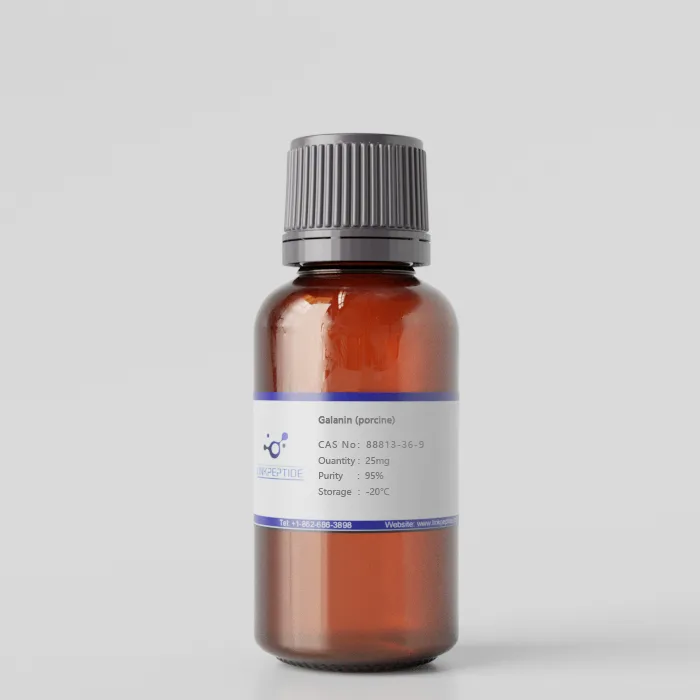
Product Name:Galanin (porcine)
CAS No:88813-36-9
Purity:95%
Molar Mass:3210.55
Chemical Formula:C146H213N43O40
Storage:Store at -20 degrees Celsius
Sequence:GWTLNSAGYLLGPHAIDNHRSFHDKYGLA
Target:porcine galanin
Application:
Galanin (porcine) is a neuropeptide that plays a critical role in modulating a variety of physiological processes, including pain perception, feeding behavior, mood regulation, and neuroendocrine functions. It acts by binding to three galanin receptors (GAL1, GAL2, and GAL3) in both the central and peripheral nervous systems. Galanin (porcine) is commonly used in research to study its influence on neural signaling, particularly in areas such as neurodegenerative diseases, mood disorders, and pain management. Its effects on appetite regulation and hormone secretion also make it a focus of studies related to metabolism and obesity.
Current Research:
Galanin is a neuropeptide comprising 29 amino acids in most species, including pigs, and 30 amino acids in humans. It is widely distributed in the central and peripheral nervous systems, as well as in the gastrointestinal tract. The peptide is derived from a larger precursor protein, preprogalanin, which also gives rise to galanin message-associated peptide (GMAP).
Discovery and Structure
Galanin was first isolated from porcine intestinal extracts in 1978 by Professor Viktor Mutt and colleagues at the Karolinska Institute, Sweden. The peptide's name reflects its structural features: an N-terminal glycine ("Gly") and a C-terminal alanine ("Ala") amide. The amino acid sequence of galanin is highly conserved across species, with over 85% homology between rat, mouse, porcine, bovine, and human sequences. In these species, the first 15 amino acids from the N-terminus are identical, while variations occur in the C-terminal region. This conservation suggests a fundamental role in physiological processes.
Physiological Functions
Galanin is involved in a multitude of physiological functions:
Neuromodulation: It modulates neuronal activity by inhibiting neurotransmitter release, including acetylcholine, serotonin, and norepinephrine. This modulation affects processes such as nociception, cognition, and mood regulation.
Feeding Behavior: Galanin influences feeding behavior, particularly by promoting the intake of fatty foods. Its expression in the hypothalamus is associated with the regulation of appetite and energy homeostasis.
Endocrine Regulation: In the gastrointestinal tract, galanin inhibits the secretion of hormones such as insulin and somatostatin, thereby playing a role in glucose metabolism and digestive processes.
Reproductive Functions: Galanin neurons in the medial preoptic area of the hypothalamus are implicated in governing parental behavior, indicating a role in reproductive physiology.
Clinical Implications
Alterations in galanin expression and signaling have been linked to various pathological conditions:
Neurological Disorders: Changes in galanin levels are associated with Alzheimer's disease, epilepsy, depression, and eating disorders. Its neuroprotective properties suggest potential therapeutic applications in these conditions.
Cancer: Galanin has been found in endocrine tumors, and within gastric cancer cells, it exhibits tumor-suppressive roles. However, hypermethylation can inhibit its tumor-suppressive properties, indicating a complex role in oncogenesis.
Research Applications
Due to its diverse functions, galanin serves as a significant focus in research aimed at understanding its roles in health and disease. Studies on porcine galanin have been instrumental in elucidating its structure-function relationships and in developing therapeutic strategies targeting galanin receptors.
In summary, porcine galanin is a conserved neuropeptide with extensive involvement in regulating physiological processes, including neuromodulation, feeding behavior, endocrine secretion, and reproductive functions. Its dysregulation is implicated in various diseases, making it a critical target for ongoing biomedical research.
Reference:
Get a Quote
 LinkPeptide

![[Ala17]-MCH](https://www.linkpeptide.com/wp-content/uploads/2024/08/Ala17-MCH-jpg.webp "[Ala17]-MCH")