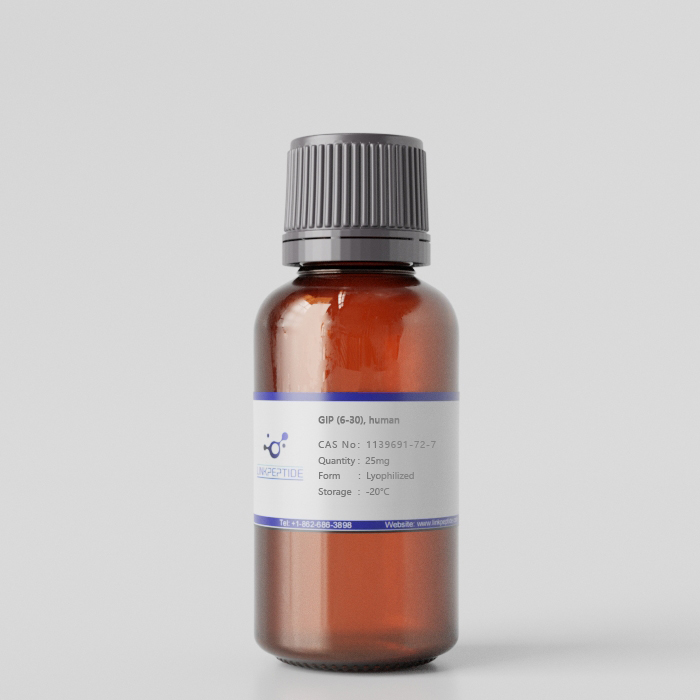
Product Name: GIP (6-30), human
Sequence One Letter Code: FISDYSIAMDKIHQQDFVNWLLAQK-OH
Sequence Three Letter Code: Phe-Ile-Ser-Asp-Tyr-Ser-Ile-Ala-Met-Asp-Lys-Ile-His-Gln-Gln-Asp-Phe-Val-Asn-Trp-Leu-Leu-Ala-Gln-Lys-OH
Cas No: 1139691-72-7
Chemical Formula:C139H208N34O39S1
Molecular Weight: 3011.44
Purity: ≥ 95%
Form: Lyophilized
Storage Conditions: - 20 °C
SMILES: CC[C@H](C)[C@@H](C(=O)N[C@@H](CC1=CN=CN1)C(=O)N[C@@H](CCC(=O)N)C(=O)N[C@@H](CCC(=O)N)C(=O)N[C@@H](CC(=O)O)C(=O)N[C@@H](CC2=CC=CC=C2)C(=O)N[C@@H](C(C)C)C(=O)N[C@@H](CC(=O)N)C(=O)N[C@@H](CC3=CNC4=CC=CC=C43)C(=O)N[C@@H](CC(C)C)C(=O)N[C@@H](CC(C)C)C(=O)N[C@@H](C)C(=O)N[C@@H](CCC(=O)N)C(=O)N[C@@H](CCCCN)C(=O)N)NC(=O)[C@H](CCCCN)NC(=O)[C@H](CC(=O)O)NC(=O)[C@H](CCSC)NC(=O)[C@H](C)NC(=O)[C@H]([C@@H](C)CC)NC(=O)[C@H](CO)NC(=O)[C@H](CC5=CC=C(C=C5)O)NC(=O)[C@H](CC(=O)O)NC(=O)[C@H](CO)NC(=O)[C@H]([C@@H](C)CC)NC(=O)[C@H](CC6=CC=CC=C6)N
IUPAC: (3S)-4-[[(2S)-6-amino-1-[[(2S,3S)-1-[[(2S)-1-[[(2S)-5-amino-1-[[(2S)-5-amino-1-[[(2S)-1-[[(2S)-1-[[(2S)-1-[[(2S)-4-amino-1-[[(2S)-1-[[(2S)-1-[[(2S)-1-[[(2S)-1-[[(2S)-5-amino-1-[[(2S)-1,6-diamino-1-oxohexan-2-yl]amino]-1,5-dioxopentan-2-yl]amino]-1-oxopropan-2-yl]amino]-4-methyl-1-oxopentan-2-yl]amino]-4-methyl-1-oxopentan-2-yl]amino]-3-(1H-indol-3-yl)-1-oxopropan-2-yl]amino]-1,4-dioxobutan-2-yl]amino]-3-methyl-1-oxobutan-2-yl]amino]-1-oxo-3-phenylpropan-2-yl]amino]-3-carboxy-1-oxopropan-2-yl]amino]-1,5-dioxopentan-2-yl]amino]-1,5-dioxopentan-2-yl]amino]-3-(1H-imidazol-5-yl)-1-oxopropan-2-yl]amino]-3-methyl-1-oxopentan-2-yl]amino]-1-oxohexan-2-yl]amino]-3-[[(2S)-2-[[(2S)-2-[[(2S,3S)-2-[[(2S)-2-[[(2S)-2-[[(2S)-2-[[(2S)-2-[[(2S,3S)-2-[[(2S)-2-amino-3-phenylpropanoyl]amino]-3-methylpentanoyl]amino]-3-hydroxypropanoyl]amino]-3-carboxypropanoyl]amino]-3-(4-hydroxyphenyl)propanoyl]amino]-3-hydroxypropanoyl]amino]-3-methylpentanoyl]amino]propanoyl]amino]-4-methylsulfanylbutanoyl]amino]-4-oxobutanoic acid
INCHIKEY: YGIQNDBYDZASQG-YQRZJRGOSA-N
INCHI:
InChI=1S/C139H209N35O38S/c1-16-72(10)112(174-135(208)103(67-176)169-126(199)94(57-79-39-41-82(177)42-40-79)161-132(205)101(63-110(186)187)166-134(207)102(66-175)170-139(212)113(73(11)17-2)172-118(191)84(142)55-77-31-21-19-22-32-77)137(210)152-76(14)117(190)155-91(49-52-213-15)122(195)165-99(61-108(182)183)130(203)156-87(38-28-30-51-141)123(196)173-114(74(12)18-3)138(211)167-97(59-81-65-148-68-150-81)128(201)158-89(44-47-105(144)179)120(193)157-90(45-48-106(145)180)121(194)164-100(62-109(184)185)131(204)162-95(56-78-33-23-20-24-34-78)133(206)171-111(71(8)9)136(209)168-98(60-107(146)181)129(202)163-96(58-80-64-149-85-36-26-25-35-83(80)85)127(200)160-93(54-70(6)7)125(198)159-92(53-69(4)5)124(197)151-75(13)116(189)154-88(43-46-104(143)178)119(192)153-86(115(147)188)37-27-29-50-140/h19-26,31-36,39-42,64-65,68-76,84,86-103,111-114,149,175-177H,16-18,27-30,37-38,43-63,66-67,140-142H2,1-15H3,(H2,143,178)(H2,144,179)(H2,145,180)(H2,146,181)(H2,147,188)(H,148,150)(H,151,197)(H,152,210)(H,153,192)(H,154,189)(H,155,190)(H,156,203)(H,157,193)(H,158,201)(H,159,198)(H,160,200)(H,161,205)(H,162,204)(H,163,202)(H,164,194)(H,165,195)(H,166,207)(H,167,211)(H,168,209)(H,169,199)(H,170,212)(H,171,206)(H,172,191)(H,173,196)(H,174,208)(H,182,183)(H,184,185)(H,186,187)/t72-,73-,74-,75-,76-,84-,86-,87-,88-,89-,90-,91-,92-,93-,94-,95-,96-,97-,98-,99-,100-,101-,102-,103-,111-,112-,113-,114-/m0/s1
Source / Species: human
Conjugation: Unconjugated
Application: GIP (6–30) is a truncated human glucose-dependent insulinotropic polypeptide fragment corresponding to residues 6–30 of the full-length incretin hormone. This biologically active peptide retains key functional properties involved in incretin signaling and pancreatic β-cell regulation. Along with GLP family peptides, GIP contributes to glucose homeostasis, insulin secretion, and lipid metabolism. GIP (6–30) is useful for studying structure–function relationships of GIP, receptor activation mechanisms, truncated incretin biology, metabolic signaling, and gut hormone regulation. It is widely applied in diabetes, obesity, endocrine, and metabolic disease research.
Get a Quote
 LinkPeptide