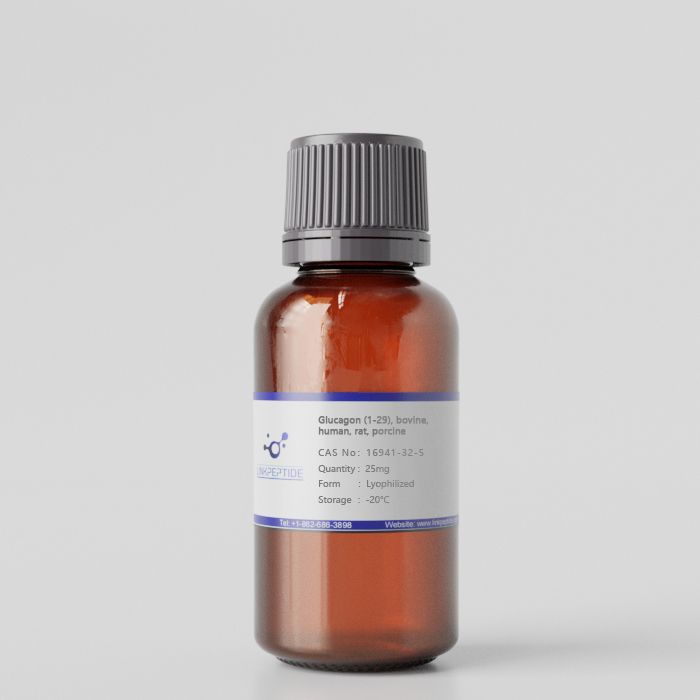
Product Name: Glucagon (1-29), bovine, human, rat, porcine
Sequence One Letter Code: HSQGTFTSDYSKYLDSRRAQDFVQWLMNT
Sequence Three Letter Code: H-His-Ser-Gln-Gly-Thr-Phe-Thr-Ser-Asp-Tyr-Ser-Lys-Tyr-Leu-Asp-Ser-Arg-Arg-Ala-Gln-Asp-Phe-Val-Gln-Trp-Leu-Met-Asn-Thr-OH
Cas No: 16941-32-5
Chemical Formula:C153H225N43O49S
Molecular Weight: 3483
Purity: 95%
Form: Lyophilized
Storage Conditions: - 20 °C
Research Area: Diabetes and Metabolic Syndrome
SMILES: C[C@H]([C@@H](C(=O)N[C@@H](CC1=CC=CC=C1)C(=O)N[C@@H]([C@@H](C)O)C(=O)N[C@@H](CO)C(=O)N[C@@H](CC(=O)O)C(=O)N[C@@H](CC2=CC=C(C=C2)O)C(=O)N[C@@H](CO)C(=O)N[C@@H](CCCCN)C(=O)N[C@@H](CC3=CC=C(C=C3)O)C(=O)N[C@@H](CC(C)C)C(=O)N[C@@H](CC(=O)O)C(=O)N[C@@H](CO)C(=O)N[C@@H](CCCNC(=N)N)C(=O)N[C@@H](CCCNC(=N)N)C(=O)N[C@@H](C)C(=O)N[C@@H](CCC(=O)N)C(=O)N[C@@H](CC(=O)O)C(=O)N[C@@H](CC4=CC=CC=C4)C(=O)N[C@@H](C(C)C)C(=O)N[C@@H](CCC(=O)N)C(=O)N[C@@H](CC5=CNC6=CC=CC=C65)C(=O)N[C@@H](CC(C)C)C(=O)N[C@@H](CCSC)C(=O)N[C@@H](CC(=O)N)C(=O)N[C@@H]([C@@H](C)O)C(=O)O)NC(=O)CNC(=O)[C@H](CCC(=O)N)NC(=O)[C@H](CO)NC(=O)[C@H](CC7=CN=CN7)N)O
IUPAC: (3S)-3-[[(2S)-5-amino-2-[[(2S)-2-[[(2S)-2-[[(2S)-2-[[(2S)-2-[[(2S)-2-[[(2S)-2-[[(2S)-2-[[(2S)-6-amino-2-[[(2S)-2-[[(2S)-2-[[(2S)-2-[[(2S)-2-[[(2S,3R)-2-[[(2S)-2-[[(2S,3R)-2-[[2-[[(2S)-5-amino-2-[[(2S)-2-[[(2S)-2-amino-3-(1H-imidazol-5-yl)propanoyl]amino]-3-hydroxypropanoyl]amino]-5-oxopentanoyl]amino]acetyl]amino]-3-hydroxybutanoyl]amino]-3-phenylpropanoyl]amino]-3-hydroxybutanoyl]amino]-3-hydroxypropanoyl]amino]-3-carboxypropanoyl]amino]-3-(4-hydroxyphenyl)propanoyl]amino]-3-hydroxypropanoyl]amino]hexanoyl]amino]-3-(4-hydroxyphenyl)propanoyl]amino]-4-methylpentanoyl]amino]-3-carboxypropanoyl]amino]-3-hydroxypropanoyl]amino]-5-carbamimidamidopentanoyl]amino]-5-carbamimidamidopentanoyl]amino]propanoyl]amino]-5-oxopentanoyl]amino]-4-[[(2S)-1-[[(2S)-1-[[(2S)-5-amino-1-[[(2S)-1-[[(2S)-1-[[(2S)-1-[[(2S)-4-amino-1-[[(1S,2R)-1-carboxy-2-hydroxypropyl]amino]-1,4-dioxobutan-2-yl]amino]-4-methylsulfanyl-1-oxobutan-2-yl]amino]-4-methyl-1-oxopentan-2-yl]amino]-3-(1H-indol-3-yl)-1-oxopropan-2-yl]amino]-1,5-dioxopentan-2-yl]amino]-3-methyl-1-oxobutan-2-yl]amino]-1-oxo-3-phenylpropan-2-yl]amino]-4-oxobutanoic acid
INCHIKEY: MASNOZXLGMXCHN-ZLPAWPGGSA-N
INCHI:
InChI=1S/C153H225N43O49S/c1-72(2)52-97(133(226)176-96(47-51-246-11)132(225)184-104(60-115(159)209)143(236)196-123(78(10)203)151(244)245)179-137(230)103(58-83-64-167-89-29-19-18-28-87(83)89)183-131(224)95(43-46-114(158)208)177-148(241)120(74(5)6)194-141(234)101(54-79-24-14-12-15-25-79)182-138(231)105(61-117(211)212)185-130(223)94(42-45-113(157)207)171-124(217)75(7)170-127(220)91(31-22-49-165-152(160)161)172-128(221)92(32-23-50-166-153(162)163)174-146(239)110(69-199)191-140(233)107(63-119(215)216)186-134(227)98(53-73(3)4)178-135(228)99(56-81-33-37-85(204)38-34-81)180-129(222)90(30-20-21-48-154)173-145(238)109(68-198)190-136(229)100(57-82-35-39-86(205)40-36-82)181-139(232)106(62-118(213)214)187-147(240)111(70-200)192-150(243)122(77(9)202)195-142(235)102(55-80-26-16-13-17-27-80)188-149(242)121(76(8)201)193-116(210)66-168-126(219)93(41-44-112(156)206)175-144(237)108(67-197)189-125(218)88(155)59-84-65-164-71-169-84/h12-19,24-29,33-40,64-65,71-78,88,90-111,120-123,167,197-205H,20-23,30-32,41-63,66-70,154-155H2,1-11H3,(H2,156,206)(H2,157,207)(H2,158,208)(H2,159,209)(H,164,169)(H,168,219)(H,170,220)(H,171,217)(H,172,221)(H,173,238)(H,174,239)(H,175,237)(H,176,226)(H,177,241)(H,178,228)(H,179,230)(H,180,222)(H,181,232)(H,182,231)(H,183,224)(H,184,225)(H,185,223)(H,186,227)(H,187,240)(H,188,242)(H,189,218)(H,190,229)(H,191,233)(H,192,243)(H,193,210)(H,194,234)(H,195,235)(H,196,236)(H,211,212)(H,213,214)(H,215,216)(H,244,245)(H4,160,161,165)(H4,162,163,166)/t75-,76+,77+,78+,88-,90-,91-,92-,93-,94-,95-,96-,97-,98-,99-,100-,101-,102-,103-,104-,105-,106-,107-,108-,109-,110-,111-,120-,121-,122-,123-/m0/s1
Source / Species: bovine, human, rat, porcine
Conjugation: Unconjugated
Code Nacres: NA.26
Application: Glucagon (1–29) is a peptide hormone secreted by pancreatic α-cells in response to hypoglycemia and plays a central role in glucose homeostasis. It acts primarily on the liver to stimulate glycogenolysis and gluconeogenesis, thereby increasing circulating glucose levels. Glucagon is a key regulator of metabolic balance, counteracting insulin activity to maintain blood glucose stability. Dysregulated glucagon secretion is associated with metabolic disorders, particularly type 2 diabetes, where elevated levels contribute to hyperglycemia. Due to its high sequence conservation across species, this peptide is widely used in metabolic and endocrine research to study hepatic glucose regulation, hormone signaling pathways, and mechanisms underlying glucose metabolism and diabetes progression.
Current Research: Glucagon (1–29) is a 29-amino-acid peptide hormone produced and secreted by pancreatic α-cells in response to low blood glucose levels (hypoglycemia). As a key component of endocrine regulation, glucagon plays a critical role in maintaining glucose homeostasis by counterbalancing the actions of insulin. Its primary function is to increase circulating glucose levels, ensuring a stable energy supply, particularly during fasting or metabolic stress. Because of its well-defined physiological role and high sequence conservation across species, glucagon is widely used in metabolic and endocrine research, especially in studies related to diabetes and energy metabolism. Role in Glucose Homeostasis Glucagon acts as a counter-regulatory hormone to insulin, working to prevent hypoglycemia by increasing blood glucose levels. When glucose concentrations fall, glucagon is released into the bloodstream and targets the liver, the primary organ responsible for glucose production. Its key metabolic effects include: Stimulation of glycogenolysis, breaking down stored glycogen into glucose Activation of gluconeogenesis, generating glucose from non-carbohydrate substrates Promotion of hepatic glucose output, increasing circulating glucose availability Through these mechanisms, glucagon ensures that vital organs—particularly the brain—have a continuous supply of glucose. Mechanism of Action Glucagon exerts its effects by binding to the glucagon receptor (GCGR), a G protein–coupled receptor primarily expressed in hepatocytes. Upon activation, the receptor triggers intracellular signaling pathways involving: cAMP production and activation of protein kinase A (PKA) Phosphorylation of key metabolic enzymes Upregulation of genes involved in gluconeogenesis These signaling cascades coordinate metabolic responses that increase glucose production and release into the bloodstream. Balance Between Glucagon and Insulin Glucose homeostasis depends on the dynamic balance between insulin and glucagon. While insulin promotes glucose uptake and storage, glucagon stimulates glucose release. Together, they form a tightly regulated system that maintains blood glucose within a narrow physiological range. Disruption of this balance can lead to metabolic disorders. In particular: Excess glucagon activity contributes to elevated hepatic glucose production Impaired insulin signaling reduces glucose uptake This imbalance is a hallmark of type 2 diabetes, where inappropriate glucagon secretion plays a significant role in hyperglycemia. Applications in Metabolic and Endocrine Research Glucagon (1–29) is widely used as a model peptide in studies of glucose metabolism and hormone signaling. Its conserved structure and well-characterized biological activity make it suitable for a variety of experimental systems. Common research applications include: Investigation of hepatic glucose regulation Studies of glucagon receptor signaling pathways Analysis of insulin–glucagon interplay in metabolic control Evaluation of glucose production and energy metabolism Development of therapeutics targeting glucagon signaling These applications are critical for understanding the physiological and pathological mechanisms underlying metabolic diseases. Relevance to Diabetes and Metabolic Disorders In type 2 diabetes, glucagon secretion is often inappropriately elevated, even when blood glucose levels are high. This leads to excessive hepatic glucose production, exacerbating hyperglycemia. Research involving glucagon (1–29) has helped clarify: Mechanisms of dysregulated hormone secretion Contribution of glucagon to diabetic hyperglycemia Potential therapeutic targets within glucagon signaling pathways Modulating glucagon activity is therefore an important strategy in the development of treatments for metabolic disorders. A Fundamental Tool for Studying Metabolic Regulation Glucagon (1–29) remains a cornerstone reagent in studies of endocrine physiology and metabolic control. Its central role in regulating glucose production and maintaining energy balance makes it indispensable for investigating the molecular mechanisms of glucose homeostasis. Through its application in biochemical, cellular, and in vivo studies, glucagon continues to support advances in understanding hormone signaling, metabolic disease progression, and therapeutic intervention strategies for diabetes and related disorders.
Get a Quote
 LinkPeptide