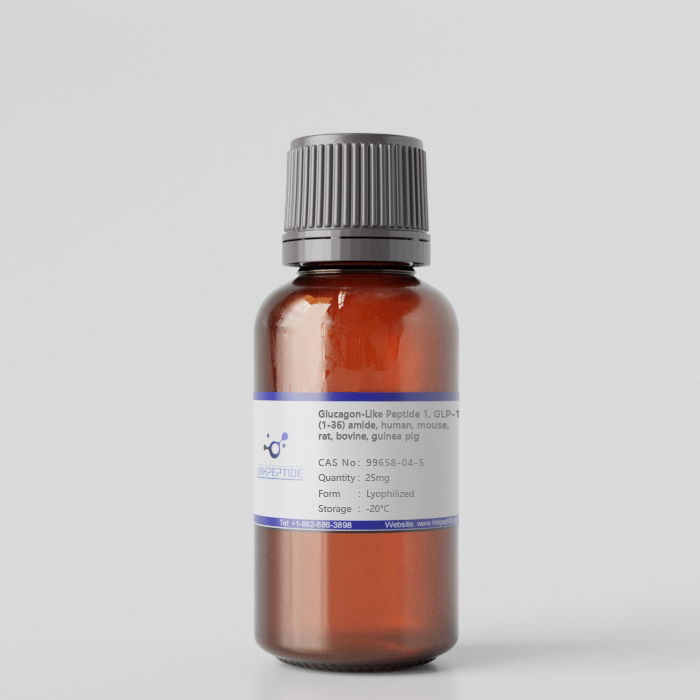
Product Name: Glucagon-Like Peptide 1, GLP-1 (1-36) amide, human, mouse, rat, bovine, guinea pig
Sequence One Letter Code: HDEFERHAEGTFTSDVSSYLEGQAAKEFIAWLVKGR-NH2
Sequence Three Letter Code: H-His-Asp-Glu-Phe-Glu-Arg-His-Ala-Glu-Gly-Thr-Phe-Thr-Ser-Asp-Val-Ser-Ser-Tyr-Leu-Glu-Gly-Gln-Ala-Ala-Lys-Glu-Phe-Ile-Ala-Trp-Leu-Val-Lys-Gly-Arg-NH2
Cas No: 99658-04-5
Chemical Formula:C184H273N51O57
Molecular Weight: 4111.7
Purity: 95%
Form: Lyophilized
Storage Conditions: - 20 °C
Research Area: Diabetes and Metabolic Syndrome
SMILES: CC[C@H](C)[C@@H](C(=O)N[C@@H](C)C(=O)N[C@@H](CC1=CNC2=CC=CC=C21)C(=O)N[C@@H](CC(C)C)C(=O)N[C@@H](C(C)C)C(=O)N[C@@H](CCCCN)C(=O)NCC(=O)N[C@@H](CCCNC(=N)N)C(=O)N)NC(=O)[C@H](CC3=CC=CC=C3)NC(=O)[C@H](CCC(=O)O)NC(=O)[C@H](CCCCN)NC(=O)[C@H](C)NC(=O)[C@H](C)NC(=O)[C@H](CCC(=O)N)NC(=O)CNC(=O)[C@H](CCC(=O)O)NC(=O)[C@H](CC(C)C)NC(=O)[C@H](CC4=CC=C(C=C4)O)NC(=O)[C@H](CO)NC(=O)[C@H](CO)NC(=O)[C@H](C(C)C)NC(=O)[C@H](CC(=O)O)NC(=O)[C@H](CO)NC(=O)[C@H]([C@@H](C)O)NC(=O)[C@H](CC5=CC=CC=C5)NC(=O)[C@H]([C@@H](C)O)NC(=O)CNC(=O)[C@H](CCC(=O)O)NC(=O)[C@H](C)NC(=O)[C@H](CC6=CN=CN6)NC(=O)[C@H](CCCNC(=N)N)NC(=O)[C@H](CCC(=O)O)NC(=O)[C@H](CC7=CC=CC=C7)NC(=O)[C@H](CCC(=O)O)NC(=O)[C@H](CC(=O)O)NC(=O)[C@H](CC8=CN=CN8)N
IUPAC: (4S)-5-[[2-[[(2S,3R)-1-[[(2S)-1-[[(2S,3R)-1-[[(2S)-1-[[(2S)-1-[[(2S)-1-[[(2S)-1-[[(2S)-1-[[(2S)-1-[[(2S)-1-[[(2S)-1-[[2-[[(2S)-5-amino-1-[[(2S)-1-[[(2S)-1-[[(2S)-6-amino-1-[[(2S)-1-[[(2S)-1-[[(2S,3S)-1-[[(2S)-1-[[(2S)-1-[[(2S)-1-[[(2S)-1-[[(2S)-6-amino-1-[[2-[[(2S)-1-amino-5-carbamimidamido-1-oxopentan-2-yl]amino]-2-oxoethyl]amino]-1-oxohexan-2-yl]amino]-3-methyl-1-oxobutan-2-yl]amino]-4-methyl-1-oxopentan-2-yl]amino]-3-(1H-indol-3-yl)-1-oxopropan-2-yl]amino]-1-oxopropan-2-yl]amino]-3-methyl-1-oxopentan-2-yl]amino]-1-oxo-3-phenylpropan-2-yl]amino]-4-carboxy-1-oxobutan-2-yl]amino]-1-oxohexan-2-yl]amino]-1-oxopropan-2-yl]amino]-1-oxopropan-2-yl]amino]-1,5-dioxopentan-2-yl]amino]-2-oxoethyl]amino]-4-carboxy-1-oxobutan-2-yl]amino]-4-methyl-1-oxopentan-2-yl]amino]-3-(4-hydroxyphenyl)-1-oxopropan-2-yl]amino]-3-hydroxy-1-oxopropan-2-yl]amino]-3-hydroxy-1-oxopropan-2-yl]amino]-3-methyl-1-oxobutan-2-yl]amino]-3-carboxy-1-oxopropan-2-yl]amino]-3-hydroxy-1-oxopropan-2-yl]amino]-3-hydroxy-1-oxobutan-2-yl]amino]-1-oxo-3-phenylpropan-2-yl]amino]-3-hydroxy-1-oxobutan-2-yl]amino]-2-oxoethyl]amino]-4-[[(2S)-2-[[(2S)-2-[[(2S)-2-[[(2S)-2-[[(2S)-2-[[(2S)-2-[[(2S)-2-[[(2S)-2-amino-3-(1H-imidazol-5-yl)propanoyl]amino]-3-carboxypropanoyl]amino]-4-carboxybutanoyl]amino]-3-phenylpropanoyl]amino]-4-carboxybutanoyl]amino]-5-carbamimidamidopentanoyl]amino]-3-(1H-imidazol-5-yl)propanoyl]amino]propanoyl]amino]-5-oxopentanoic acid
INCHIKEY: IXEAJSJZACHTSH-FTFYVAQHSA-N
INCHI:
InChI=1S/C184H273N51O57/c1-17-93(10)147(180(290)207-97(14)154(264)218-127(73-104-78-198-110-42-28-27-41-108(104)110)169(279)221-122(68-90(4)5)171(281)232-145(91(6)7)178(288)217-112(43-29-31-63-185)156(266)199-81-135(243)208-111(150(189)260)45-33-65-196-183(190)191)234-172(282)125(70-101-37-23-19-24-38-101)223-163(273)119(55-61-141(252)253)214-160(270)113(44-30-32-64-186)210-152(262)95(12)204-151(261)94(11)205-159(269)117(51-57-134(188)242)209-136(244)82-200-158(268)116(53-59-139(248)249)213-166(276)121(67-89(2)3)220-168(278)124(72-103-47-49-107(241)50-48-103)224-175(285)131(84-236)228-177(287)133(86-238)229-179(289)146(92(8)9)233-174(284)130(77-144(258)259)226-176(286)132(85-237)230-182(292)149(99(16)240)235-173(283)126(71-102-39-25-20-26-40-102)227-181(291)148(98(15)239)231-137(245)83-201-157(267)115(52-58-138(246)247)211-153(263)96(13)206-165(275)128(75-106-80-195-88-203-106)225-161(271)114(46-34-66-197-184(192)193)212-162(272)118(54-60-140(250)251)215-167(277)123(69-100-35-21-18-22-36-100)222-164(274)120(56-62-142(254)255)216-170(280)129(76-143(256)257)219-155(265)109(187)74-105-79-194-87-202-105/h18-28,35-42,47-50,78-80,87-99,109,111-133,145-149,198,236-241H,17,29-34,43-46,51-77,81-86,185-187H2,1-16H3,(H2,188,242)(H2,189,260)(H,194,202)(H,195,203)(H,199,266)(H,200,268)(H,201,267)(H,204,261)(H,205,269)(H,206,275)(H,207,290)(H,208,243)(H,209,244)(H,210,262)(H,211,263)(H,212,272)(H,213,276)(H,214,270)(H,215,277)(H,216,280)(H,217,288)(H,218,264)(H,219,265)(H,220,278)(H,221,279)(H,222,274)(H,223,273)(H,224,285)(H,225,271)(H,226,286)(H,227,291)(H,228,287)(H,229,289)(H,230,292)(H,231,245)(H,232,281)(H,233,284)(H,234,282)(H,235,283)(H,246,247)(H,248,249)(H,250,251)(H,252,253)(H,254,255)(H,256,257)(H,258,259)(H4,190,191,196)(H4,192,193,197)/t93-,94-,95-,96-,97-,98+,99+,109-,111-,112-,113-,114-,115-,116-,117-,118-,119-,120-,121-,122-,123-,124-,125-,126-,127-,128-,129-,130-,131-,132-,133-,145-,146-,147-,148-,149-/m0/s1
Source / Species: human
Conjugation: Unconjugated
Code Nacres: NA.26
Application: Glucagon-Like Peptide-1 (GLP-1) (1–36) amide is a proglucagon-derived peptide produced in intestinal L cells and select neuronal populations. Although it serves as a precursor to the more abundant truncated incretin forms GLP-1 (7–36) amide and GLP-1 (7–37), the full-length (1–36) peptide remains important for studying GLP-1 biosynthesis and processing pathways. GLP-1 signaling regulates glucose-dependent insulin secretion, suppresses glucagon release, delays gastric emptying, and influences satiety through central mechanisms. This peptide is commonly applied in metabolic research to investigate prohormone processing, β-cell physiology, and incretin receptor signaling. It supports mechanistic evaluation of glucose homeostasis and neuroendocrine regulation in experimental diabetes and metabolic disorder models.
Current Research: Glucagon-Like Peptide-1 (GLP-1) (1–36) amide is a proglucagon-derived peptide produced primarily in intestinal enteroendocrine L cells and in select neuronal populations within the central nervous system. Although the biologically dominant circulating incretin hormones are the truncated forms GLP-1 (7–36) amide and GLP-1 (7–37), the full-length (1–36) amide peptide plays an essential role in understanding GLP-1 biosynthesis, post-translational processing, and endocrine regulation. As the immediate precursor to active incretin forms, GLP-1 (1–36) amide serves as a critical reagent for studying prohormone convertase–mediated cleavage and incretin pathway regulation. Biosynthesis and Prohormone Processing GLP-1 is generated from the proglucagon precursor through tissue-specific proteolytic processing. In intestinal L cells and certain neurons, prohormone convertase 1/3 (PC1/3) cleaves proglucagon to produce GLP-1 (1–36) amide, which is subsequently processed to the active GLP-1 (7–36) amide form. This N-terminal truncation is essential for high-affinity activation of the GLP-1 receptor (GLP-1R). GLP-1 (1–36) amide is therefore particularly valuable for mechanistic investigations of: Prohormone convertase specificity Differential tissue processing of proglucagon Intracellular peptide trafficking and secretion Enzymatic regulation of incretin maturation By studying the full-length precursor peptide, researchers can dissect regulatory checkpoints governing incretin production under physiological and pathological conditions. GLP-1 Signaling Pathways While GLP-1 (1–36) amide itself exhibits limited classical incretin activity compared to truncated forms, its role in incretin biology is central. Active GLP-1 binds to GLP-1R, a class B G protein–coupled receptor that signals primarily through G_s-mediated cAMP production. Downstream activation of protein kinase A (PKA) and Epac pathways enhances glucose-dependent insulin secretion from pancreatic β-cells. GLP-1 signaling also suppresses glucagon release from α-cells, slows gastric emptying, and promotes satiety through central nervous system pathways. The incretin axis is therefore integral to postprandial glucose homeostasis and metabolic regulation. Applications in Metabolic and Diabetes Research GLP-1 (1–36) amide is widely used in metabolic research contexts that require precise evaluation of biosynthetic and processing pathways. Applications include: Studies of proglucagon gene expression and peptide maturation Investigation of PC1/3 enzymatic activity β-cell physiology and insulin secretion models GLP-1 receptor signaling pathway analysis Experimental diabetes and obesity research In models of type 2 diabetes and metabolic syndrome, altered prohormone processing and incretin signaling are areas of active investigation. The full-length peptide supports experimental systems designed to clarify how dysregulated processing affects glucose control. Neuroendocrine and Gut–Brain Axis Research GLP-1 is also synthesized in the nucleus tractus solitarius and contributes to appetite regulation and energy balance. Although truncated forms are primarily responsible for receptor activation, GLP-1 (1–36) amide is relevant for understanding neuronal proglucagon processing and peptide trafficking in central pathways. Studies examining gut–brain communication, vagal signaling, and central satiety mechanisms benefit from inclusion of precursor peptides to map biosynthetic routes and enzymatic conversion efficiency. Experimental Advantages Defined precursor sequence for incretin processing studies Suitable for enzymatic cleavage assays Supports investigation of prohormone convertase function Compatible with metabolic and endocrine research models Enables mechanistic study of glucose homeostasis regulation Because incretin biology underpins widely used therapeutic strategies in diabetes treatment, detailed understanding of GLP-1 processing remains highly relevant. GLP-1 (1–36) amide provides a mechanistically informative tool for dissecting early steps in incretin biosynthesis and endocrine regulation. Research Significance GLP-1 (1–36) amide occupies a foundational position in studies of proglucagon processing and incretin pathway biology. By enabling precise investigation of peptide maturation, β-cell signaling, and neuroendocrine regulation, it supports mechanistic exploration of glucose homeostasis and metabolic disease progression.
Get a Quote
 LinkPeptide