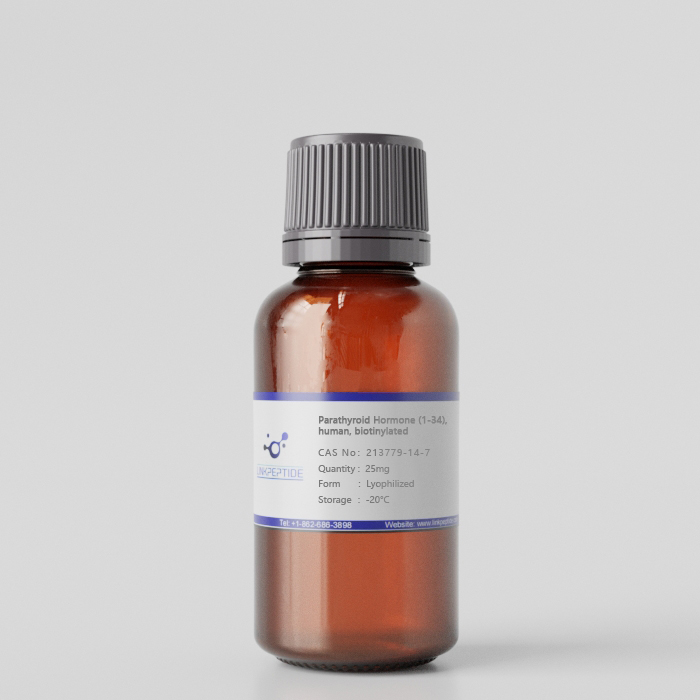
Product Name: Glucagon-Like Peptide 1, GLP-1 (7-36)-Lys(Biotin), amide, human, mouse, rat, bovine, guinea pig
Sequence One Letter Code: HAEGTFTSDVSSYLEGQAAKEFIAWLVKGRK(Biotin)-NH2
Sequence Three Letter Code: H-His-Ala-Glu-Gly-Thr-Phe-Thr-Ser-Asp-Val-Ser-Ser-Tyr-Leu-Glu-Gly-Gln-Ala-Ala-Lys-Glu-Phe-Ile-Ala-Trp-Leu-Val-Lys-Gly-Arg-Lys(Biotin)-NH2
Cas No: 1802086-70-9
Chemical Formula:C165H252N44O48S
Molecular Weight: 3652.3
Purity: 95%
Form: Lyophilized
Storage Conditions: - 20 °C
Research Area: Diabetes and Metabolic Syndrome
SMILES: CC[C@H](C)[C@@H](C(=O)N[C@@H](C)C(=O)N[C@@H](CC1=CNC2=CC=CC=C21)C(=O)N[C@@H](CC(C)C)C(=O)N[C@@H](C(C)C)C(=O)N[C@@H](CCCCN)C(=O)NCC(=O)N[C@@H](CCCNC(=N)N)C(=O)N[C@@H](CCCCNC(=O)CCCC[C@H]3[C@@H]4[C@H](CS3)NC(=O)N4)C(=O)N)NC(=O)[C@H](CC5=CC=CC=C5)NC(=O)[C@H](CCC(=O)O)NC(=O)[C@H](CCCCN)NC(=O)[C@H](C)NC(=O)[C@H](C)NC(=O)[C@H](CCC(=O)N)NC(=O)CNC(=O)[C@H](CCC(=O)O)NC(=O)[C@H](CC(C)C)NC(=O)[C@H](CC6=CC=C(C=C6)O)NC(=O)[C@H](CO)NC(=O)[C@H](CO)NC(=O)[C@H](C(C)C)NC(=O)[C@H](CC(=O)O)NC(=O)[C@H](CO)NC(=O)[C@H]([C@@H](C)O)NC(=O)[C@H](CC7=CC=CC=C7)NC(=O)[C@H]([C@@H](C)O)NC(=O)CNC(=O)[C@H](CCC(=O)O)NC(=O)[C@H](C)NC(=O)[C@H](CC8=CNC=N8)N
IUPAC: (4S)-5-[[2-[[(2S,3R)-1-[[(2S)-1-[[(2S,3R)-1-[[(2S)-1-[[(2S)-1-[[(2S)-1-[[(2S)-1-[[(2S)-1-[[(2S)-1-[[(2S)-1-[[(2S)-1-[[2-[[(2S)-1-[[(2S)-1-[[(2S)-1-[[(2S)-1-[[(2S)-1-[[(2S)-1-[[(2S,3S)-1-[[(2S)-1-[[(2S)-1-[[(2S)-1-[[(2S)-1-[[(2S)-1-[[2-[[(2S)-1-[[(2S)-6-[5-[(3aS,4S,6aR)-2-oxo-1,3,3a,4,6,6a-hexahydrothieno[3,4-d]imidazol-4-yl]pentanoylamino]-1-amino-1-oxohexan-2-yl]amino]-5-carbamimidamido-1-oxopentan-2-yl]amino]-2-oxoethyl]amino]-6-amino-1-oxohexan-2-yl]amino]-3-methyl-1-oxobutan-2-yl]amino]-4-methyl-1-oxopentan-2-yl]amino]-3-(1H-indol-3-yl)-1-oxopropan-2-yl]amino]-1-oxopropan-2-yl]amino]-3-methyl-1-oxopentan-2-yl]amino]-1-oxo-3-phenylpropan-2-yl]amino]-4-carboxy-1-oxobutan-2-yl]amino]-6-amino-1-oxohexan-2-yl]amino]-1-oxopropan-2-yl]amino]-1-oxopropan-2-yl]amino]-5-amino-1,5-dioxopentan-2-yl]amino]-2-oxoethyl]amino]-4-carboxy-1-oxobutan-2-yl]amino]-4-methyl-1-oxopentan-2-yl]amino]-3-(4-hydroxyphenyl)-1-oxopropan-2-yl]amino]-3-hydroxy-1-oxopropan-2-yl]amino]-3-hydroxy-1-oxopropan-2-yl]amino]-3-methyl-1-oxobutan-2-yl]amino]-3-carboxy-1-oxopropan-2-yl]amino]-3-hydroxy-1-oxopropan-2-yl]amino]-3-hydroxy-1-oxobutan-2-yl]amino]-1-oxo-3-phenylpropan-2-yl]amino]-3-hydroxy-1-oxobutan-2-yl]amino]-2-oxoethyl]amino]-4-[[(2S)-2-[[(2S)-2-amino-3-(1H-imidazol-4-yl)propanoyl]amino]propanoyl]amino]-5-oxopentanoic acid
INCHIKEY: DVZRWUQLVWOAPV-PSQNHTQXSA-N
InChI=1S/C165H252N44O48S/c1-17-85(10)132(161(254)184-89(14)140(233)193-114(68-95-71-176-100-40-25-24-39-98(95)100)151(244)195-110(64-82(4)5)152(245)205-130(83(6)7)159(252)192-102(42-28-31-59-166)142(235)177-73-123(218)185-103(44-34-62-175-164(171)172)146(239)187-101(136(170)229)41-30-33-61-174-122(217)46-27-26-45-120-135-119(79-258-120)203-165(257)209-135)207-153(246)112(65-92-35-20-18-21-36-92)196-148(241)108(54-58-128(225)226)191-147(240)104(43-29-32-60-167)188-138(231)87(12)181-137(230)86(11)183-145(238)107(51-55-121(169)216)186-124(219)74-178-144(237)106(53-57-127(223)224)190-149(242)109(63-81(2)3)194-150(243)111(67-94-47-49-97(215)50-48-94)197-156(249)116(76-210)200-158(251)118(78-212)201-160(253)131(84(8)9)206-155(248)115(70-129(227)228)198-157(250)117(77-211)202-163(256)134(91(16)214)208-154(247)113(66-93-37-22-19-23-38-93)199-162(255)133(90(15)213)204-125(220)75-179-143(236)105(52-56-126(221)222)189-139(232)88(13)182-141(234)99(168)69-96-72-173-80-180-96/h18-25,35-40,47-50,71-72,80-91,99,101-120,130-135,176,210-215H,17,26-34,41-46,51-70,73-79,166-168H2,1-16H3,(H2,169,216)(H2,170,229)(H,173,180)(H,174,217)(H,177,235)(H,178,237)(H,179,236)(H,181,230)(H,182,234)(H,183,238)(H,184,254)(H,185,218)(H,186,219)(H,187,239)(H,188,231)(H,189,232)(H,190,242)(H,191,240)(H,192,252)(H,193,233)(H,194,243)(H,195,244)(H,196,241)(H,197,249)(H,198,250)(H,199,255)(H,200,251)(H,201,253)(H,202,256)(H,204,220)(H,205,245)(H,206,248)(H,207,246)(H,208,247)(H,221,222)(H,223,224)(H,225,226)(H,227,228)(H4,171,172,175)(H2,203,209,257)/t85-,86-,87-,88-,89-,90+,91+,99-,101-,102-,103-,104-,105-,106-,107-,108-,109-,110-,111-,112-,113-,114-,115-,116-,117-,118-,119-,120-,130-,131-,132-,133-,134-,135-/m0/s1
Source / Species: human
Conjugation: Conjugated
Conjugation Type: Biotins
Code Nacres: NA.26
Application: Biotinylated GLP-1 (7–36) Amide is a modified incretin peptide featuring an N-terminal lysine conjugated to biotin, enabling affinity-based detection and binding studies. GLP-1 (7–36) amide stimulates glucose-dependent insulin secretion, suppresses glucagon release, and regulates gastric emptying and appetite. The peptide is rapidly degraded by dipeptidyl peptidase-4 in vivo, producing inactive metabolites. The biotin tag allows use in pull-down assays, receptor binding studies, and signaling analysis. This peptide is widely used in metabolic and endocrine research to investigate incretin biology, receptor interactions, and therapeutic mechanisms targeting glucose homeostasis and diabetes.
Current Research: Biotinylated GLP-1 (7–36) amide is a modified form of the biologically active incretin hormone GLP-1, featuring an N-terminal lysine conjugated to biotin. This modification preserves the peptide’s physiological activity while enabling affinity-based detection and interaction studies through streptavidin-based systems. As a result, it serves as a powerful tool for investigating GLP-1 receptor (GLP-1R) signaling, ligand–receptor interactions, and metabolic regulation. GLP-1 (7–36) Amide and Incretin Function GLP-1 (7–36) amide is the predominant active form of GLP-1 in circulation and plays a central role in glucose homeostasis. It is secreted by intestinal L-cells in response to nutrient intake and exerts multiple metabolic effects: Enhancement of glucose-dependent insulin secretion from pancreatic β-cells Suppression of glucagon release, reducing hepatic glucose output Delay of gastric emptying, moderating postprandial glucose spikes Promotion of satiety, contributing to reduced food intake These coordinated actions make GLP-1 a key regulator of postprandial glucose control and energy balance. Biotinylation and Functional Advantages The addition of a biotin moiety via an N-terminal lysine enables the peptide to bind with high affinity to streptavidin or avidin, facilitating a wide range of experimental applications without significantly disrupting receptor binding. Key advantages of biotinylation include: Efficient immobilization on assay surfaces Selective enrichment of receptor or binding partners Compatibility with pull-down and capture assays Enhanced detection sensitivity in biochemical workflows This makes biotinylated GLP-1 (7–36) amide particularly useful for studying ligand–receptor interactions in a controlled and quantitative manner. Mechanism of Action via GLP-1 Receptor Like the native peptide, the biotinylated form activates the GLP-1 receptor (GLP-1R), a G protein–coupled receptor expressed in pancreatic islets and other tissues. Upon binding, GLP-1R activation triggers: cAMP production and protein kinase A (PKA) activation Enhanced insulin granule exocytosis Modulation of gene expression related to β-cell function These signaling events underlie the peptide’s effects on glucose regulation and metabolic control. Applications in Receptor Binding and Interaction Studies Biotinylated GLP-1 (7–36) amide is widely used in studies focused on receptor binding, ligand affinity, and signaling mechanisms. Common applications include: Pull-down assays to identify GLP-1R-interacting proteins Receptor binding studies to evaluate ligand affinity and specificity Surface immobilization assays for kinetic and interaction analysis Mapping of receptor–ligand interfaces Proteomic studies of GLP-1–associated complexes These approaches are essential for understanding how GLP-1 engages its receptor and initiates downstream signaling. Use in Signaling and Functional Assays In addition to binding studies, this peptide is used in functional assays to monitor GLP-1–mediated signaling pathways. Applications include: Measurement of cAMP production and downstream signaling events Analysis of insulin secretion in β-cell models Investigation of receptor internalization and trafficking Evaluation of signaling pathway modulation by agonists or antagonists The biotin tag allows simultaneous functional and interaction-based analysis, enhancing experimental versatility. Stability and DPP-4 Degradation Like native GLP-1 (7–36) amide, the biotinylated peptide is susceptible to rapid degradation by dipeptidyl peptidase-4 (DPP-4), which cleaves the N-terminus to produce inactive metabolites. This characteristic is important for: Studying peptide stability and degradation pathways Evaluating DPP-4 inhibitors and incretin-based therapies Understanding the pharmacokinetics of GLP-1 signaling Relevance to Diabetes and Therapeutic Research GLP-1 signaling is a major target in type 2 diabetes and metabolic disorder research. Biotinylated GLP-1 (7–36) amide supports investigations into: Mechanisms of incretin-based therapies GLP-1 receptor pharmacology and drug development Regulation of insulin secretion and glucose homeostasis Its dual functionality as both a bioactive ligand and affinity probe makes it especially valuable in translational research. A Versatile Tool for Incretin Biology Biotinylated GLP-1 (7–36) amide combines physiological relevance with experimental flexibility, enabling detailed analysis of receptor interactions, signaling pathways, and metabolic regulation. By facilitating both functional assays and affinity-based studies, it remains an essential reagent for advancing research in endocrinology, diabetes, and peptide therapeutics.
Get a Quote
 LinkPeptide

![[Lys(Me2)20]-Histone H4 (8-30)-WGK(Biotin)](https://www.linkpeptide.com/wp-content/uploads/2026/06/LysMe220-Histone-H4-8-30-WGKBiotin.jpg "[Lys(Me2)20]-Histone H4 (8-30)-WGK(Biotin)")