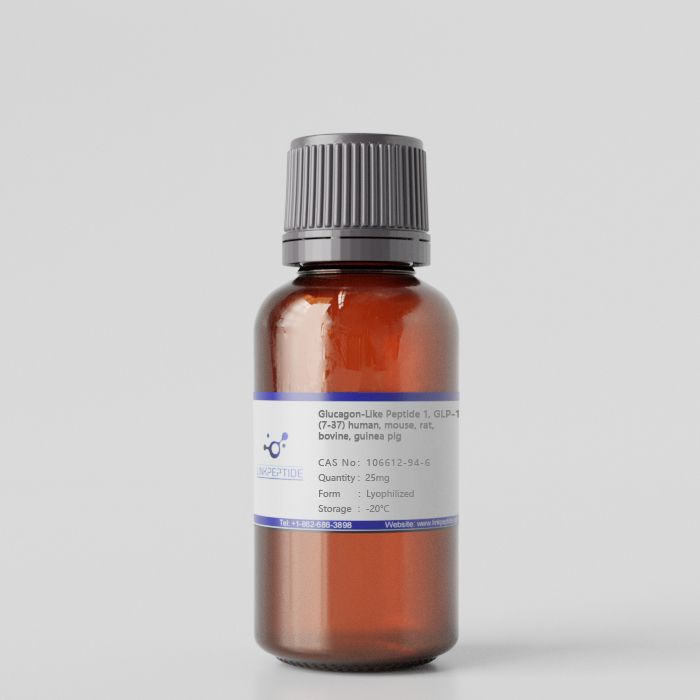
Product Name: Glucagon-Like Peptide 1, GLP-1 (7-37) human, mouse, rat, bovine, guinea pig
Sequence One Letter Code: HAEGTFTSDVSSYLEGQAAKEFIAWLVKGRG
Sequence Three Letter Code: H-His-Ala-Glu-Gly-Thr-Phe-Thr-Ser-Asp-Val-Ser-Ser-Tyr-Leu-Glu-Gly-Gln-Ala-Ala-Lys-Glu-Phe-Ile-Ala-Trp-Leu-Val-Lys-Gly-Arg-Gly-OH
Cas No: 106612-94-6
Chemical Formula:C151H228N40O47
Molecular Weight: 3355.9
Purity: 95%
Form: Lyophilized
Storage Conditions: - 20 °C
Research Area: Diabetes and Metabolic Syndrome
SMILES: CC[C@H](C)[C@@H](C(=O)N[C@@H](C)C(=O)N[C@@H](CC1=CNC2=CC=CC=C21)C(=O)N[C@@H](CC(C)C)C(=O)N[C@@H](C(C)C)C(=O)N[C@@H](CCCCN)C(=O)NCC(=O)N[C@@H](CCCNC(=N)N)C(=O)NCC(=O)O)NC(=O)[C@H](CC3=CC=CC=C3)NC(=O)[C@H](CCC(=O)O)NC(=O)[C@H](CCCCN)NC(=O)[C@H](C)NC(=O)[C@H](C)NC(=O)[C@H](CCC(=O)N)NC(=O)CNC(=O)[C@H](CCC(=O)O)NC(=O)[C@H](CC(C)C)NC(=O)[C@H](CC4=CC=C(C=C4)O)NC(=O)[C@H](CO)NC(=O)[C@H](CO)NC(=O)[C@H](C(C)C)NC(=O)[C@H](CC(=O)O)NC(=O)[C@H](CO)NC(=O)[C@H]([C@@H](C)O)NC(=O)[C@H](CC5=CC=CC=C5)NC(=O)[C@H]([C@@H](C)O)NC(=O)CNC(=O)[C@H](CCC(=O)O)NC(=O)[C@H](C)NC(=O)[C@H](CC6=CNC=N6)N
IUPAC: (4S)-5-[[2-[[(2S,3R)-1-[[(2S)-1-[[(2S,3R)-1-[[(2S)-1-[[(2S)-1-[[(2S)-1-[[(2S)-1-[[(2S)-1-[[(2S)-1-[[(2S)-1-[[(2S)-1-[[2-[[(2S)-5-amino-1-[[(2S)-1-[[(2S)-1-[[(2S)-6-amino-1-[[(2S)-1-[[(2S)-1-[[(2S,3S)-1-[[(2S)-1-[[(2S)-1-[[(2S)-1-[[(2S)-1-[[(2S)-6-amino-1-[[2-[[(2S)-5-carbamimidamido-1-(carboxymethylamino)-1-oxopentan-2-yl]amino]-2-oxoethyl]amino]-1-oxohexan-2-yl]amino]-3-methyl-1-oxobutan-2-yl]amino]-4-methyl-1-oxopentan-2-yl]amino]-3-(1H-indol-3-yl)-1-oxopropan-2-yl]amino]-1-oxopropan-2-yl]amino]-3-methyl-1-oxopentan-2-yl]amino]-1-oxo-3-phenylpropan-2-yl]amino]-4-carboxy-1-oxobutan-2-yl]amino]-1-oxohexan-2-yl]amino]-1-oxopropan-2-yl]amino]-1-oxopropan-2-yl]amino]-1,5-dioxopentan-2-yl]amino]-2-oxoethyl]amino]-4-carboxy-1-oxobutan-2-yl]amino]-4-methyl-1-oxopentan-2-yl]amino]-3-(4-hydroxyphenyl)-1-oxopropan-2-yl]amino]-3-hydroxy-1-oxopropan-2-yl]amino]-3-hydroxy-1-oxopropan-2-yl]amino]-3-methyl-1-oxobutan-2-yl]amino]-3-carboxy-1-oxopropan-2-yl]amino]-3-hydroxy-1-oxopropan-2-yl]amino]-3-hydroxy-1-oxobutan-2-yl]amino]-1-oxo-3-phenylpropan-2-yl]amino]-3-hydroxy-1-oxobutan-2-yl]amino]-2-oxoethyl]amino]-4-[[(2S)-2-[[(2S)-2-amino-3-(1H-imidazol-4-yl)propanoyl]amino]propanoyl]amino]-5-oxopentanoic acid
INCHIKEY: GCYXWQUSHADNBF-AAEALURTSA-N
INCHI:
InChI=1S/C151H228N40O47/c1-17-77(10)121(148(236)169-81(14)127(215)177-105(60-87-63-160-92-36-25-24-35-90(87)92)138(226)179-101(56-74(4)5)139(227)188-119(75(6)7)146(234)176-94(37-26-28-52-152)130(218)161-65-111(199)170-93(39-30-54-159-151(156)157)129(217)164-68-118(210)211)190-140(228)103(57-84-31-20-18-21-32-84)180-135(223)99(47-51-116(206)207)175-134(222)95(38-27-29-53-153)172-125(213)79(12)166-124(212)78(11)168-133(221)98(44-48-110(155)198)171-112(200)66-162-132(220)97(46-50-115(204)205)174-136(224)100(55-73(2)3)178-137(225)102(59-86-40-42-89(197)43-41-86)181-143(231)107(69-192)184-145(233)109(71-194)185-147(235)120(76(8)9)189-142(230)106(62-117(208)209)182-144(232)108(70-193)186-150(238)123(83(16)196)191-141(229)104(58-85-33-22-19-23-34-85)183-149(237)122(82(15)195)187-113(201)67-163-131(219)96(45-49-114(202)203)173-126(214)80(13)167-128(216)91(154)61-88-64-158-72-165-88/h18-25,31-36,40-43,63-64,72-83,91,93-109,119-123,160,192-197H,17,26-30,37-39,44-62,65-71,152-154H2,1-16H3,(H2,155,198)(H,158,165)(H,161,218)(H,162,220)(H,163,219)(H,164,217)(H,166,212)(H,167,216)(H,168,221)(H,169,236)(H,170,199)(H,171,200)(H,172,213)(H,173,214)(H,174,224)(H,175,222)(H,176,234)(H,177,215)(H,178,225)(H,179,226)(H,180,223)(H,181,231)(H,182,232)(H,183,237)(H,184,233)(H,185,235)(H,186,238)(H,187,201)(H,188,227)(H,189,230)(H,190,228)(H,191,229)(H,202,203)(H,204,205)(H,206,207)(H,208,209)(H,210,211)(H4,156,157,159)/t77-,78-,79-,80-,81-,82+,83+,91-,93-,94-,95-,96-,97-,98-,99-,100-,101-,102-,103-,104-,105-,106-,107-,108-,109-,119-,120-,121-,122-,123-/m0/s1
Source / Species: human, sheep, rat, mouse, hamster, bovine
Conjugation: Unconjugated
Code Nacres: NA.26
Application: GLP-1 (7–37) is an active incretin hormone derived from proglucagon processing, involved in glucose metabolism and energy balance. It stimulates glucose-dependent insulin secretion from pancreatic β-cells, suppresses glucagon release, and slows gastric emptying. Additionally, GLP-1 promotes satiety and influences peripheral glucose utilization. Although less abundant than GLP-1 (7–36), the non-amidated GLP-1 (7–37) retains significant biological activity. It is widely used in metabolic and endocrine research to study insulin signaling, glucose homeostasis, and incretin biology. This peptide is also relevant in diabetes research, supporting investigations into therapeutic mechanisms targeting metabolic disorders and energy regulation pathways.
Current Research: Glucagon-like peptide-1 (GLP-1) is a key hormone in the regulation of glucose metabolism and energy balance. Derived from proglucagon processing in intestinal L-cells, GLP-1 exists in multiple bioactive forms, including GLP-1 (7–36) amide and GLP-1 (7–37). Although the amidated form is more abundant in circulation, GLP-1 (7–37) retains substantial biological activity and is widely used in research to investigate incretin signaling, insulin secretion, and metabolic control. GLP-1 and Incretin Physiology GLP-1 is a central component of the incretin system, a hormonal network that enhances insulin secretion in response to nutrient intake. Following food consumption, GLP-1 is released into the bloodstream and acts on multiple target tissues to regulate postprandial glucose levels. Key physiological functions of GLP-1 include: Stimulation of glucose-dependent insulin secretion from pancreatic β-cells Suppression of glucagon release from α-cells, reducing hepatic glucose production Slowing of gastric emptying, moderating glucose absorption Promotion of satiety, contributing to reduced food intake These coordinated actions help maintain glucose homeostasis and prevent excessive fluctuations in blood glucose levels. Structural Characteristics of GLP-1 (7–37) GLP-1 (7–37) is a 37-amino-acid peptide corresponding to the biologically active N-terminal segment of proglucagon-derived GLP-1. Unlike GLP-1 (7–36) amide, this form retains a free C-terminal carboxyl group rather than an amidated terminus. Despite this structural difference, GLP-1 (7–37) maintains the ability to bind and activate the GLP-1 receptor (GLP-1R), a G protein–coupled receptor expressed in pancreatic islets, the gastrointestinal tract, and the central nervous system. The preservation of receptor-binding capability allows GLP-1 (7–37) to serve as a functionally relevant model peptide in studies of incretin biology. Mechanism of Action GLP-1 exerts its effects primarily through activation of GLP-1R, leading to intracellular signaling cascades that enhance insulin secretion and regulate metabolic processes. Upon receptor activation: cAMP levels increase, promoting insulin granule exocytosis in β-cells Glucagon secretion is inhibited, reducing hepatic glucose output Gastrointestinal motility is modulated, slowing nutrient transit Central signaling pathways are engaged, influencing appetite and energy intake Importantly, GLP-1–mediated insulin secretion is glucose-dependent, meaning it is enhanced only when blood glucose levels are elevated. This property makes GLP-1 signaling particularly important for maintaining metabolic balance without causing hypoglycemia. Applications in Metabolic and Endocrine Research GLP-1 (7–37) is widely used as a research tool for studying incretin hormone function and metabolic regulation. Its biological activity and structural similarity to endogenous GLP-1 make it suitable for both in vitro and in vivo experimental systems. Common research applications include: Investigation of insulin secretion mechanisms in pancreatic β-cells Studies of glucagon regulation and hepatic glucose production Analysis of GLP-1 receptor signaling pathways Evaluation of gastric emptying and nutrient absorption dynamics Research on appetite regulation and energy balance These applications contribute to a deeper understanding of how incretin hormones coordinate metabolic responses to food intake. Relevance to Diabetes and Metabolic Disorders GLP-1 signaling is a major focus in the study of type 2 diabetes and metabolic disease, where impaired insulin secretion and dysregulated glucagon release contribute to hyperglycemia. Research using GLP-1 (7–37) helps elucidate the mechanisms by which incretin hormones improve glucose control. In particular, GLP-1–based pathways are associated with: Enhanced β-cell function and survival Improved postprandial glucose regulation Reduced appetite and potential weight modulation These properties have made GLP-1 signaling a key target for therapeutic strategies aimed at managing metabolic disorders. A Valuable Tool for Incretin Biology Studies Although GLP-1 (7–36) amide is the predominant circulating form, GLP-1 (7–37) remains a biologically active and experimentally valuable peptide. Its ability to engage GLP-1 receptors and replicate core incretin functions makes it a useful model for studying hormone signaling, glucose homeostasis, and metabolic regulation. By enabling detailed investigation of insulin secretion, glucagon suppression, and energy balance, GLP-1 (7–37) continues to support advances in understanding endocrine physiology and the molecular basis of metabolic diseases.
Get a Quote



 LinkPeptide