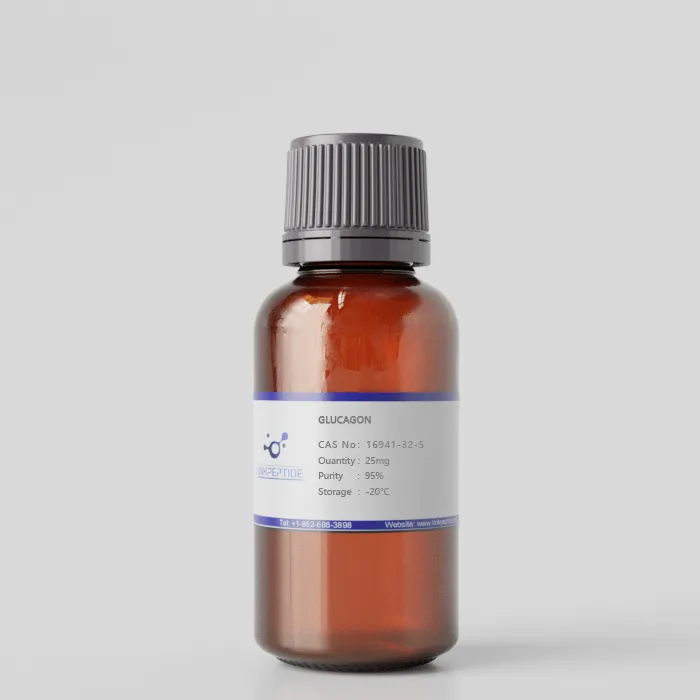
Product Name:GLUCAGON
Form:Acetate salt
Purity:95%
Storage:-20oC
Cas No:16941-32-5
Molar Mass:3482.7
Chemical Formula:C153H225N43O49S
IUPAC Name:(3S)-3-[[(2S)-5-amino-2-[[(2S)-2-[[(2S)-2-[[(2S)-2-[[(2S)-2-[[(2S)-2-[[(2S)-2-[[(2S)-2-[[(2S)-6-amino-2-[[(2S)-2-[[(2S)-2-[[(2S)-2-[[(2S)-2-[[(2S,3R)-2-[[(2S)-2-[[(2S,3R)-2-[[2-[[(2S)-5-amino-2-[[(2S)-2-[[(2S)-2-amino-3-(1H-imidazol-5-yl)propanoyl]amino]-3-hydroxypropanoyl]amino]-5-oxopentanoyl]amino]acetyl]amino]-3-hydroxybutanoyl]amino]-3-phenylpropanoyl]amino]-3-hydroxybutanoyl]amino]-3-hydroxypropanoyl]amino]-3-carboxypropanoyl]amino]-3-(4-hydroxyphenyl)propanoyl]amino]-3-hydroxypropanoyl]amino]hexanoyl]amino]-3-(4-hydroxyphenyl)propanoyl]amino]-4-methylpentanoyl]amino]-3-carboxypropanoyl]amino]-3-hydroxypropanoyl]amino]-5-carbamimidamidopentanoyl]amino]-5-carbamimidamidopentanoyl]amino]propanoyl]amino]-5-oxopentanoyl]amino]-4-[[(2S)-1-[[(2S)-1-[[(2S)-5-amino-1-[[(2S)-1-[[(2S)-1-[[(2S)-1-[[(2S)-4-amino-1-[[(1S,2R)-1-carboxy-2-hydroxypropyl]amino]-1,4-dioxobutan-2-yl]amino]-4-methylsulfanyl-1-oxobutan-2-yl]amino]-4-methyl-1-oxopentan-2-yl]amino]-3-(1H-indol-3-yl)-1-oxopropan-2-yl]amino]-1,5-dioxopentan-2-yl]amino]-3-methyl-1-oxobutan-2-yl]amino]-1-oxo-3-phenylpropan-2-yl]amino]-4-oxobutanoic acid
SMILES:C[C@H]([C@@H](C(=O)N[C@@H](CC1=CC=CC=C1)C(=O)N[C@@H]([C@@H](C)O)C(=O)N[C@@H](CO)C(=O)N[C@@H](CC(=O)O)C(=O)N[C@@H](CC2=CC=C(C=C2)O)C(=O)N[C@@H](CO)C(=O)N[C@@H](CCCCN)C(=O)N[C@@H](CC3=CC=C(C=C3)O)C(=O)N[C@@H](CC(C)C)C(=O)N[C@@H](CC(=O)O)C(=O)N[C@@H](CO)C(=O)N[C@@H](CCCNC(=N)N)C(=O)N[C@@H](CCCNC(=N)N)C(=O)N[C@@H](C)C(=O)N[C@@H](CCC(=O)N)C(=O)N[C@@H](CC(=O)O)C(=O)N[C@@H](CC4=CC=CC=C4)C(=O)N[C@@H](C(C)C)C(=O)N[C@@H](CCC(=O)N)C(=O)N[C@@H](CC5=CNC6=CC=CC=C65)C(=O)N[C@@H](CC(C)C)C(=O)N[C@@H](CCSC)C(=O)N[C@@H](CC(=O)N)C(=O)N[C@@H]([C@@H](C)O)C(=O)O)NC(=O)CNC(=O)[C@H](CCC(=O)N)NC(=O)[C@H](CO)NC(=O)[C@H](CC7=CN=CN7)N)O
InChIKey:MASNOZXLGMXCHN-ZLPAWPGGSA-N
InChI:InChI=1S/C153H225N43O49S/c1-72(2)52-97(133(226)176-96(47-51-246-11)132(225)184-104(60-115(159)209)143(236)196-123(78(10)203)151(244)245)179-137(230)103(58-83-64-167-89-29-19-18-28-87(83)89)183-131(224)95(43-46-114(158)208)177-148(241)120(74(5)6)194-141(234)101(54-79-24-14-12-15-25-79)182-138(231)105(61-117(211)212)185-130(223)94(42-45-113(157)207)171-124(217)75(7)170-127(220)91(31-22-49-165-152(160)161)172-128(221)92(32-23-50-166-153(162)163)174-146(239)110(69-199)191-140(233)107(63-119(215)216)186-134(227)98(53-73(3)4)178-135(228)99(56-81-33-37-85(204)38-34-81)180-129(222)90(30-20-21-48-154)173-145(238)109(68-198)190-136(229)100(57-82-35-39-86(205)40-36-82)181-139(232)106(62-118(213)214)187-147(240)111(70-200)192-150(243)122(77(9)202)195-142(235)102(55-80-26-16-13-17-27-80)188-149(242)121(76(8)201)193-116(210)66-168-126(219)93(41-44-112(156)206)175-144(237)108(67-197)189-125(218)88(155)59-84-65-164-71-169-84/h12-19,24-29,33-40,64-65,71-78,88,90-111,120-123,167,197-205H,20-23,30-32,41-63,66-70,154-155H2,1-11H3,(H2,156,206)(H2,157,207)(H2,158,208)(H2,159,209)(H,164,169)(H,168,219)(H,170,220)(H,171,217)(H,172,221)(H,173,238)(H,174,239)(H,175,237)(H,176,226)(H,177,241)(H,178,228)(H,179,230)(H,180,222)(H,181,232)(H,182,231)(H,183,224)(H,184,225)(H,185,223)(H,186,227)(H,187,240)(H,188,242)(H,189,218)(H,190,229)(H,191,233)(H,192,243)(H,193,210)(H,194,234)(H,195,235)(H,196,236)(H,211,212)(H,213,214)(H,215,216)(H,244,245)(H4,160,161,165)(H4,162,163,166)/t75-,76+,77+,78+,88-,90-,91-,92-,93-,94-,95-,96-,97-,98-,99-,100-,101-,102-,103-,104-,105-,106-,107-,108-,109-,110-,111-,120-,121-,122-,123-/m0/s1
Sequence:HSQGTFTSDYSKYLDSRRAQDFVQWLMNT
Application:Glucagon is a peptide hormone secreted by the alpha cells of the pancreas, primarily responsible for increasing blood glucose levels by stimulating glycogen breakdown (glycogenolysis) and gluconeogenesis in the liver. It is widely used in emergency treatment of severe hypoglycemia in diabetes patients and in diagnostic procedures such as glucagon stimulation tests for endocrine disorders. Beyond its traditional role in glucose metabolism, research is exploring glucagon's effects on weight loss, metabolic disorders, and cardiovascular function, positioning it as a potential therapeutic agent in obesity, fatty liver disease (NAFLD), and heart failure.
Current Research:Glucagon is a counter-regulatory hormone to insulin, playing a critical role in blood sugar regulation, lipid metabolism, and energy balance. While it is primarily used for hypoglycemia treatment, emerging research suggests that glucagon has potential applications in obesity, metabolic disorders, cardiovascular health, and neuroprotection. Hypoglycemia Treatment and Diabetes Research Glucagon has long been the primary treatment for severe hypoglycemia in diabetes patients, particularly those on insulin therapy. Emergency glucagon formulations: New nasal glucagon and ready-to-use glucagon injections have improved accessibility and usability for hypoglycemic emergencies. Dual hormone therapy (insulin + glucagon pumps): Research is exploring bi-hormonal artificial pancreas systems that deliver both insulin and glucagon to prevent hypoglycemia in type 1 diabetes. Glucagon receptor antagonists: Some studies are investigating glucagon suppression as a potential treatment for hyperglycemia in type 2 diabetes, given that excess glucagon contributes to insulin resistance. Glucagon and Obesity Research Recent research suggests that glucagon plays a role in appetite suppression and energy expenditure, making it a promising target for obesity treatment. Glucagon-based weight loss therapies: Clinical trials are assessing glucagon receptor agonists for their ability to increase metabolic rate and reduce food intake. Combination with GLP-1 receptor agonists: Dual agonists (e.g., glucagon + GLP-1 receptor agonists like tirzepatide) are being tested for superior weight loss and metabolic benefits compared to GLP-1 alone. Fat oxidation and thermogenesis: Glucagon has been shown to stimulate lipolysis and energy expenditure, contributing to its potential as a fat-reducing agent. Liver Health and Non-Alcoholic Fatty Liver Disease (NAFLD) Glucagon has significant effects on hepatic metabolism, leading researchers to explore its role in liver disease management. NAFLD and NASH treatment: Studies suggest glucagon may reduce hepatic fat accumulation, making it a potential therapy for non-alcoholic fatty liver disease (NAFLD) and non-alcoholic steatohepatitis (NASH). Hepatic glucose metabolism: Research indicates that glucagon can modulate hepatic insulin sensitivity, impacting overall glucose and lipid balance. Cardiovascular Health and Heart Failure Glucagon is also being studied for its vasodilatory effects and role in cardiovascular diseases. Glucagon in heart failure: Some studies suggest glucagon may improve cardiac output and perfusion in heart failure patients, particularly those with low cardiac output syndrome. Vasodilatory effects: Glucagon has potential as a treatment for shock-related hypotension and heart block, particularly in cases of beta-blocker overdose. Emerging Research Areas Neuroprotection and brain metabolism: Studies indicate that glucagon may influence brain glucose metabolism, with potential applications in Alzheimer??s and Parkinson??s disease. Ketogenesis and fasting metabolism: Research is exploring how glucagon enhances ketone production, which may have applications in epilepsy, fasting-mimicking diets, and metabolic health. Glucagon receptor modulation: New drugs targeting glucagon receptors are being tested for controlling blood sugar, weight, and lipid metabolism in metabolic syndrome. With ongoing research, glucagon is emerging as a multi-functional hormone with potential therapeutic applications in diabetes, obesity, liver disease, and cardiovascular medicine.
Get a Quote
 LinkPeptide