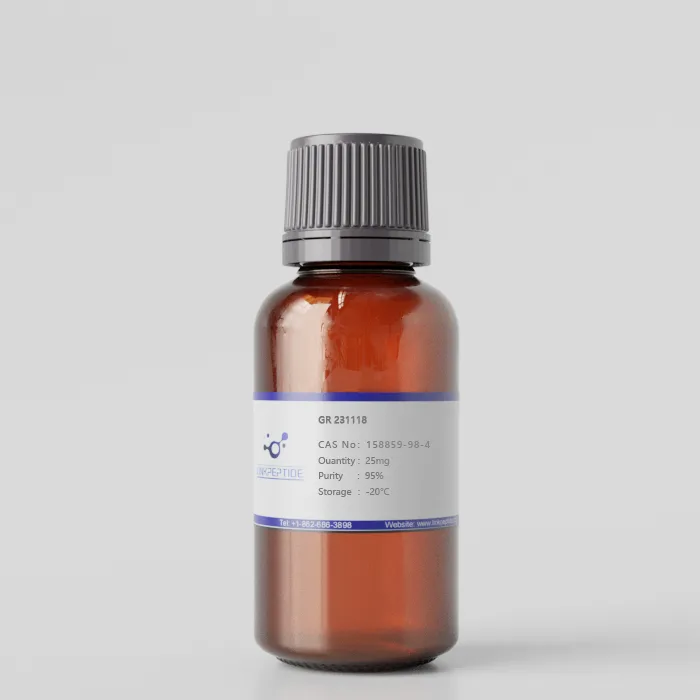
Product Name:GR 231118
CAS No:158859-98-4
Purity:95%
Molar Mass:2352.7
Chemical Formula:C110H170N34O24
Storage:Store at -20 degrees Celsius
Sequence:IEPXYRLRY IEPXYRLRY*
Target:NPY Y1 receptor antagonist
Application:
GR 231118 is a selective non-peptide antagonist of the neuropeptide Y (NPY) Y1 receptor, primarily used in pharmacological research to explore the role of NPY in various physiological and pathological processes. By inhibiting the Y1 receptor, GR 231118 helps to elucidate the effects of NPY on appetite regulation, anxiety, and cardiovascular function. This compound is valuable in preclinical studies aimed at understanding the mechanisms underlying obesity, stress-related disorders, and hypertension, offering potential pathways for the development of novel therapeutic agents targeting these conditions.
Current Research:
GR 231118 (also known as 1229U91 or GW 1229) is a synthetic peptide that functions as a potent and selective ligand for neuropeptide Y (NPY) receptors, specifically exhibiting antagonist activity at the Y₁ receptor and agonist activity at the Y₄ receptor.
Pharmacological Profile:
NPY Y₁ Receptor Antagonist: GR 231118 exhibits high affinity for the NPY Y₁ receptor, acting as a competitive antagonist with pA₂ values of 10 and 10.5 at rat and human Y₁ receptors, respectively.
NPY Y₄ Receptor Agonist: It serves as a potent and selective agonist at the NPY Y₄ receptor, with pEC₅₀ values of 6.0 for rat Y₂, 8.6 for human Y₄, and 6.1 for rat Y₅ receptors.
Neuropeptide FF (NPFF) Receptor Affinity: GR 231118 also binds to NPFF receptors in vitro, with Kᵢ values ranging from 43 to 73 nM.
Biological Activity:
In vivo studies have demonstrated that GR 231118 suppresses spontaneous food intake in rats, indicating its potential role in modulating feeding behavior.
Applications in Research:
Due to its dual activity as an NPY Y₁ receptor antagonist and Y₄ receptor agonist, GR 231118 is utilized in research to investigate the physiological and pathological roles of NPY receptors, particularly in studies related to appetite regulation, energy homeostasis, and cardiovascular function.
Handling and Storage:
GR 231118 is typically supplied as a lyophilized powder. For optimal stability, it should be stored desiccated at -20°C. Reconstitution should be performed using sterile water or an appropriate buffer, depending on the intended experimental application.
Reference:
Get a Quote
 LinkPeptide

![[Ala17]-MCH](https://www.linkpeptide.com/wp-content/uploads/2024/08/Ala17-MCH-jpg.webp "[Ala17]-MCH")