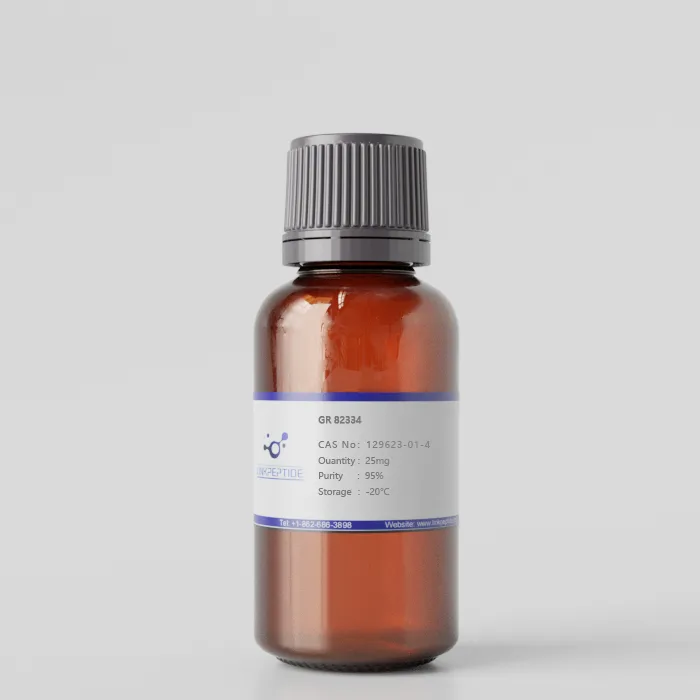
Product Name:GR 82334
CAS No:129623-01-4
Purity:95%
Molar Mass:1386.6
Chemical Formula:C69H91N15O16
Storage:Store at -20 degrees Celsius
Sequence:XADPNKFYXL W
Target:neurokinin NK1 receptor
Application:
GR 82334 is a potent and selective antagonist of neurokinin NK1 receptors, widely used in research focused on understanding the role of substance P in the nervous system. This peptide is instrumental in studying the modulation of pain, inflammation, and emesis, making it particularly relevant for investigating therapeutic approaches for conditions like chronic pain, depression, and chemotherapy-induced nausea. GR 82334 exhibits high specificity and stability, ensuring consistent and reliable results in experimental settings. It is an essential tool for researchers aiming to elucidate the physiological and pharmacological functions of NK1 receptors.
Current Research:
GR 82334 is a potent and specific reversible antagonist of the tachykinin NK? receptor, exhibiting high affinity and selectivity. Its chemical structure is characterized by a spirolactam-constrained analogue of physalaemin, enhancing its resistance to peptidase degradation. The peptide sequence is pGlu-Ala-Asp-Pro-Asn-Lys-Phe-Tyr-Pro(spiro-??-lactam-Leu-Trp-NH?).
In vitro studies have demonstrated that GR 82334 effectively inhibits NK? receptor-mediated responses. For instance, it significantly attenuates slow depolarizing responses in neonatal rat spinal cord preparations induced by primary afferent stimulation. This inhibition underscores its utility in dissecting NK? receptor functions in nociceptive pathways.
In vivo, intrathecal administration of GR 82334 in rodent models has been shown to modulate reflex bladder contractions and chemonociceptive reflexes. Specifically, doses of 1 nmol effectively block capsaicin-induced micturition reflexes without affecting bladder contractions induced by other stimuli, indicating a targeted action on NK? receptor-mediated pathways.
Despite its research utility, GR 82334 has been withdrawn from commercial sale for unspecified reasons. Researchers seeking to study NK? receptor functions may need to consider alternative antagonists or synthesize the compound independently.
In summary, GR 82334 has served as a valuable tool in neuropharmacological research, particularly in elucidating the roles of NK? receptors in pain and reflex modulation. Its high specificity and reversible binding properties have provided significant insights into tachykinin receptor pharmacology.
Reference:
Get a Quote
 LinkPeptide

![SCYLLATOXIN [Tyr2]-](https://www.linkpeptide.com/wp-content/uploads/2024/10/SCYLLATOXIN-Tyr2-jpg-2.webp "SCYLLATOXIN [Tyr2]-")