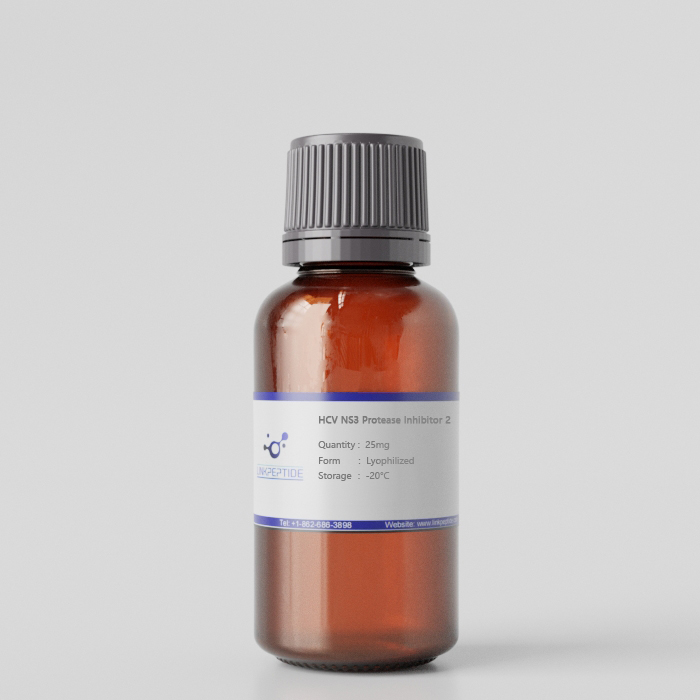
Product Name: HCV NS3 Protease Inhibitor 2
Sequence One Letter Code: Ac-DE-Dif-E-Cha-C
Sequence Three Letter Code: Ac-Asp-Glu-Dif-Glu-Cha-Cys-OH
Chemical Formula:C43H56N6O14S
Molecular Weight: 913.1
Purity: 95%
Form: Lyophilized
Storage Conditions: - 20 °C
Research Area: Antiviral
Source / Species: HCV
Conjugation: Unconjugated
Code Nacres: NA.26
Application: HCV NS3 Protease Inhibitor 2 is a peptide-based inhibitor developed for research on Hepatitis C virus proteolytic processing. The NS3 serine protease is essential for viral polyprotein cleavage and replication, making it a critical antiviral target. This inhibitor is widely used in biochemical assays to suppress NS3 activity and investigate enzyme kinetics, substrate recognition, and inhibitor–protease interactions, supporting mechanistic and antiviral strategy studies.
Current Research: HCV NS3 Protease Inhibitor 2 is a peptide-based inhibitor designed for biochemical investigation of the Hepatitis C virus (HCV) NS3 serine protease, a viral enzyme essential for polyprotein processing and viral replication. NS3, in complex with its cofactor NS4A, cleaves the HCV polyprotein at multiple junctions to generate mature nonstructural proteins required for RNA replication. Because of its indispensable role in the viral life cycle, NS3 protease is a validated and high-value antiviral target. This inhibitor serves as a research tool for suppressing NS3 catalytic activity in purified enzyme systems and cell-free assays, enabling mechanistic characterization of viral proteolysis. Biological and Structural Context The HCV NS3 protein contains an N-terminal chymotrypsin-like serine protease domain and a C-terminal helicase domain. The protease domain: Requires NS4A as a cofactor for optimal catalytic efficiency Recognizes specific cleavage sequences within the viral polyprotein Utilizes a catalytic triad typical of serine proteases Inhibition of NS3 blocks polyprotein maturation, thereby preventing assembly of the replication complex. Mechanism of Inhibition HCV NS3 Protease Inhibitor 2 is designed as a peptide-mimetic inhibitor that engages the active site of the NS3 protease. By occupying substrate-binding pockets and interacting with catalytic residues, it: Prevents access of natural polyprotein substrates Reduces proteolytic turnover Suppresses downstream viral protein generation Depending on structural design, inhibition may be competitive with substrate or may involve transition-state mimicry. Research Applications 1. Enzyme Kinetics and Mechanistic Studies The inhibitor is widely applied in assays using recombinant NS3/NS4A complexes to: Determine inhibition constants (Ki or IC₅₀) Evaluate competitive versus noncompetitive inhibition Characterize structure–activity relationships (SAR) 2. Substrate Recognition Analysis By blocking catalytic turnover, the inhibitor supports investigation of substrate-binding determinants and protease–substrate specificity. 3. Antiviral Strategy Development Although primarily a research reagent, it provides a reference compound for comparing potency of newly developed NS3 inhibitors and validating assay systems used in antiviral drug discovery. 4. Assay Validation and Quality Control In biochemical screening platforms employing fluorogenic or chromogenic NS3 substrates, the inhibitor functions as a positive control to confirm assay responsiveness and dynamic range. Experimental Considerations NS3 protease assays typically require inclusion of the NS4A cofactor and appropriate buffer conditions (often slightly alkaline pH) to maintain enzymatic activity. Inhibitor potency may vary depending on substrate concentration and enzyme source. Parallel controls without inhibitor are necessary to establish baseline protease activity.
Get a Quote
 LinkPeptide