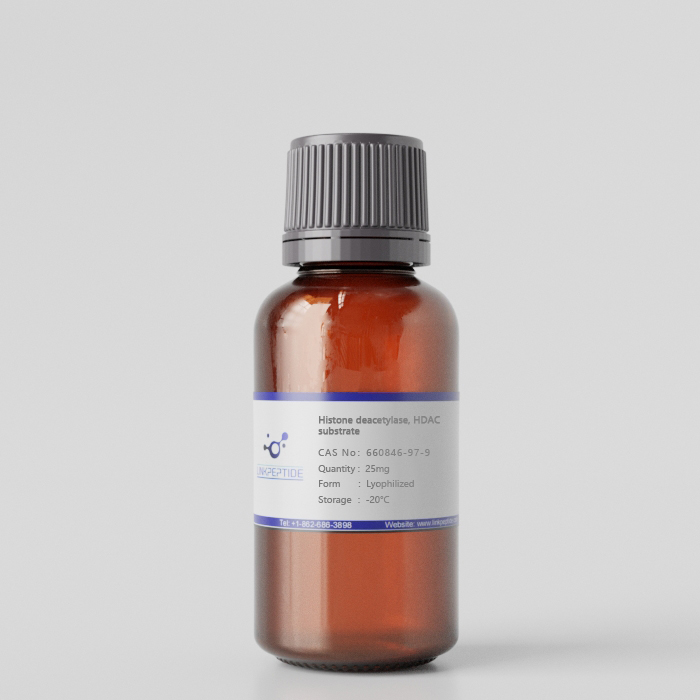
Product Name: Histone deacetylase, HDAC substrate
Sequence One Letter Code: Ac-RGK(Ac)-AMC
Sequence Three Letter Code: Ac-Arg-Gly-Lys(Ac)-AMC
Cas No: 660846-97-9
Chemical Formula:C28H40N8O7
Molecular Weight: 600.7
Purity: 95%
Form: Lyophilized
Storage Conditions: - 20 °C Protected from light
Research Area: peptide substrate
SMILES: CC1=CC(=O)OC2=C1C=CC(=C2)NC(=O)[C@H](CCCCNC(=O)C)NC(=O)CNC(=O)[C@H](CCCN=C(N)N)NC(=O)C
IUPAC: (2S)-6-acetamido-2-[[2-[[(2S)-2-acetamido-5-(diaminomethylideneamino)pentanoyl]amino]acetyl]amino]-N-(4-methyl-2-oxochromen-7-yl)hexanamide
INCHIKEY: HABKINWCDDLXSZ-VXKWHMMOSA-N
INCHI:
InChI=1S/C28H40N8O7/c1-16-13-25(40)43-23-14-19(9-10-20(16)23)35-27(42)22(7-4-5-11-31-17(2)37)36-24(39)15-33-26(41)21(34-18(3)38)8-6-12-32-28(29)30/h9-10,13-14,21-22H,4-8,11-12,15H2,1-3H3,(H,31,37)(H,33,41)(H,34,38)(H,35,42)(H,36,39)(H4,29,30,32)/t21-,22-/m0/s1
Source / Species: Synthetic construct
Conjugation: Conjugated
Conjugation Type: Fluorescent dyes
Code Nacres: NA.26
Application: HDAC Fluorogenic Substrate (Acetyl-Lysine–MCA Peptide) is a sensitive fluorescent peptide substrate designed to measure histone deacetylase (HDAC) activity in biochemical and cellular assays. The peptide contains an ε-acetylated lysine residue and a C-terminal 7-amino-4-methylcoumarin (MCA) fluorophore, enabling fluorescence-based detection following HDAC-mediated deacetylation and subsequent enzymatic processing. HDAC enzymes are central regulators of epigenetic control, chromatin remodeling, and transcriptional regulation through lysine deacetylation of histones and other proteins. Upon deacetylation, the substrate releases a fluorescent signal that provides a quantitative readout of HDAC enzymatic activity. This fluorogenic peptide substrate is widely used for HDAC activity assays, inhibitor screening, and enzyme kinetics studies, and supports research in epigenetics, cancer biology, neurobiology, and transcriptional regulation.
Current Research: Epigenetic regulation is essential for controlling gene expression, chromatin structure, and cellular identity. One of the most important mechanisms in epigenetic control involves the reversible acetylation and deacetylation of lysine residues on histone proteins and other regulatory molecules. Histone deacetylases (HDACs) remove acetyl groups from lysine residues, influencing chromatin compaction and transcriptional activity. To study these enzymes and their regulatory roles, researchers rely on sensitive biochemical tools such as fluorogenic HDAC substrates. The HDAC Fluorogenic Substrate (Acetyl-Lysine–MCA Peptide) is a widely used fluorescent peptide designed to measure HDAC enzymatic activity in biochemical assays, cellular extracts, and inhibitor screening experiments. By combining an acetylated lysine residue with a fluorescent reporter group, the substrate enables accurate and quantitative monitoring of HDAC-mediated reactions. Histone Deacetylases in Epigenetic Regulation Histone deacetylases are enzymes that remove acetyl groups from lysine residues on histones and other proteins. This process counteracts the activity of histone acetyltransferases (HATs), which add acetyl groups to lysines and generally promote transcriptionally active chromatin. Deacetylation of histones typically results in increased chromatin compaction, reducing accessibility of DNA to transcription factors and RNA polymerase. Through this mechanism, HDACs play a major role in regulating: Gene expression and transcriptional repression Chromatin remodeling and epigenetic signaling Cell cycle progression and differentiation Cellular stress responses In addition to histones, HDACs also regulate numerous non-histone proteins, affecting signaling pathways involved in metabolism, apoptosis, and immune responses. Structure and Design of the Fluorogenic Substrate The HDAC Fluorogenic Substrate is engineered to provide a clear fluorescence signal when HDAC enzymes act on the peptide. The substrate includes two critical components: ε-Acetylated lysine residue – serves as the recognition site for HDAC enzymes. 7-amino-4-methylcoumarin (MCA) – a fluorescent reporter attached to the C-terminus of the peptide. In its intact state, the peptide remains non-fluorescent or weakly fluorescent. When HDAC enzymes remove the acetyl group from the lysine residue, the modified peptide becomes susceptible to subsequent enzymatic cleavage by a developer enzyme. This cleavage releases the MCA fluorophore, generating a strong fluorescent signal that can be detected using standard fluorescence plate readers or spectrophotometers. Fluorescence-Based Detection of HDAC Activity The generation of fluorescence provides a direct and quantitative measure of HDAC activity. As HDAC enzymes deacetylate the substrate, more fluorophore is released, resulting in increased fluorescence intensity over time. This signal can be monitored continuously or measured at defined time points, allowing researchers to determine: Enzyme activity levels Reaction kinetics Effects of inhibitors or regulatory molecules Because the assay relies on fluorescence, it offers high sensitivity and rapid detection, making it suitable for both small-scale experiments and high-throughput screening formats. Applications in HDAC Activity Assays The Acetyl-Lysine–MCA peptide substrate is widely used in HDAC enzymatic activity assays. Researchers employ the substrate to analyze HDAC function in purified enzyme systems as well as in complex biological samples such as cell lysates or tissue extracts. Typical experimental uses include: Measurement of HDAC activity in biochemical assays Quantitative comparison of HDAC expression or activity across cell types Characterization of enzyme kinetics and substrate specificity These studies help reveal how HDAC enzymes regulate epigenetic signaling pathways under different physiological conditions. Inhibitor Screening and Drug Discovery HDACs are important targets in therapeutic research because abnormal HDAC activity is associated with several diseases, including cancer, neurodegenerative disorders, and inflammatory conditions. Consequently, many pharmaceutical efforts focus on identifying molecules that selectively inhibit HDAC activity. The fluorogenic substrate is particularly well suited for high-throughput screening assays, where researchers evaluate large numbers of candidate compounds for their ability to inhibit HDAC enzymes. In these experiments, reduced fluorescence indicates effective inhibition of enzyme activity. This screening approach has contributed to the discovery of several HDAC inhibitors used in cancer research and therapeutic development. Applications in Epigenetics and Cell Biology Beyond inhibitor screening, the HDAC fluorogenic substrate is also used in broader studies examining how epigenetic mechanisms influence cellular behavior. Researchers employ the assay to investigate HDAC regulation in contexts such as: Cancer biology and tumor progression Neurobiology and neurodegenerative disease mechanisms Transcriptional control during development and differentiation Cellular responses to environmental stress By enabling precise measurement of enzyme activity, the substrate supports deeper understanding of how histone deacetylation shapes gene expression programs. Supporting Research in Epigenetic Regulation Fluorescent peptide substrates provide powerful tools for studying enzyme function in complex biological systems. The HDAC Fluorogenic Substrate (Acetyl-Lysine–MCA Peptide) combines a specific HDAC recognition site with a sensitive fluorescent reporter, enabling accurate detection of lysine deacetylation events. Through its application in HDAC activity assays, inhibitor screening experiments, and kinetic studies, this substrate continues to support research into epigenetic regulation, chromatin remodeling, and transcriptional control. These insights contribute to advances in understanding the molecular basis of diseases associated with epigenetic dysregulation and help guide the development of targeted therapeutic strategies.
Get a Quote
 LinkPeptide