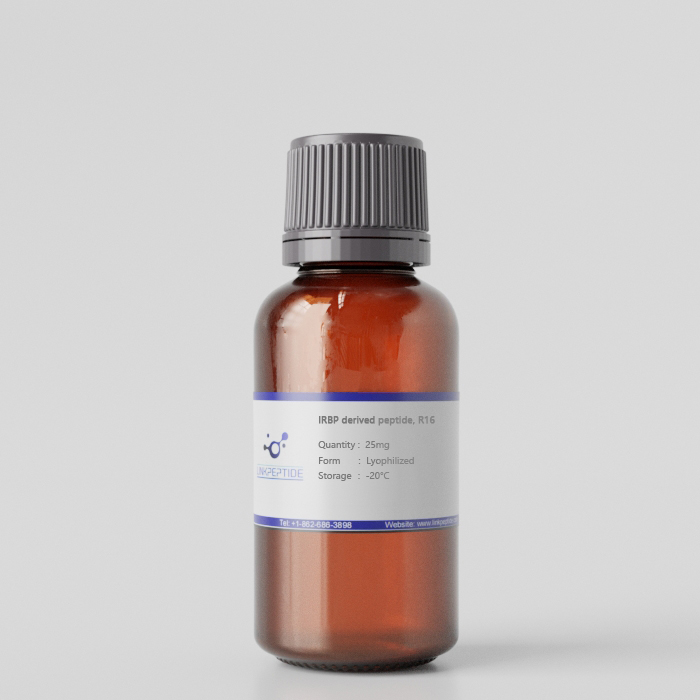
Product Name: IRBP derived peptide, R16
Sequence One Letter Code: ADGSSWEGVGVVPDV
Sequence Three Letter Code: H-Ala-Asp-Gly-Ser-Ser-Trp-Glu-Gly-Val-Gly-Val-Val-Pro-Asp-Val-OH
Chemical Formula:C64H96N16O24
Molecular Weight: 1473.7
Purity: 95%
Form: Lyophilized
Storage Conditions: - 20 °C
Research Area: Inflammation and Immunology Research
Source / Species: human, macaque
Conjugation: Unconjugated
Code Nacres: NA.26
Application: The R16 peptide is derived from interphotoreceptor retinoid-binding protein (IRBP), a photoreceptor-associated protein involved in retinal immune responses. This peptide is widely used to induce experimental autoimmune uveitis (EAU) in genetically susceptible animal strains, making it a key model antigen in ocular immunology research. EAU closely resembles human autoimmune uveitis and is commonly used to study T-cell–mediated inflammation and immune responses in the eye. The R16 peptide enables researchers to investigate mechanisms of autoimmune disease development, immune privilege of ocular tissues, and inflammatory pathways involved in retinal damage. It is also useful for evaluating therapeutic strategies aimed at controlling autoimmune uveitis and related inflammatory eye disorders.
Current Research: Autoimmune diseases affecting the eye can lead to severe inflammation and vision impairment. To better understand the immune mechanisms underlying these conditions, researchers often rely on well-defined experimental models. One of the most widely used models in ocular immunology is experimental autoimmune uveitis (EAU), a T-cell–mediated inflammatory disease that closely resembles human autoimmune uveitis. The R16 peptide, derived from interphotoreceptor retinoid-binding protein (IRBP), serves as a key antigen used to induce this disease model in genetically susceptible animals. Because of its ability to trigger controlled autoimmune responses targeting retinal tissue, the R16 peptide has become an important research tool for investigating ocular inflammation, immune regulation in the eye, and mechanisms driving autoimmune retinal damage. Interphotoreceptor Retinoid-Binding Protein and Ocular Immunity Interphotoreceptor retinoid-binding protein (IRBP) is a photoreceptor-associated protein located in the interphotoreceptor matrix of the retina. It plays an essential physiological role in the visual cycle, facilitating the transport of retinoids between photoreceptor cells and the retinal pigment epithelium. Beyond its role in vision, IRBP also functions as an important antigen in ocular immune responses. Under certain conditions, immune recognition of IRBP-derived peptides can trigger autoimmune inflammation directed against retinal tissues. This phenomenon forms the basis of experimental autoimmune uveitis models used in immunology and ophthalmology research. The R16 peptide, derived from IRBP, represents one of the most immunogenic epitopes capable of inducing this autoimmune response in susceptible animal strains. Induction of Experimental Autoimmune Uveitis Experimental autoimmune uveitis is typically induced by immunizing animals with retinal antigens such as IRBP peptides in combination with immune-stimulating adjuvants. The R16 peptide has proven particularly effective in triggering disease in specific rodent models, leading to immune-mediated inflammation that mirrors many aspects of human autoimmune uveitis. During EAU induction, antigen-presenting cells process the R16 peptide and present it through major histocompatibility complex (MHC) molecules to T lymphocytes. This process activates autoreactive T cells, which then migrate to ocular tissues and initiate inflammatory responses. The resulting disease model displays several pathological features similar to those observed in human uveitis, including: Retinal inflammation and immune cell infiltration Disruption of retinal architecture Photoreceptor damage Inflammatory cytokine production within ocular tissues Because these characteristics closely resemble clinical disease, EAU provides a valuable system for studying immune-mediated eye disorders. Studying T-Cell–Mediated Retinal Inflammation The R16 peptide is particularly useful for examining T-cell–driven autoimmune processes. In EAU models, the disease is largely mediated by CD4⁺ T helper cells, which recognize IRBP-derived peptides and orchestrate inflammatory responses within the retina. Activation of these autoreactive T cells leads to the release of pro-inflammatory cytokines and recruitment of additional immune cells into ocular tissues. This cascade contributes to tissue damage and retinal dysfunction. By using the R16 peptide to initiate disease, researchers can analyze key immunological events involved in autoimmune pathology, including: T-cell activation and differentiation Cytokine signaling pathways Immune cell infiltration into retinal tissues Interactions between immune cells and retinal cells These studies help clarify how immune dysregulation leads to inflammation and tissue injury in autoimmune eye diseases. Insights into Ocular Immune Privilege The eye possesses a unique form of immune regulation known as immune privilege, which limits inflammatory responses in order to protect delicate visual structures. However, in autoimmune conditions such as uveitis, these regulatory mechanisms can break down. EAU models induced with the R16 peptide provide a valuable opportunity to study how immune privilege is maintained or disrupted in the eye. Researchers can examine how regulatory T cells, immune checkpoints, and local immune suppressive mechanisms influence the progression of ocular inflammation. Understanding these processes is critical for identifying strategies that restore immune balance and prevent retinal damage. Applications in Therapeutic Research Because experimental autoimmune uveitis closely mimics human disease, the R16 peptide model is frequently used to evaluate potential therapies for autoimmune eye disorders. Researchers can test how various treatments influence immune responses, inflammation, and retinal protection. Common research applications include: Evaluation of anti-inflammatory or immunosuppressive therapies Investigation of T-cell–targeted treatments Assessment of cytokine signaling inhibitors Studies of immune tolerance–inducing strategies Testing of biologic therapies for autoimmune diseases These studies contribute to the development of new approaches for managing uveitis and other inflammatory retinal diseases. A Valuable Tool in Ocular Immunology The R16 peptide derived from IRBP has become a cornerstone reagent in ocular immunology research due to its ability to reliably induce experimental autoimmune uveitis in susceptible animal models. By triggering controlled autoimmune responses against retinal tissue, the peptide allows researchers to investigate the complex interactions between the immune system and ocular structures. Through studies of T-cell–mediated inflammation, immune privilege mechanisms, and therapeutic interventions, the R16 peptide continues to support advances in understanding autoimmune eye disease and the development of strategies to protect vision from inflammatory damage.
Get a Quote
 LinkPeptide