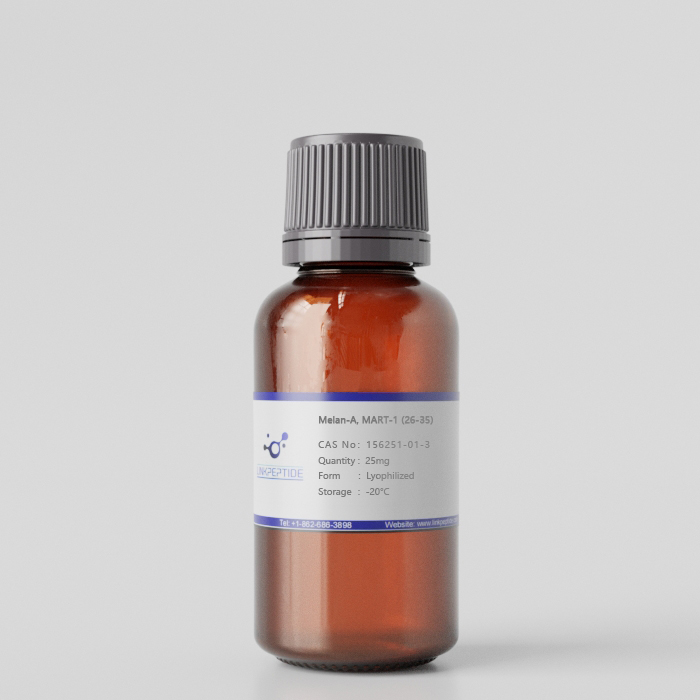
Product Name: Melan-A, MART-1 (26-35)
Sequence One Letter Code: EAAGIGILTV
Sequence Three Letter Code: H-Glu-Ala-Ala-Gly-Ile-Gly-Ile-Leu-Thr-Val-OH
Cas No: 156251-01-3
Chemical Formula:C42H74N10O14
Molecular Weight: 943.2
Purity: 95%
Form: Lyophilized
Storage Conditions: - 20 °C
Research Area: Cancer Immunotherapy
SMILES: CC[C@H](C)[C@@H](C(=O)NCC(=O)N[C@@H]([C@@H](C)CC)C(=O)N[C@@H](CC(C)C)C(=O)N[C@@H]([C@@H](C)O)C(=O)N[C@@H](C(C)C)C(=O)O)NC(=O)CNC(=O)[C@H](C)NC(=O)[C@H](C)NC(=O)[C@H](CCC(=O)O)N
IUPAC: (4S)-4-amino-5-[[(2S)-1-[[(2S)-1-[[2-[[(2S,3S)-1-[[2-[[(2S,3S)-1-[[(2S)-1-[[(2S,3R)-1-[[(1S)-1-carboxy-2-methylpropyl]amino]-3-hydroxy-1-oxobutan-2-yl]amino]-4-methyl-1-oxopentan-2-yl]amino]-3-methyl-1-oxopentan-2-yl]amino]-2-oxoethyl]amino]-3-methyl-1-oxopentan-2-yl]amino]-2-oxoethyl]amino]-1-oxopropan-2-yl]amino]-1-oxopropan-2-yl]amino]-5-oxopentanoic acid
INCHIKEY: TUIOKRGNEZUFAI-NMIMMQBESA-N
INCHI:
InChI=1S/C42H74N10O14/c1-12-21(7)32(49-28(54)17-44-35(58)23(9)46-36(59)24(10)47-37(60)26(43)14-15-30(56)57)39(62)45-18-29(55)50-33(22(8)13-2)40(63)48-27(16-19(3)4)38(61)52-34(25(11)53)41(64)51-31(20(5)6)42(65)66/h19-27,31-34,53H,12-18,43H2,1-11H3,(H,44,58)(H,45,62)(H,46,59)(H,47,60)(H,48,63)(H,49,54)(H,50,55)(H,51,64)(H,52,61)(H,56,57)(H,65,66)/t21-,22-,23-,24-,25+,26-,27-,31-,32-,33-,34-/m0/s1
Source / Species: human
Conjugation: Unconjugated
Code Nacres: NA.26
Application: Melan-A / MART-1 (26–35) is a native decapeptide epitope derived from the melanocyte differentiation antigen Melan-A, a tumor-associated antigen expressed in melanocytes and melanoma cells. This sequence represents an immunodominant HLA-A*0201-restricted epitope and is efficiently recognized by melanoma-specific CD8⁺ T cells, including tumor-infiltrating lymphocytes (TILs). Although it displays lower MHC binding affinity than optimized analogs, it retains strong physiological relevance for antigen presentation studies. The peptide is widely used in tumor immunology to investigate melanoma-specific T cell responses, antigen recognition, and immune monitoring in human experimental systems.
Current Research: Melan-A / MART-1 (26–35) is a native decapeptide epitope derived from the melanocyte differentiation antigen Melan-A (MART-1), a lineage-specific tumor-associated antigen expressed in normal melanocytes and the majority of melanoma cells. This sequence constitutes a well-characterized HLA-A*0201–restricted immunodominant epitope, recognized by melanoma-specific CD8⁺ cytotoxic T lymphocytes (CTLs), including tumor-infiltrating lymphocytes (TILs) isolated from patient lesions. Because of its defined MHC restriction and reproducible T cell recognition, Melan-A (26–35) remains one of the most extensively studied human tumor epitopes in cancer immunology and translational immune monitoring. Immunological Significance Melan-A is a differentiation antigen selectively expressed in melanocytic cells, making it a prototypical self/tumor-associated antigen rather than a neoantigen. The (26–35) epitope is naturally processed and presented on HLA-A*0201 molecules, enabling direct recognition by antigen-specific CD8⁺ T cells. Although optimized heteroclitic analogs (e.g., anchor-modified variants with enhanced HLA binding) demonstrate higher MHC stability and immunogenicity, the native sequence maintains superior physiological relevance. Its authentic processing and presentation profile make it particularly valuable for mechanistic studies evaluating antigen recognition under endogenous conditions. Recognition by Melanoma-Specific CD8⁺ T Cells Melan-A (26–35) is efficiently recognized by: Peripheral blood melanoma-specific CD8⁺ T cells Expanded tumor-infiltrating lymphocytes (TILs) TCR-engineered T cells targeting MART-1 This epitope is frequently used as a model system to investigate: TCR affinity and avidity Functional avidity thresholds Immune escape via antigen downregulation Cross-reactivity and autoimmunity toward melanocytes Its reproducible immunogenicity has established it as a benchmark epitope in melanoma-directed T cell research. Applications in Tumor Immunology 1. Immune Monitoring in Clinical Studies Melan-A (26–35) is widely employed in immune monitoring assays for melanoma patients undergoing: Checkpoint blockade therapy Adoptive T cell transfer Cancer vaccination strategies Assay platforms include: IFN-γ ELISPOT Intracellular cytokine staining (ICS) Multimer/tetramer staining (HLA-A2/MART-1 complexes) Cytotoxicity assays The peptide provides a standardized reagent to quantify antigen-specific CD8⁺ T cell frequency and functionality. 2. Antigen Presentation and Processing Studies Because it is naturally processed from the full-length Melan-A protein, this epitope is valuable for dissecting: Proteasomal cleavage requirements TAP-dependent transport Peptide–MHC stability dynamics Effects of inflammatory signaling on antigen presentation 3. T Cell Engineering and Functional Testing Melan-A–specific TCRs are commonly used in preclinical engineering studies. The peptide serves as a defined target to evaluate: TCR-transduced T cell activation Cytotoxic potency Off-target reactivity Activation-induced exhaustion markers Comparative Considerations: Native vs. Analog Peptides While heteroclitic variants exhibit increased HLA-A*0201 binding affinity and can enhance in vitro T cell expansion, the native (26–35) peptide provides a more accurate representation of endogenous tumor antigen presentation. For studies focused on translational relevance and physiological immune recognition, the native sequence is often preferred. Experimental Notes Optimal stimulation concentrations should be empirically established depending on assay format and cell source. In immune monitoring settings, appropriate negative controls and HLA-matched donor samples are recommended to ensure specificity.
Get a Quote
 LinkPeptide