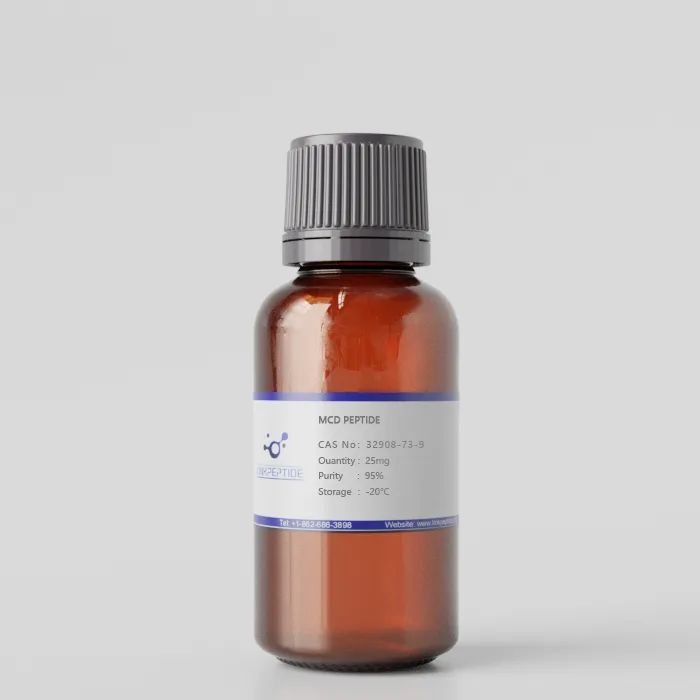
Product Name:MCD PEPTIDE
Synonyms:MCD peptide
CAS No:32908-73-9
Purity:95%
Molar Mass:2587.2
Chemical Formula:C110H192N40O24S4
Storage:Store at -20 degrees Celsius
Sequence:XKCNCKRXVXKPXXCRKXCGKN
Application:
MCD Peptide is a small, biologically active peptide derived from the venom of the honeybee (Apis mellifera). It is known for its potent ability to modulate ion channels, particularly in mast cells, where it triggers degranulation and the release of histamine. This makes MCD Peptide a valuable tool in immunological research, especially for studying allergic reactions and inflammatory responses. Its precise action on cell membranes also makes it useful in exploring mechanisms underlying various immune disorders. With high purity and stability, MCD Peptide is ideal for advanced research in immunology and pharmacology.
Current Research:
Mast Cell Degranulating (MCD) peptide, also known as peptide 401, is a 22-amino acid peptide isolated from honeybee (Apis mellifera) venom. Its sequence is Ile-Lys-Cys-Asn-Cys-Lys-Arg-His-Val-Ile-Lys-Pro-His-Ile-Cys-Arg-Lys-Ile-Cys-Gly-Lys-Asn-NH₂, featuring two disulfide bridges between Cys³-Cys¹⁵ and Cys⁵-Cys¹⁹, which stabilize its three-dimensional structure.
MCD peptide is renowned for its ability to induce mast cell degranulation, leading to the release of histamine and other inflammatory mediators. This action has made it a valuable tool in immunological research, particularly in studying allergic reactions and inflammatory processes. Additionally, MCD peptide selectively blocks certain neuronal voltage-gated potassium (K⁺) channels, affecting neuronal excitability and synaptic transmission.
In vivo studies have demonstrated that MCD peptide exhibits potent anti-inflammatory properties. It effectively inhibits edema induced by agents like carrageenan or turpentine in rat models, with an ED₅₀ around 0.1 mg/kg. The peptide also reduces vascular permeability increases caused by various smooth muscle spasmogens, including histamine, bradykinin, serotonin, and prostaglandins.
The dual functionality of MCD peptide—as a mast cell activator and potassium channel blocker—has provided significant insights into the mechanisms underlying inflammation and neuronal signaling. Its unique properties continue to make it a subject of interest in pharmacological research, with potential therapeutic applications in modulating immune responses and treating neurological disorders.
Reference:
Get a Quote
 LinkPeptide

![[Leu27]-Melan-A, MART-1 (26-35)](https://www.linkpeptide.com/wp-content/uploads/2026/05/Leu27-Melan-A-MART-1-26-35.jpg "[Leu27]-Melan-A, MART-1 (26-35)")