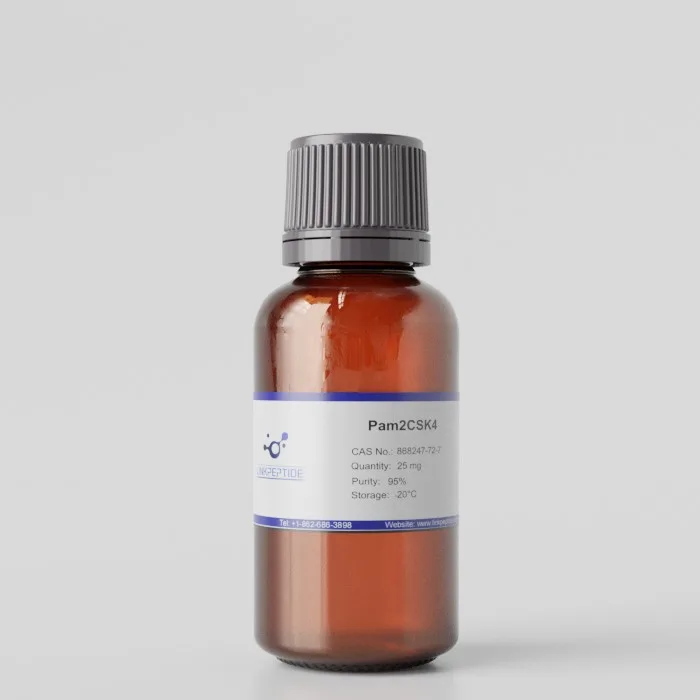
Product Name: Pam2CSK4
CAS No: 868247-72-7
Purity: 95%
Molar Mass: 1271.8
Chemical Formula: C65H126N10O12S
Storage: Store at -20 degrees Celsius
Sequence: {(2R)-2,3-Bis(1-oxohexadecyl)oxy]propyl}-CSKKKK
Target: TLR2
Application:
Pam2CSK4 is a synthetic lipopeptide that serves as a potent agonist for Toll-like receptor 2 (TLR2). It consists of a diacylated cysteine-serine-lysine sequence linked to a lipid tail. Upon binding to TLR2, Pam2CSK4 activates signaling pathways that trigger the innate immune response, leading to the production of pro-inflammatory cytokines and chemokines. This peptide is extensively used in immunological research to study host-pathogen interactions, immune system activation, and the development of immune responses. Pam2CSK4 is also employed in vaccine adjuvant research to enhance the efficacy of vaccines by stimulating robust immune reactions against pathogens.
Current Research:
Pam2CSK4 is a synthetic diacylated lipopeptide that mimics the N-terminal structure of bacterial lipoproteins, specifically designed to target the Toll-like receptor 2 (TLR2) and Toll-like receptor 6 (TLR6) heterodimer. It is widely used as a tool to study innate immune responses and the activation of pro-inflammatory pathways mediated by TLR2/TLR6.
Mechanism of Action
Pam2CSK4 functions by binding to the TLR2/TLR6 complex on the surface of immune cells such as macrophages and dendritic cells. This interaction triggers a signaling cascade involving MyD88, leading to the activation of NF-κB and the production of pro-inflammatory cytokines like TNF-α, IL-6, and IL-1β. Its diacylated structure is critical for its specificity toward the TLR2/TLR6 heterodimer, distinguishing it from triacylated lipopeptides like Pam3CSK4, which target TLR2/TLR1.
Applications in Research
Innate Immunity Studies
Pam2CSK4 is frequently used to investigate the mechanisms of TLR2/TLR6 activation and its role in innate immunity. By mimicking bacterial lipopeptides, it provides a model for studying how host cells recognize and respond to pathogens.
Inflammatory Disease Models
The compound is used in preclinical models to study inflammatory diseases and the development of new anti-inflammatory therapies. It helps in understanding the role of TLR2/TLR6 signaling in conditions such as sepsis, autoimmune diseases, and chronic inflammation.
Adjuvant Development
As a potent activator of immune responses, Pam2CSK4 has been evaluated for its potential as an adjuvant in vaccine development. Its ability to stimulate innate immunity makes it an attractive candidate for enhancing adaptive immune responses.
Host-Pathogen Interactions
Researchers use Pam2CSK4 to explore how pathogens evade or exploit TLR2/TLR6 signaling, providing insights into microbial pathogenesis and host defense mechanisms.
Advantages
High specificity for TLR2/TLR6 heterodimers.
Well-characterized mechanism of action, making it a reliable tool for research.
Potent activation of NF-κB and cytokine production.
Conclusion
Pam2CSK4 is a valuable compound in immunological research, enabling the study of TLR2/TLR6 signaling pathways, immune activation, and inflammatory processes. Its applications extend from basic research on host-pathogen interactions to the development of therapeutic strategies targeting immune dysregulation.
Reference:
Get a Quote
 LinkPeptide