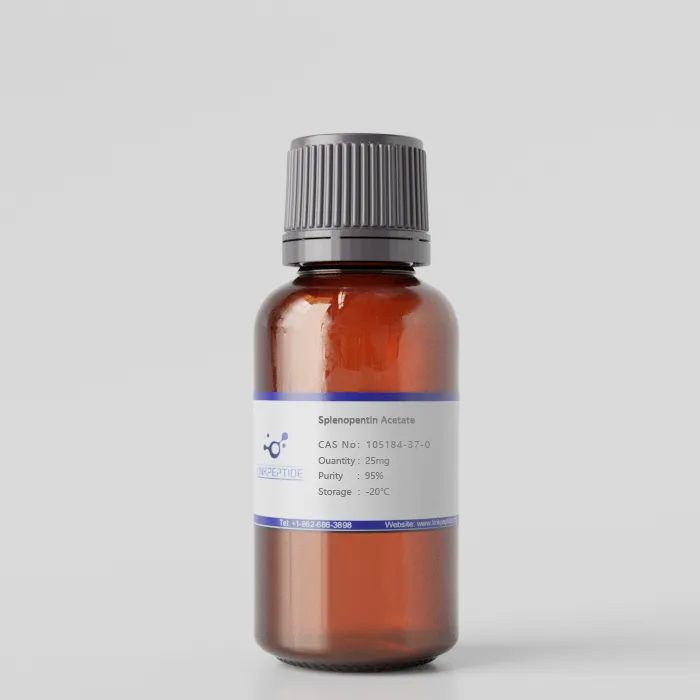
Product Name:Splenopentin Acetate
Form:Acetate salt
Purity:95%
Storage:-20oC
Cas No:105184-37-0
Molar Mass:813.9
Chemical Formula:C35H59N9O13
IUPAC Name:acetic acid;4-[[6-amino-2-[[2-amino-5-(diaminomethylideneamino)pentanoyl]amino]hexanoyl]amino]-5-[[1-[[1-carboxy-2-(4-hydroxyphenyl)ethyl]amino]-3-methyl-1-oxobutan-2-yl]amino]-5-oxopentanoic acid
SMILES:CC(C)C(C(=O)NC(CC1=CC=C(C=C1)O)C(=O)O)NC(=O)C(CCC(=O)O)NC(=O)C(CCCCN)NC(=O)C(CCCN=C(N)N)N.CC(=O)O.CC(=O)O
InChIKey:VJGQADLDXWXFKW-UHFFFAOYSA-N
InChI:InChI=1S/C31H51N9O9.2C2H4O2/c1-17(2)25(29(47)39-23(30(48)49)16-18-8-10-19(41)11-9-18)40-28(46)22(12-13-24(42)43)38-27(45)21(7-3-4-14-32)37-26(44)20(33)6-5-15-36-31(34)35;2*1-2(3)4/h8-11,17,20-23,25,41H,3-7,12-16,32-33H2,1-2H3,(H,37,44)(H,38,45)(H,39,47)(H,40,46)(H,42,43)(H,48,49)(H4,34,35,36);2*1H3,(H,3,4)
Sequence:RKEVY
Application:Splenopentin Acetate is a synthetic pentapeptide derived from the active region of splenin, a thymic and spleen-associated peptide. It plays a crucial role in immune modulation by enhancing T-cell differentiation and immune response regulation. Splenopentin is primarily studied for its potential in treating immune deficiencies, autoimmune disorders, and infections by stimulating thymocyte activity. Additionally, research explores its role in cancer immunotherapy, aging-related immune decline, and inflammation control. As an immunomodulator, it is being investigated for applications in autoimmune diseases, chronic infections, and vaccine adjuvants, making it a promising therapeutic candidate in immunology and regenerative medicine.
Current Research:Splenopentin Acetate is a synthetic analog of splenin, a biologically active peptide found in the spleen and thymus that plays a key role in immune system regulation. As a pentapeptide (Arg-Lys-Glu-Val-Tyr), Splenopentin is known for its ability to enhance T-cell differentiation and immune responses, making it a promising candidate in immune therapy, infectious disease management, and immunosenescence research. Immune System Modulation and T-Cell Activation Splenopentin Acetate has demonstrated significant immunostimulatory properties by enhancing thymocyte activity and improving T-cell proliferation and differentiation. Immunodeficiency treatment: Research suggests that Splenopentin may help restore immune function in immunocompromised individuals, including patients with HIV/AIDS, chemotherapy-induced immunosuppression, and congenital immune deficiencies. Vaccine adjuvant potential: Due to its ability to enhance immune response, Splenopentin is being explored as a vaccine adjuvant to improve the efficacy of vaccines against bacterial and viral infections. Aging-related immune decline (Immunosenescence): In elderly individuals, Splenopentin is being studied for its potential to counteract thymic atrophy and improve immune surveillance, reducing susceptibility to infections and chronic inflammatory diseases. Autoimmune Disease Research Splenopentin??s ability to modulate immune function has made it an attractive target for autoimmune disease management. Rheumatoid arthritis (RA) and multiple sclerosis (MS): Studies are investigating whether Splenopentin can help rebalance immune responses, potentially reducing autoimmune-mediated inflammation. Type 1 diabetes (T1D): Research is exploring its role in preserving pancreatic beta-cell function by modulating T-cell-mediated autoimmune attacks. Cancer Immunotherapy and Tumor Immunity Splenopentin has been studied for its potential anti-tumor effects through immune system enhancement. T-cell activation in tumor suppression: By stimulating cytotoxic T-lymphocytes (CTLs) and natural killer (NK) cells, Splenopentin may help enhance immune-mediated tumor destruction. Combination with checkpoint inhibitors: Emerging research is evaluating whether Splenopentin can enhance responses to immune checkpoint inhibitors, such as anti-PD-1 and anti-CTLA-4 therapies, by boosting overall T-cell activity. Chronic Infections and Anti-Inflammatory Effects Viral infections (HIV, Hepatitis, and COVID-19): Given its immunostimulatory effects, Splenopentin is being investigated for potential therapeutic roles in chronic viral infections, particularly those that impair immune function. Inflammation control: Studies suggest that Splenopentin may help regulate chronic inflammation and cytokine imbalances, making it a candidate for treating systemic inflammatory disorders. Emerging Research Areas Neurological and neuroimmune applications: The connection between immune function and neurodegenerative diseases (e.g., Alzheimer??s, Parkinson??s, and multiple sclerosis) is an area of active research, and Splenopentin is being studied for its potential role in neuroimmune modulation. Tissue regeneration and wound healing: Some studies suggest Splenopentin may enhance tissue repair by modulating immune responses and inflammatory pathways in wound healing and organ regeneration. As research progresses, Splenopentin Acetate continues to be a promising immunomodulatory peptide, with potential applications in immune therapy, autoimmune disease treatment, cancer immunotherapy, and regenerative medicine.
Get a Quote
 LinkPeptide