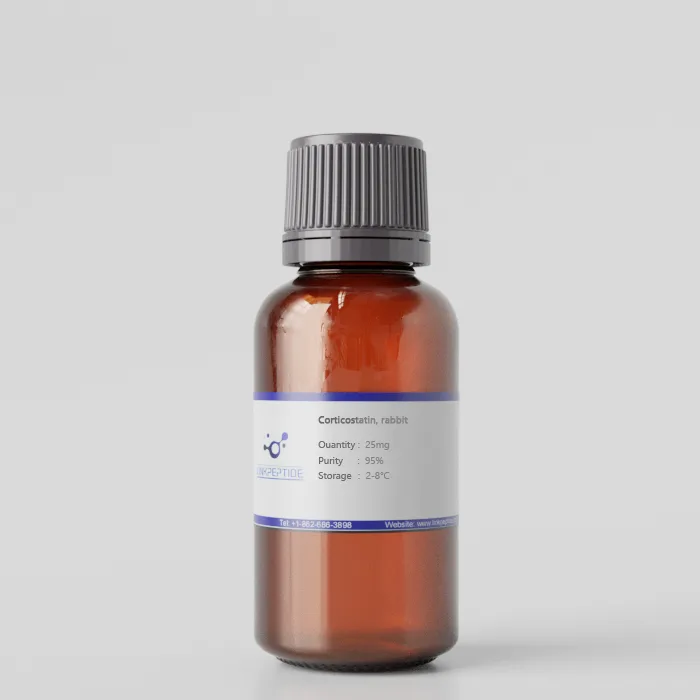
Product Name:Corticostatin, rabbit
Form:TFA salt
Purity:95%
Storage:2-8 degree Celsius
Molar Mass:3997.6
Chemical Formula:C163H259N63O44S6
Sequence:Gly-Ile-Cys-Ala-Cys-Arg-Arg-Arg-Phe-Cys-Pro-Asn-Ser-Glu-Arg-Phe-Ser-Gly-Tyr-Cys-Arg-Val-Asn-Gly-Ala-Arg-Tyr-Val-Arg-Cys-Cys-Ser-Arg-Arg
Application:Corticostatin, rabbit is a naturally occurring peptide that modulates adrenal corticosteroid production by interacting with melanocortin and other neuroendocrine pathways. Unlike corticotropin (ACTH), corticostatin has been found to inhibit adrenal steroidogenesis, suggesting a regulatory role in stress and immune responses. It is also implicated in neuropeptide signaling and inflammatory modulation. Research on corticostatin focuses on its effects on adrenal function, neuroendocrine balance, and immune regulation. It is a valuable tool for studying adrenal suppression, stress physiology, and cytokine-mediated inflammation, particularly in conditions related to neuroimmunology, metabolic regulation, and endocrine disorders.
Current Research:
Introduction
Corticostatin is a peptide hormone that plays an inhibitory role in corticosteroid synthesis, distinguishing it from ACTH, which stimulates adrenal glucocorticoid release. Initially identified in rabbit adrenal tissue, corticostatin has gained interest in research on adrenal regulation, neuropeptide function, and immune response modulation. Unlike classic melanocortin system peptides, corticostatin appears to counterbalance ACTH activity, making it relevant in studies of stress adaptation, metabolic diseases, and inflammatory control.
Regulation of Adrenal Function
Corticostatin’s primary role involves the suppression of adrenal steroidogenesis, likely through interactions with adrenal cortical cells. This effect contrasts with ACTH, which stimulates glucocorticoid release via the melanocortin 2 receptor (MC2R). Research suggests that corticostatin may function through an alternative receptor pathway or act as an endogenous regulatory factor, preventing excessive corticosteroid production.
This inhibitory effect is significant in research on Cushing’s syndrome, adrenal insufficiency, and stress-related disorders, as it suggests a potential mechanism for controlling glucocorticoid overproduction. Understanding corticostatin’s regulatory role could lead to new treatments for hypercortisolic states, including metabolic diseases and psychiatric conditions linked to chronic stress.
Neuropeptide and Neuromodulatory Roles
Beyond its function in adrenal regulation, corticostatin has been found to influence central and peripheral neuroendocrine signaling. It is suggested to interact with corticotropin-releasing hormone (CRH) pathways, affecting hypothalamic-pituitary-adrenal (HPA) axis activity. Studies indicate that corticostatin may contribute to stress resilience, mood regulation, and behavioral adaptation, making it relevant in research on depression, anxiety, and neuroendocrine disorders.
Additionally, corticostatin may have an effect on neurotransmitter systems, such as dopaminergic and serotonergic pathways, which are critical for cognition and emotional regulation. These findings raise the possibility of its use in psychiatric research and neuroprotection studies.
Immunomodulatory and Anti-Inflammatory Effects
Recent studies suggest that corticostatin plays a role in immune system regulation, particularly in inflammatory and autoimmune responses. Its presence in immune-related tissues suggests that it may function as an anti-inflammatory modulator. Researchers have observed that corticostatin can inhibit pro-inflammatory cytokine production, reducing levels of IL-6, TNF-α, and other mediators involved in chronic inflammatory diseases such as rheumatoid arthritis, multiple sclerosis, and inflammatory bowel disease.
Furthermore, corticostatin’s ability to regulate immune function has led to investigations into its role in sepsis, infection-induced inflammation, and immune-mediated metabolic disorders. This peptide may help to balance stress-induced immune suppression and inflammation, potentially offering new therapeutic pathways in immune-based conditions.
Conclusion
Corticostatin, rabbit is a unique peptide with inhibitory effects on adrenal steroidogenesis and significant roles in neuroendocrine regulation and immune modulation. Its ability to counteract ACTH suggests potential applications in adrenal disorders, stress-related conditions, and metabolic diseases. Additionally, its impact on neurotransmission and immune signaling makes it an important research focus in neurology, endocrinology, and immunology. Future studies may uncover therapeutic applications for corticostatin in stress resilience, inflammatory diseases, and endocrine dysfunctions.
Get a Quote
 LinkPeptide

![[Leu27]-Melan-A, MART-1 (26-35)](https://www.linkpeptide.com/wp-content/uploads/2026/05/Leu27-Melan-A-MART-1-26-35.jpg "[Leu27]-Melan-A, MART-1 (26-35)")