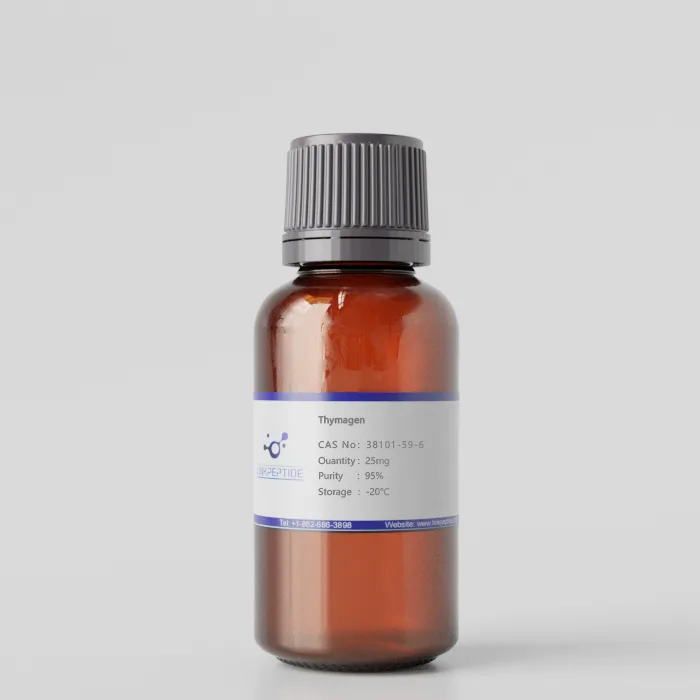
Product Name:Thymagen
Cas No:38101-59-6
Purity:95%
Chemical Formula:C16H19N3O5
Molar Mass:333.34
Synonyms:Oglufanide; 38101-59-6; H-Glu-Trp-OH; Glu-trp; Thymogen; Glutamyltryptophan
IUPAC Name:(4S)-4-amino-5-[[(1S)-1-carboxy-2-(1H-indol-3-yl)ethyl]amino]-5-oxopentanoic acid
SMILES:C1=CC=C2C(=C1)C(=CN2)C[C@@H](C(=O)O)NC(=O)[C@H](CCC(=O)O)N
InChIKey:LLEUXCDZPQOJMY-AAEUAGOBSA-N
InChI:InChI=1S/C16H19N3O5/c17-11(5-6-14(20)21)15(22)19-13(16(23)24)7-9-8-18-12-4-2-1-3-10(9)12/h1-4,8,11,13,18H,5-7,17H2,(H,19,22)(H,20,21)(H,23,24)/t11-,13-/m0/s1
Storage:-20 degree Celsius
Sequence:EW
Application:Thymagen is a short peptide bioregulator derived from thymic tissue, developed to support the restoration and regulation of immune function. It acts on thymic epithelial cells and lymphoid progenitors to normalize T-cell differentiation, improve immune surveillance, and modulate inflammatory responses. Thymagen has been studied in models of immunosenescence, autoimmune dysregulation, chronic infection, and oncology-related immune suppression, where it enhances both innate and adaptive immunity. It is used in research aimed at supporting thymic hormone balance, immune cell maturation, and epigenetic rejuvenation of the immune system, especially in aging and post-stress recovery scenarios.
Current Research:
Introduction: What Is Thymagen?
Thymagen is a synthetic peptide derived from extracts of thymic tissue, specifically designed to restore immune homeostasis through regulation of thymic function and T-cell maturation. It is part of a class of cytogenetic peptides that interact with DNA to influence gene expression related to cellular differentiation, proliferation, and immune signaling.
The thymus plays a crucial role in T-lymphocyte development, and its function declines with age or chronic stress—a process known as thymic involution. Thymagen has been studied extensively as a potential anti-immunosenescence peptide, targeting both thymic tissue and immune cell gene regulation.
Mechanism of Action: Epigenetic Immune Modulation
Thymagen exerts its biological effects by:
Binding to GC-rich DNA sequences in thymic epithelial and progenitor cells
Reactivating gene expression necessary for T-cell receptor (TCR) diversity and thymocyte maturation
Enhancing the transcription of genes involved in interleukin signaling, antigen presentation, and MHC expression
Regulating cytokine production, restoring the balance between pro-inflammatory and anti-inflammatory responses
These actions contribute to the reconstitution of thymic activity, support immune education, and promote a more robust and balanced immune profile.
Applications in Aging and Immune Decline
Thymagen is particularly valuable in models of aging, where the immune system experiences:
Reduced T-cell output
Accumulation of senescent immune cells
Decline in thymic hormone production
Increased risk of infection, cancer, and autoimmunity
In elderly animal models and human studies, Thymagen has been shown to:
Increase the proportion of naïve T-cells
Enhance T-cell proliferation and responsiveness
Improve vaccine efficacy
Reduce chronic inflammation markers
These findings support its use in gerontology research, particularly for reversing aspects of immunosenescence.
Applications in Immunosuppression and Recovery
Thymagen has also been used in studies involving secondary immunodeficiency caused by:
Chemotherapy or radiation
Chronic infections
Autoimmune diseases
Stress and trauma
In these contexts, Thymagen supports:
Recovery of white blood cell counts
Regulation of T-helper/T-regulatory cell balance
Faster resolution of inflammatory flare-ups
Protection against opportunistic infections
This makes it a candidate for research on post-illness recovery and supportive immunotherapy in cancer patients.
Autoimmunity and Immune Regulation
In autoimmune models, where immune tolerance is disrupted, Thymagen has demonstrated the ability to:
Normalize regulatory T-cell function
Suppress autoreactive immune responses
Reduce tissue damage and inflammation in organs like the liver, joints, and skin
It appears to promote immune education and tolerance rather than broad immune suppression, offering a more homeostatic approach to autoimmune modulation.
Use in Pediatric and Developmental Immunity
The thymus is most active in early life. In pediatric studies, especially in low birthweight or immunocompromised infants, Thymagen has been studied for:
Supporting early T-cell development
Enhancing resistance to respiratory and gastrointestinal infections
Improving outcomes in children with frequent viral infections
Its safety profile makes it suitable for exploring age-adapted immune support protocols.
Conclusion
Thymagen is a potent, tissue-specific peptide bioregulator with broad implications for immune health, thymic rejuvenation, and epigenetic restoration of immune balance. Whether in the context of aging, chronic illness, autoimmune dysregulation, or post-treatment immune rebuilding, it provides a targeted, non-immunosuppressive means to enhance immune competence and support systemic resilience. As peptide-based immunomodulation advances, Thymagen remains a key player in precision immune restoration research.
Reference:
Get a Quote
 LinkPeptide