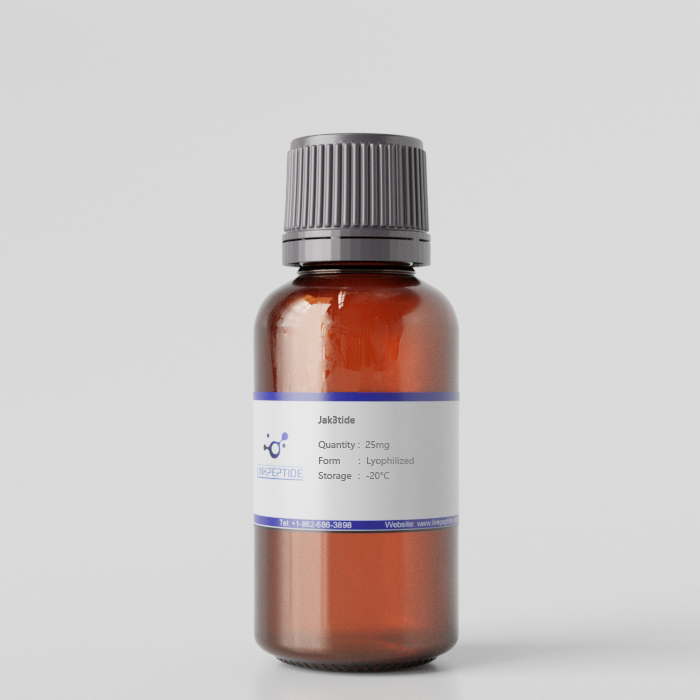
Product Name: Jak3tide
Sequence One Letter Code: GGEEEEYFELVKKKK
Sequence Three Letter Code: H-Gly-Gly-Glu-Glu-Glu-Glu-Tyr-Phe-Glu-Leu-Val-Lys-Lys-Lys-Lys-OH
Chemical Formula:C82H129N19O27
Molecular Weight: 1813.1
Purity: 95%
Form: Lyophilized
Storage Conditions: - 20 °C
Research Area: Inflammation and Immunology Research
Source / Species: human
Conjugation: Unconjugated
Code Nacres: NA.26
Application: Jak3tide is a synthetic peptide substrate specifically designed for Janus kinase 3 (JAK3) enzymatic assays. It contains a defined tyrosine phosphorylation site at position 7 that is selectively recognized and phosphorylated by JAK3. This peptide enables precise measurement of kinase activity in vitro and is widely used to characterize enzyme kinetics, substrate specificity, and catalytic efficiency. Jak3tide is particularly valuable for screening small-molecule inhibitors targeting JAK-mediated signaling pathways, which play critical roles in cytokine receptor signaling and immune cell development. By providing a reliable and reproducible substrate, it supports mechanistic studies of JAK3 activation and downstream signaling cascades. Jak3tide is suitable for immunology research, signal transduction studies, and therapeutic discovery programs focused on autoimmune disorders, inflammatory diseases, and hematological malignancies associated with dysregulated JAK activity.
Current Research: Janus kinase 3 (JAK3) is a non-receptor tyrosine kinase predominantly expressed in hematopoietic cells and plays a central role in cytokine receptor signaling. JAK3 associates with the common γ-chain (γc) shared by multiple interleukin receptors, including IL-2, IL-4, IL-7, IL-9, IL-15, and IL-21 receptors. Upon cytokine engagement, JAK3 becomes activated through trans-phosphorylation, subsequently phosphorylating downstream targets such as STAT transcription factors. Dysregulated JAK3 signaling has been implicated in autoimmune diseases, inflammatory disorders, immunodeficiencies, and hematological malignancies. Jak3tide is a synthetic peptide substrate specifically engineered to enable precise and reproducible measurement of JAK3 kinase activity in vitro. Jak3tide contains a defined tyrosine phosphorylation site positioned within a sequence context optimized for selective recognition by JAK3. The tyrosine residue at position 7 serves as the primary phosphorylation target. This design allows the peptide to function as a minimal and well-characterized substrate, reducing variability associated with full-length protein substrates. By isolating the catalytic event to a single phosphorylation site, Jak3tide enables accurate quantification of enzymatic turnover and kinetic parameters. In in vitro kinase assays, recombinant JAK3 is incubated with Jak3tide in the presence of ATP and appropriate cofactors. Phosphorylation of the tyrosine residue can be detected using radiometric incorporation, phosphotyrosine-specific antibodies, fluorescence-based assays, or mass spectrometry. These methods provide quantitative measurements of catalytic activity and support determination of kinetic constants such as Km and Vmax. Because the peptide is structurally simple and soluble, it facilitates reproducible assay conditions and straightforward interpretation of results. Jak3tide is widely used in drug discovery programs targeting the JAK family. Selective inhibition of JAK3 is of therapeutic interest due to its restricted expression profile and critical role in lymphocyte development and immune signaling. Small-molecule inhibitors can be evaluated in competitive assays measuring their ability to reduce phosphorylation of Jak3tide. Dose–response curves enable calculation of IC50 and Ki values, supporting structure–activity relationship (SAR) optimization. The defined substrate format enhances assay sensitivity and compatibility with high-throughput screening platforms. The peptide also supports mechanistic studies of kinase activation and regulation. JAK3 activity is influenced by phosphorylation within its activation loop and by interactions with receptor-associated proteins. By using Jak3tide as a standardized substrate, researchers can assess how mutations, regulatory domains, or upstream signaling events alter catalytic efficiency. Comparative assays with related JAK isoforms (JAK1, JAK2, TYK2) help clarify isoform specificity and off-target inhibitor effects. In immunology research, quantifying JAK3 activity provides insight into cytokine-driven signaling cascades that govern T cell proliferation, NK cell development, and immune homeostasis. Jak3tide-based assays allow functional evaluation of pathway modulation under experimental conditions, such as exposure to cytokines or pharmacological agents. This is particularly relevant in studying diseases linked to aberrant γc signaling. From a translational perspective, JAK inhibitors are approved for treatment of autoimmune and inflammatory conditions, and continued development focuses on improving selectivity and safety. Jak3tide remains a critical reagent for validating compound potency and mechanistic action during preclinical evaluation. In summary, Jak3tide is a synthetic peptide substrate containing a defined tyrosine phosphorylation site selectively targeted by JAK3. It enables accurate measurement of kinase activity, kinetic characterization, and inhibitor screening. As a reliable and reproducible assay substrate, Jak3tide supports immunology research, signal transduction analysis, and therapeutic discovery efforts aimed at modulating dysregulated JAK-mediated signaling pathways.
Get a Quote
 LinkPeptide

![CDK1 Substrate [HATPPKKKRK]](https://www.linkpeptide.com/wp-content/uploads/2026/05/CDK1-Substrate-HATPPKKKRK.jpg "CDK1 Substrate [HATPPKKKRK]")