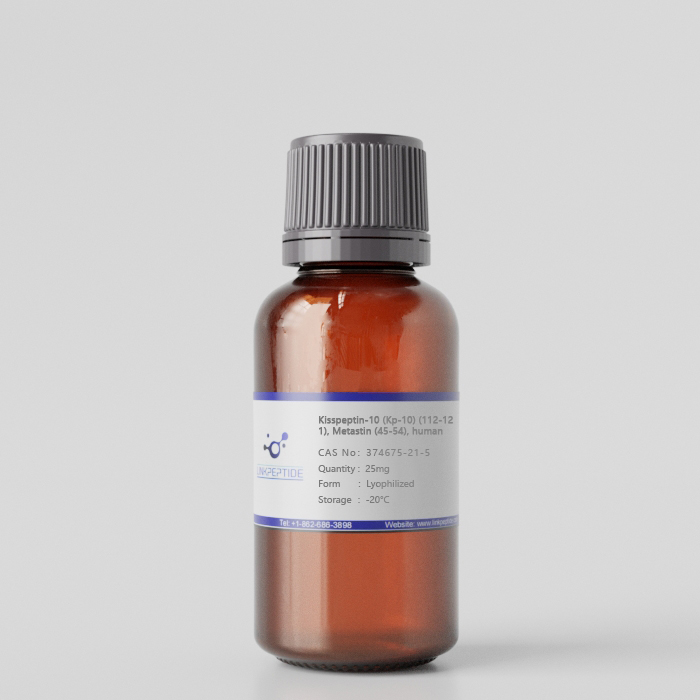
Product Name: Kisspeptin-10 (Kp-10) (112-121), Metastin (45-54), human
Sequence One Letter Code: YNWNSFGLRF-NH2
Sequence Three Letter Code: H-Tyr-Asn-Trp-Asn-Ser-Phe-Gly-Leu-Arg-Phe-NH2
Cas No: 374675-21-5
Chemical Formula:C63H83N17O14
Molecular Weight: 1302.5
Purity: 95%
Form: Lyophilized
Storage Conditions: - 20 °C
Research Area: Cancer Disease Research
SMILES: CC(C)C[C@@H](C(=O)N[C@@H](CCCN=C(N)N)C(=O)N[C@@H](CC1=CC=CC=C1)C(=O)N)NC(=O)CNC(=O)[C@H](CC2=CC=CC=C2)NC(=O)[C@H](CO)NC(=O)[C@H](CC(=O)N)NC(=O)[C@H](CC3=CNC4=CC=CC=C43)NC(=O)[C@H](CC(=O)N)NC(=O)[C@H](CC5=CC=C(C=C5)O)N
IUPAC: (2S)-N-[(2S)-1-[[(2S)-4-amino-1-[[(2S)-1-[[(2S)-1-[[2-[[(2S)-1-[[(2S)-1-[[(2S)-1-amino-1-oxo-3-phenylpropan-2-yl]amino]-5-(diaminomethylideneamino)-1-oxopentan-2-yl]amino]-4-methyl-1-oxopentan-2-yl]amino]-2-oxoethyl]amino]-1-oxo-3-phenylpropan-2-yl]amino]-3-hydroxy-1-oxopropan-2-yl]amino]-1,4-dioxobutan-2-yl]amino]-3-(1H-indol-3-yl)-1-oxopropan-2-yl]-2-[[(2S)-2-amino-3-(4-hydroxyphenyl)propanoyl]amino]butanediamide
INCHIKEY: RITKWYDZSSQNJI-INXYWQKQSA-N
INCHI:
InChI=1S/C63H83N17O14/c1-34(2)24-45(58(90)74-43(18-11-23-70-63(68)69)57(89)75-44(54(67)86)26-35-12-5-3-6-13-35)73-53(85)32-72-56(88)46(27-36-14-7-4-8-15-36)77-62(94)50(33-81)80-61(93)49(30-52(66)84)79-59(91)47(28-38-31-71-42-17-10-9-16-40(38)42)78-60(92)48(29-51(65)83)76-55(87)41(64)25-37-19-21-39(82)22-20-37/h3-10,12-17,19-22,31,34,41,43-50,71,81-82H,11,18,23-30,32-33,64H2,1-2H3,(H2,65,83)(H2,66,84)(H2,67,86)(H,72,88)(H,73,85)(H,74,90)(H,75,89)(H,76,87)(H,77,94)(H,78,92)(H,79,91)(H,80,93)(H4,68,69,70)/t41-,43-,44-,45-,46-,47-,48-,49-,50-/m0/s1
Source / Species: human
Conjugation: Unconjugated
Code Nacres: NA.26
Application: Kisspeptin-10 represents the minimal active sequence required for activation of the GPR54 receptor, also known as the kisspeptin receptor. Activation of this receptor plays a central role in regulating reproductive hormone signaling by stimulating the release of gonadotropin-releasing hormone (GnRH). Through this pathway, Kisspeptin-10 contributes to the control of puberty onset, fertility, and reproductive endocrine function. In addition to its role in reproductive biology, the peptide has been shown to inhibit CXCR4 signaling and stromal cell–derived factor-1 (SDF-1)-induced chemotaxis, linking kisspeptin signaling to suppression of tumor metastasis. Kisspeptin-10 is widely used in endocrine and cancer research to investigate hormone regulation, GPCR signaling mechanisms, and metastasis-related cellular pathways.
Current Research: Kisspeptin peptides have emerged as critical regulators of reproductive physiology and endocrine signaling. Among them, Kisspeptin-10 represents the minimal bioactive fragment capable of activating the GPR54 receptor, also known as the kisspeptin receptor (KISS1R). This short peptide retains the essential functional properties of the larger kisspeptin family and has become a widely used research tool for studying reproductive hormone regulation, GPCR signaling, and cancer metastasis mechanisms. Originally identified as part of the KISS1 metastasis-suppressor gene pathway, kisspeptins have since been recognized for their fundamental role in controlling the hypothalamic–pituitary–gonadal (HPG) axis, which regulates reproductive hormone secretion and fertility. Because Kisspeptin-10 preserves the receptor-activating core sequence, it allows researchers to investigate these biological processes in a simplified and experimentally accessible format. Kisspeptin Signaling and the GPR54 Receptor Kisspeptins exert their biological activity by binding to GPR54 (KISS1R), a G-protein–coupled receptor expressed in several tissues, including the hypothalamus. Activation of this receptor triggers intracellular signaling pathways that ultimately regulate the secretion of gonadotropin-releasing hormone (GnRH) from hypothalamic neurons. GnRH release is a critical step in reproductive hormone signaling. Once secreted, GnRH stimulates the anterior pituitary gland to produce luteinizing hormone (LH) and follicle-stimulating hormone (FSH). These hormones act on the gonads to regulate processes such as gamete maturation, steroid hormone production, and reproductive function. Because Kisspeptin-10 effectively activates GPR54, it can reproduce this signaling cascade in experimental systems. Researchers frequently use the peptide to examine how kisspeptin signaling influences hormone release and reproductive physiology. Regulation of Puberty and Fertility The kisspeptin–GPR54 signaling axis plays a central role in puberty onset and reproductive development. In both humans and animal models, mutations in the KISS1 or KISS1R genes can lead to disorders of pubertal timing and reproductive function. Activation of GPR54 by kisspeptin peptides stimulates GnRH neurons, triggering hormonal events that initiate puberty. As a result, Kisspeptin-10 has become an important research reagent for studying: The neuroendocrine mechanisms that control puberty initiation Regulation of the hypothalamic–pituitary–gonadal axis Hormonal signaling involved in fertility and reproductive health In experimental models, the peptide is often used to stimulate GnRH release and evaluate downstream endocrine responses. Inhibition of CXCR4 Signaling and Tumor Metastasis Beyond its endocrine functions, kisspeptin signaling has also been linked to cancer metastasis suppression. The KISS1 gene was initially identified as a metastasis suppressor in melanoma and other cancers. Subsequent studies revealed that kisspeptin peptides, including Kisspeptin-10, can interfere with signaling pathways involved in tumor cell migration. One key pathway involves the CXCR4 chemokine receptor and its ligand stromal cell–derived factor-1 (SDF-1). This signaling axis promotes chemotaxis and migration of cancer cells, contributing to metastatic spread. Kisspeptin-10 has been shown to inhibit CXCR4 signaling and SDF-1-induced chemotaxis, thereby reducing cellular migration in experimental systems. This interaction connects kisspeptin signaling to mechanisms that regulate tumor progression and metastasis. Because of these effects, the peptide is widely used in studies investigating how signaling networks influence tumor cell motility and metastatic behavior. Applications in Endocrine and Cancer Research Due to its defined structure and strong biological activity, Kisspeptin-10 is commonly used across multiple research fields. Typical experimental applications include: GPCR signaling studies examining activation of the kisspeptin receptor Endocrine research exploring regulation of GnRH and reproductive hormones Neuroendocrine investigations of hypothalamic signaling pathways Cancer biology studies focusing on metastasis suppression and cell migration Chemotaxis assays analyzing CXCR4-dependent cellular responses These applications allow researchers to dissect the molecular pathways linking receptor activation to physiological outcomes. Advancing Research in Reproductive and Cancer Biology The discovery of kisspeptin signaling has significantly expanded our understanding of how the endocrine system regulates reproductive function. At the same time, the connection between kisspeptins and metastasis suppression highlights the broader importance of this pathway in cell signaling and disease biology. Kisspeptin-10, as the minimal active fragment capable of activating GPR54, provides a powerful experimental tool for studying these processes. By enabling controlled investigation of receptor signaling, hormone regulation, and chemotactic pathways, the peptide continues to support research in reproductive endocrinology, GPCR biology, and cancer metastasis mechanisms.
Get a Quote

 LinkPeptide