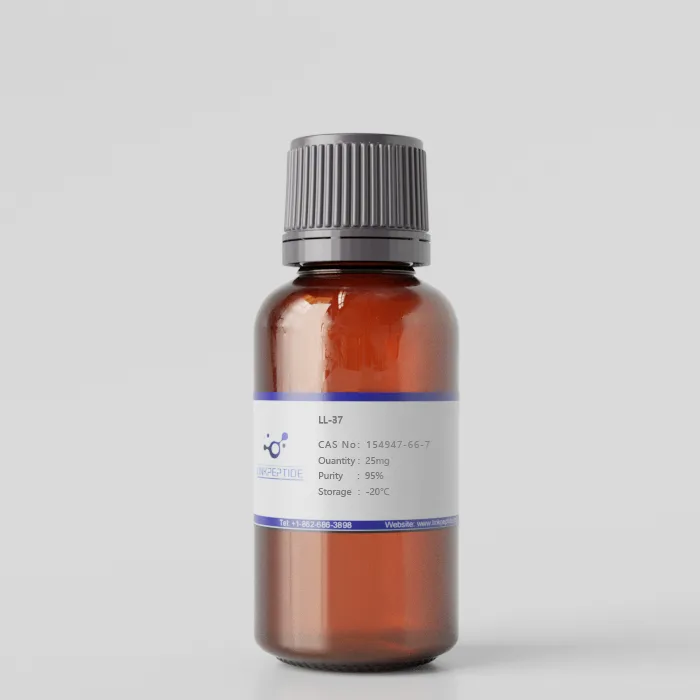
Product Name:LL-37
Cas No:154947-66-7
Purity:95%
Chemical Formula:C205H340N60O53
Molar Mass:4493
Synonyms:Cathelicidin; ropocamptide
IUPAC Name:(4S)-5-[[(2S)-6-amino-1-[[(2S,3S)-1-[[2-[[(2S)-6-amino-1-[[(2S)-1-[[(2S)-1-[[(2S)-6-amino-1-[[(2S)-1-[[(2S,3S)-1-[[(2S)-1-[[(2S)-5-amino-1-[[(2S)-1-[[(2S,3S)-1-[[(2S)-6-amino-1-[[(2S)-1-[[(2S)-1-[[(2S)-1-[[(2S)-1-[[(2S)-4-amino-1-[[(2S)-1-[[(2S)-1-[(2S)-2-[[(2S)-5-carbamimidamido-1-[[(2S,3R)-1-[[(2S)-4-carboxy-1-[[(1S)-1-carboxy-2-hydroxyethyl]amino]-1-oxobutan-2-yl]amino]-3-hydroxy-1-oxobutan-2-yl]amino]-1-oxopentan-2-yl]carbamoyl]pyrrolidin-1-yl]-3-methyl-1-oxobutan-2-yl]amino]-4-methyl-1-oxopentan-2-yl]amino]-1,4-dioxobutan-2-yl]amino]-5-carbamimidamido-1-oxopentan-2-yl]amino]-4-methyl-1-oxopentan-2-yl]amino]-1-oxo-3-phenylpropan-2-yl]amino]-3-carboxy-1-oxopropan-2-yl]amino]-1-oxohexan-2-yl]amino]-3-methyl-1-oxopentan-2-yl]amino]-5-carbamimidamido-1-oxopentan-2-yl]amino]-1,5-dioxopentan-2-yl]amino]-3-methyl-1-oxobutan-2-yl]amino]-3-methyl-1-oxopentan-2-yl]amino]-5-carbamimidamido-1-oxopentan-2-yl]amino]-1-oxohexan-2-yl]amino]-1-oxo-3-phenylpropan-2-yl]amino]-4-carboxy-1-oxobutan-2-yl]amino]-1-oxohexan-2-yl]amino]-2-oxoethyl]amino]-3-methyl-1-oxopentan-2-yl]amino]-1-oxohexan-2-yl]amino]-4-[[(2S)-6-amino-2-[[(2S)-2-[[(2S)-6-amino-2-[[(2S)-2-[[(2S)-2-[[(2S)-2-[[(2S)-2-[[2-[[(2S)-2-[[(2S)-2-amino-4-methylpentanoyl]amino]-4-methylpentanoyl]amino]acetyl]amino]-3-carboxypropanoyl]amino]-3-phenylpropanoyl]amino]-3-phenylpropanoyl]amino]-5-carbamimidamidopentanoyl]amino]hexanoyl]amino]-3-hydroxypropanoyl]amino]hexanoyl]amino]-5-oxopentanoic acid
SMILES:CC[C@H](C)[C@@H](C(=O)NCC(=O)N[C@@H](CCCCN)C(=O)N[C@@H](CCC(=O)O)C(=O)N[C@@H](CC1=CC=CC=C1)C(=O)N[C@@H](CCCCN)C(=O)N[C@@H](CCCNC(=N)N)C(=O)N[C@@H]([C@@H](C)CC)C(=O)N[C@@H](C(C)C)C(=O)N[C@@H](CCC(=O)N)C(=O)N[C@@H](CCCNC(=N)N)C(=O)N[C@@H]([C@@H](C)CC)C(=O)N[C@@H](CCCCN)C(=O)N[C@@H](CC(=O)O)C(=O)N[C@@H](CC2=CC=CC=C2)C(=O)N[C@@H](CC(C)C)C(=O)N[C@@H](CCCNC(=N)N)C(=O)N[C@@H](CC(=O)N)C(=O)N[C@@H](CC(C)C)C(=O)N[C@@H](C(C)C)C(=O)N3CCC[C@H]3C(=O)N[C@@H](CCCNC(=N)N)C(=O)N[C@@H]([C@@H](C)O)C(=O)N[C@@H](CCC(=O)O)C(=O)N[C@@H](CO)C(=O)O)NC(=O)[C@H](CCCCN)NC(=O)[C@H](CCC(=O)O)NC(=O)[C@H](CCCCN)NC(=O)[C@H](CO)NC(=O)[C@H](CCCCN)NC(=O)[C@H](CCCNC(=N)N)NC(=O)[C@H](CC4=CC=CC=C4)NC(=O)[C@H](CC5=CC=CC=C5)NC(=O)[C@H](CC(=O)O)NC(=O)CNC(=O)[C@H](CC(C)C)NC(=O)[C@H](CC(C)C)N
InChIKey:POIUWJQBRNEFGX-XAMSXPGMSA-N
InChI:InChI=1S/C205H340N60O53/c1-20-114(16)162(261-179(296)128(66-40-46-86-211)235-176(293)135(74-78-155(273)274)243-170(287)125(63-37-43-83-208)241-192(309)148(106-266)257-174(291)126(64-38-44-84-209)234-171(288)129(67-47-87-225-201(215)216)240-185(302)142(98-119-55-29-24-30-56-119)252-187(304)144(100-121-59-33-26-34-60-121)253-189(306)146(102-158(279)280)233-154(272)104-230-167(284)138(94-109(6)7)248-166(283)122(212)93-108(4)5)194(311)231-105-153(271)232-123(61-35-41-81-206)168(285)242-136(75-79-156(275)276)177(294)251-141(97-118-53-27-23-28-54-118)184(301)238-124(62-36-42-82-207)169(286)236-131(69-49-89-227-203(219)220)181(298)263-164(116(18)22-3)197(314)259-160(112(12)13)195(312)246-134(73-77-151(213)269)175(292)237-132(70-50-90-228-204(221)222)180(297)262-163(115(17)21-2)196(313)245-127(65-39-45-85-210)172(289)256-147(103-159(281)282)190(307)254-143(99-120-57-31-25-32-58-120)186(303)249-139(95-110(8)9)183(300)239-130(68-48-88-226-202(217)218)173(290)255-145(101-152(214)270)188(305)250-140(96-111(10)11)191(308)260-161(113(14)15)199(316)265-92-52-72-150(265)193(310)244-133(71-51-91-229-205(223)224)182(299)264-165(117(19)268)198(315)247-137(76-80-157(277)278)178(295)258-149(107-267)200(317)318/h23-34,53-60,108-117,122-150,160-165,266-268H,20-22,35-52,61-107,206-212H2,1-19H3,(H2,213,269)(H2,214,270)(H,230,284)(H,231,311)(H,232,271)(H,233,272)(H,234,288)(H,235,293)(H,236,286)(H,237,292)(H,238,301)(H,239,300)(H,240,302)(H,241,309)(H,242,285)(H,243,287)(H,244,310)(H,245,313)(H,246,312)(H,247,315)(H,248,283)(H,249,303)(H,250,305)(H,251,294)(H,252,304)(H,253,306)(H,254,307)(H,255,290)(H,256,289)(H,257,291)(H,258,295)(H,259,314)(H,260,308)(H,261,296)(H,262,297)(H,263,298)(H,264,299)(H,273,274)(H,275,276)(H,277,278)(H,279,280)(H,281,282)(H,317,318)(H4,215,216,225)(H4,217,218,226)(H4,219,220,227)(H4,221,222,228)(H4,223,224,229)/t114-,115-,116-,117+,122-,123-,124-,125-,126-,127-,128-,129-,130-,131-,132-,133-,134-,135-,136-,137-,138-,139-,140-,141-,142-,143-,144-,145-,146-,147-,148-,149-,150-,160-,161-,162-,163-,164-,165-/m0/s1
Storage:-20 degree Celsius
Sequence:LLGDFFRKSKEKIGKEFKRIVQRIKDFLRNLVPRTES
Application:LL-37 (Cathelicidin) is a 37-residue cationic peptide derived from the human antimicrobial precursor protein hCAP18. As a multifunctional host defense peptide (HDP), LL-37 exhibits potent antibacterial, antiviral, antifungal, and anti-biofilm activity. It plays a key role in innate immunity, not only by disrupting microbial membranes but also by modulating immune responses, promoting wound healing, and regulating inflammation. LL-37 influences cytokine signaling, chemotaxis, and angiogenesis, making it a critical tool for studying infectious disease, chronic inflammation, autoimmune disorders, and epithelial repair. It is widely applied in both in vitro and in vivo immune and regenerative research models.
Current Research:Introduction: Origin and Structure of LL-37 LL-37 is the only human cathelicidin-derived peptide and is cleaved from the C-terminal domain of the precursor protein hCAP18, found in neutrophils and epithelial cells. The name LL-37 refers to its N-terminal leucine-leucine start and its 37-amino acid length. It is amphipathic and cationic, enabling it to interact with negatively charged microbial membranes, leading to pore formation and lysis. But beyond its antimicrobial action, LL-37 is a key regulator of inflammation, immune activation, and tissue regeneration. Antimicrobial Activity and Barrier Protection LL-37 demonstrates broad-spectrum antimicrobial effects: Bacteria: active against E. coli, Staphylococcus aureus, Pseudomonas aeruginosa, Helicobacter pylori Viruses: inhibits HIV, Influenza A, Vaccinia virus, RSV, and SARS-CoV-2 in vitro Fungi and parasites: suppresses Candida albicans and Leishmania It acts primarily by disrupting microbial membranes, but also interferes with biofilm formation, making it highly relevant in chronic wound infections, implant-associated infections, and cystic fibrosis lung models. Immunomodulation: Bridging Innate and Adaptive Immunity Unlike many antimicrobial peptides, LL-37 is also a potent immunomodulator: Stimulates chemotaxis of neutrophils, monocytes, and T cells via FPR2 Enhances TLR signaling, increasing or dampening inflammation contextually Promotes dendritic cell maturation and antigen presentation Modulates cytokine production, reducing IL-1β and TNF-α while increasing IL-8 and MCP-1 This dual action—antimicrobial and immunomodulatory—positions LL-37 as a host defense peptide capable of orchestrating an inflammatory response tailored to local needs, whether pro- or anti-inflammatory. Wound Healing and Tissue Regeneration LL-37 plays a critical role in cutaneous repair and epithelial regeneration: Promotes keratinocyte and fibroblast proliferation and migration Enhances angiogenesis via VEGF upregulation Regulates re-epithelialization in wounded skin and mucosa In chronic wound models (e.g., diabetic ulcers), LL-37 levels are often deficient, and exogenous LL-37 restores healing capacity, making it a strong candidate for regenerative medicine and bioengineered skin research. Autoimmunity and Inflammatory Disorders LL-37’s ability to form complexes with self-DNA or RNA can trigger autoimmune responses via TLR9 or TLR7, which is implicated in: Psoriasis: LL-37-DNA complexes activate plasmacytoid dendritic cells, driving inflammation Systemic lupus erythematosus (SLE): similar nucleic acid recognition drives interferon release Rheumatoid arthritis: LL-37 is elevated in synovial fluid, promoting inflammatory cascades Despite these roles, LL-37 also shows protective effects in colitis, lung injury, and sepsis, suggesting dose, location, and immune context determine its outcome. Its activity must therefore be tightly regulated in therapeutic applications. Cancer and Antitumor Roles LL-37 displays context-dependent effects in cancer: Tumor-promoting: In breast, lung, and ovarian cancers, LL-37 can enhance proliferation and angiogenesis Tumor-suppressive: In gastric and colon cancers, it may inhibit tumor cell migration and promote apoptosis These opposing effects depend on cell type, receptor expression, and tumor microenvironment, making LL-37 a complex but promising candidate in tumor microenvironment modulation. Therapeutic Development and Applications Ongoing research is focused on: LL-37 analogs with enhanced stability and targeted action Topical delivery for wound healing and infection prevention Inhalable formulations for cystic fibrosis and viral pneumonia Autoimmune modulation using LL-37 antagonists or mimetics Due to its broad spectrum of bioactivity, LL-37 is central to emerging strategies in anti-infective, regenerative, and immune-balancing therapeutics. Conclusion LL-37 is a multifunctional innate immune peptide with applications that extend far beyond direct antimicrobial action. From epithelial defense and chronic wound healing to immunomodulation and cancer, it serves as a vital component of host resilience. As research deepens, LL-37 continues to shape novel interventions across infectious disease, inflammatory regulation, and tissue regeneration.
Reference:
Get a Quote
 LinkPeptide