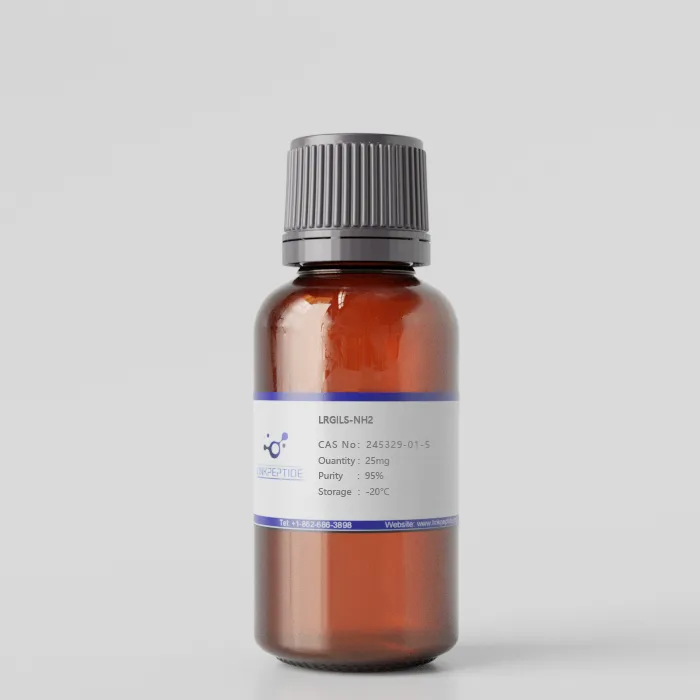
Product Name:LRGILS-NH2
CAS No:245329-01-5
Purity:95%
Molar Mass:656.83
Chemical Formula:C29H56N10O7
Storage:Store at -20 degrees Celsius
Sequence:LRGILS
Target:PAR2
Application:
LRGILS-NH2 is a synthetic peptide with the sequence Leu-Arg-Gly-Ile-Leu-Ser, and it features an amidated C-terminus (NH2). This peptide is used in research to explore its role in biological processes such as peptide-receptor interactions and cellular signaling pathways. The amidation at the C-terminus enhances the peptide's stability and binding affinity, making it useful in studying the specific functions of the peptide in various experimental contexts. LRGILS-NH2 may serve as a ligand or tool for understanding mechanisms related to its receptor interactions and potential physiological effects.
Current Research:
LRGILS-NH₂ is a synthetic hexapeptide (Leu-Arg-Gly-Ile-Leu-Ser-NH₂) designed as a reversed-sequence control for SLIGRL-NH₂, a potent agonist of protease-activated receptor 2 (PAR₂). Due to its inert nature regarding PAR₂ activation, LRGILS-NH₂ is widely used as a negative control in receptor pharmacology research to ensure experimental specificity and reliability.
Biological Properties
LRGILS-NH₂ does not activate PAR₂ or induce downstream signaling pathways, such as calcium mobilization or ERK phosphorylation, which are hallmarks of PAR₂ activation. This inactivity is crucial in confirming that the biological effects observed with SLIGRL-NH₂ are specific to PAR₂ stimulation rather than nonspecific peptide activity. By serving as a baseline in experimental setups, LRGILS-NH₂ enables researchers to differentiate between receptor-mediated responses and unrelated effects.
Applications in Research
The peptide has found extensive use in the following areas:
Validation of PAR₂ Signaling: LRGILS-NH₂ is employed in studies investigating PAR₂'s role in inflammation, pain modulation, and vascular regulation. Its inclusion ensures that observed effects are specifically attributable to PAR₂ activation.
Therapeutic Development: By acting as a control, LRGILS-NH₂ aids in the evaluation of PAR₂-targeted drugs, supporting the development of anti-inflammatory and analgesic therapies.
Mechanistic Studies: Researchers use the peptide to delineate PAR₂-related pathways, identifying downstream effectors and cross-talk with other signaling systems.
Current Advances
Recent studies have highlighted PAR₂’s involvement in diverse pathologies, including asthma, arthritis, and cancer progression. Using LRGILS-NH₂ as a control has been critical in validating these findings, ensuring specificity in experiments exploring PAR₂ as a therapeutic target.
Conclusion
LRGILS-NH₂ is an indispensable tool for investigating PAR₂-related biological processes. By providing a robust control for receptor-specific studies, it supports the development of targeted interventions for inflammatory and pain-related disorders. Its use enhances the accuracy and reproducibility of research outcomes, driving progress in receptor pharmacology.
Reference:
Get a Quote
 LinkPeptide