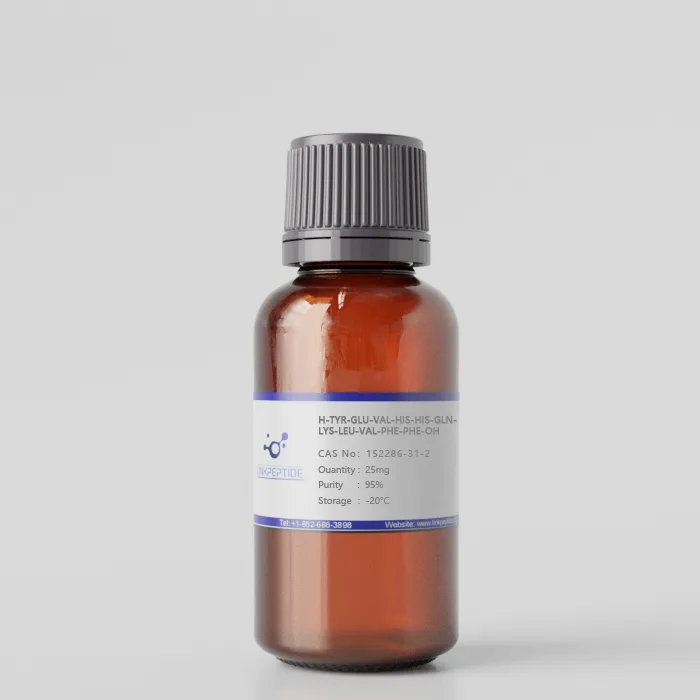
Product Name:H-TYR-GLU-VAL-HIS-HIS-GLN-LYS-LEU-VAL-PHE-PHE-OH
Synonyms:L-Tyrosyl-L-α-glutamyl-L-valyl-L-histidyl-L-histidyl-L-glutaminyl-L-lysyl-L-leucyl-L-valyl-L-phenylalanyl-L-phenylalanine (ACI)
CAS No:152286-31-2
Purity:95%
Molar Mass:1446.65
Chemical Formula:C71H99N17O16
Storage:Room temperature
Sequence:YEVHHQKLVFF
Application:
H-TYR-GLU-VAL-HIS-HIS-GLN-LYS-LEU-VAL-PHE-PHE-OH is a synthetic peptide sequence commonly used in research involving protein interactions, receptor binding, and signal transduction. This sequence, which includes amino acids such as tyrosine (TYR), glutamic acid (GLU), valine (VAL), histidine (HIS), glutamine (GLN), lysine (LYS), leucine (LEU), and phenylalanine (PHE), is designed to mimic specific protein domains or motifs involved in biological processes. The presence of aromatic residues like tyrosine and phenylalanine suggests its potential role in studies related to protein folding, receptor-ligand interactions, or enzyme activity. The free hydroxyl group (-OH) at the C-terminus ensures the peptide retains its functional integrity in biochemical assays. This peptide is ideal for exploring the dynamics of protein-protein interactions and the mechanisms underlying various cellular functions.
Current Research:
The peptide sequence H-Tyr-Glu-Val-His-His-Gln-Lys-Leu-Val-Phe-Phe-OH corresponds to a specific segment of the thymosin beta-4 (Tβ4) protein, a 43-amino acid peptide encoded by the TMSB4X gene in humans. Tβ4 is ubiquitously expressed across various tissues and plays a pivotal role in numerous physiological processes, including actin sequestration, cell migration, angiogenesis, and wound healing.
The primary function of Tβ4 involves binding to monomeric G-actin, thereby preventing its polymerization into F-actin. This actin-sequestering activity is crucial for maintaining cellular cytoskeletal dynamics, which are essential for processes such as cell motility and division. Additionally, Tβ4 has been implicated in promoting endothelial cell migration and angiogenesis, facilitating tissue regeneration and repair.
Clinically, Tβ4 has garnered interest for its potential therapeutic applications. Studies have demonstrated its efficacy in accelerating wound healing, reducing inflammation, and modulating immune responses. Notably, Tβ4 has been evaluated in clinical trials for conditions like pressure ulcers, venous ulcers, and epidermolysis bullosa, where it was found to enhance the rate of repair and was well-tolerated by patients.
In the context of sports, Tβ4 has been classified as a performance-enhancing substance and is prohibited by the World Anti-Doping Agency due to its role in aiding soft tissue recovery and enabling higher training loads. Its misuse has been central to doping controversies, underscoring the importance of regulatory oversight in its application.
The peptide sequence H-Tyr-Glu-Val-His-His-Gln-Lys-Leu-Val-Phe-Phe-OH represents a specific fragment of Tβ4, which may retain certain biological activities inherent to the full-length protein. Understanding the structure-function relationship of such peptide fragments is essential for developing targeted therapeutic strategies and elucidating the molecular mechanisms underlying Tβ4's diverse biological functions.
Reference:
Get a Quote
 LinkPeptide