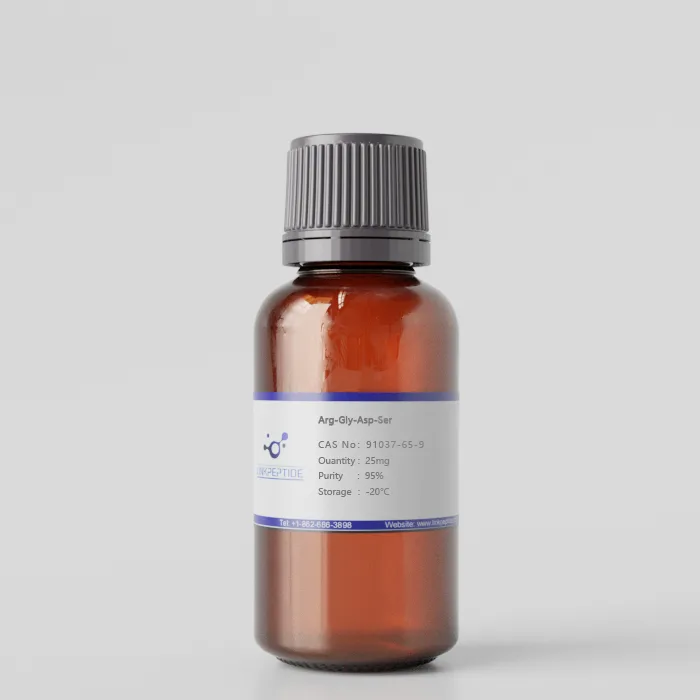
Product Name:Arg-Gly-Asp-Ser
Synonyms:RGDS peptide
CAS No:91037-65-9
Purity:95%
Molar Mass:433.42
Chemical Formula:C15H27N7O8
Storage:Store at -20 degrees Celsius
Sequence:RGDS
Target:integrin receptor
Application:
Arg-Gly-Asp-Ser (RGDS) is a short peptide sequence that plays a crucial role in cell adhesion and signaling processes. This peptide sequence, derived from the extracellular matrix protein fibronectin, is recognized by integrins, particularly those on the cell surface, facilitating cell attachment, migration, and communication. RGDS is widely used in research to study cell-matrix interactions, tissue engineering, and the development of biomaterials. By mimicking the natural binding sites of integrins, this peptide is valuable in investigating the mechanisms of cell adhesion, wound healing, and cancer metastasis, offering insights into therapeutic strategies for various diseases.
Current Research:
The tetrapeptide Arg-Gly-Asp-Ser (RGDS), with CAS number 91037-65-9, is a synthetic sequence that mimics the cell attachment site of fibronectin, a key extracellular matrix protein. This peptide is widely recognized for its ability to interact with integrin receptors, particularly those containing the αvβ3 and αIIbβ3 subunits, thereby influencing various cellular processes such as adhesion, migration, and signaling.
Mechanism of Action
RGDS functions by binding to integrin receptors on the cell surface, effectively inhibiting the interaction between integrins and their natural ligands like fibronectin. This inhibition disrupts integrin-mediated signaling pathways, which are crucial for cell adhesion and migration. Notably, RGDS has been shown to directly and specifically bind to pro-caspase-8, pro-caspase-9, and pro-caspase-3, but not to pro-caspase-1, indicating its selective interaction with certain apoptotic pathways.
Applications in Research and Medicine
Due to its integrin-binding properties, RGDS is extensively utilized in biomedical research to study cell-extracellular matrix interactions and integrin-related signaling mechanisms. It serves as a valuable tool in investigating processes such as angiogenesis, wound healing, and tumor metastasis. Additionally, RGDS-modified surfaces have been employed to enhance cell adhesion in tissue engineering applications.
In therapeutic contexts, RGDS peptides are explored for their potential to inhibit tumor growth and metastasis by blocking integrin functions essential for cancer cell migration and invasion. Moreover, RGDS-conjugated nanoparticles have been developed for targeted drug delivery, aiming to improve the specificity and efficacy of anticancer treatments.
In summary, RGDS is a pivotal peptide in the study of integrin-mediated cellular functions and holds significant promise in the development of targeted therapeutic strategies, particularly in oncology and regenerative medicine.
Reference:
Get a Quote
 LinkPeptide