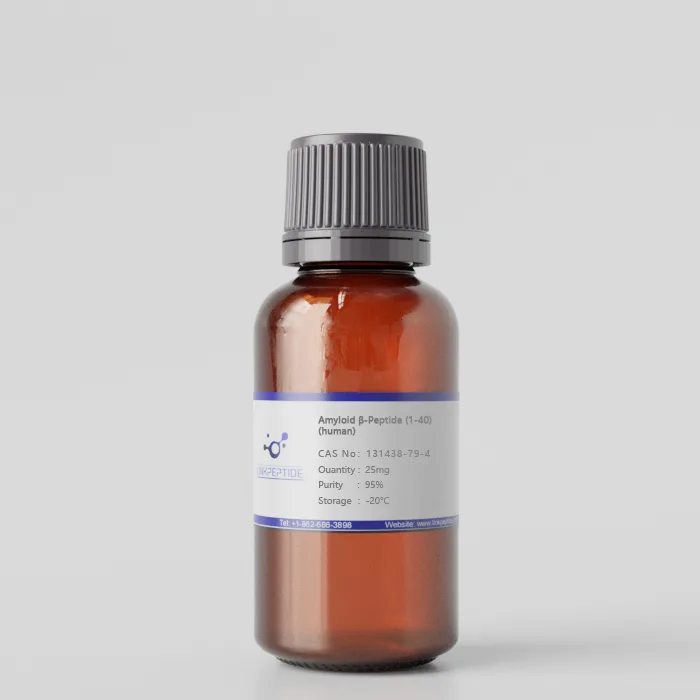
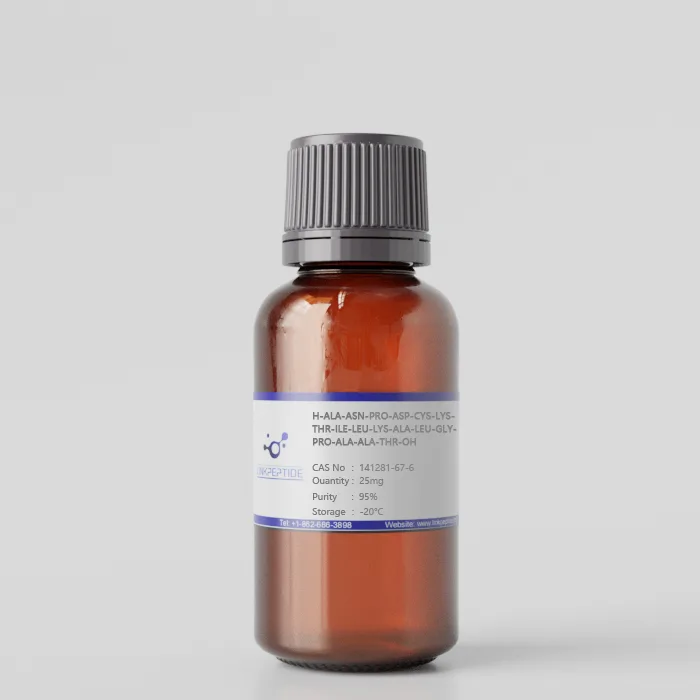
Product Name:Amyloid β-Peptide (1-40) (human)
CAS No:131438-79-4
Purity:95%
Molar Mass:4330
Chemical Formula:C194H295N53O58S
Storage:Store at -20 degrees Celsius
Sequence:DAEFRHDSGYEVHHQKLVFFAEDVGSNKGAIIGLMVGGVV
Application:
Amyloid β-Peptide (1-40) (human) is a 40-amino acid peptide fragment derived from the amyloid precursor protein (APP). It is one of the primary forms of amyloid-beta peptides found in the brain, associated with the formation of amyloid plaques, a hallmark of Alzheimer's disease. This peptide is crucial in the study of neurodegenerative diseases, as its aggregation is believed to play a significant role in the pathogenesis of Alzheimer's disease and other amyloid-related disorders. Researchers use Amyloid β-Peptide (1-40) to investigate the mechanisms of amyloid plaque formation, neurotoxicity, and potential therapeutic strategies to prevent or reduce amyloid aggregation.
Current Research:
Amyloid β-Peptide (1-40) is a 40-amino acid fragment derived from the cleavage of the amyloid precursor protein (APP) by β- and γ-secretases. This peptide is a major component of amyloid plaques, which are a hallmark of Alzheimer's disease (AD) pathology. The sequence of Amyloid β-Peptide (1-40) is:
DAEFRHDSGYEVHHQKLVFFAEDVGSNKGAIIGLMVGGVV
Key Features
Aggregation and Plaque Formation:
Amyloid β-Peptide (1-40) has a high propensity to self-aggregate into oligomers, fibrils, and plaques. While the longer variant, Aβ(1-42), is more aggregation-prone and toxic, Aβ(1-40) is the predominant form in vivo and is critical for understanding the kinetics and mechanisms of amyloid aggregation.
Neurotoxicity:
Aβ(1-40) oligomers are known to disrupt cellular processes, induce oxidative stress, and impair synaptic function, contributing to neuronal dysfunction and cognitive decline observed in Alzheimer's disease.
Solubility and Stability:
Aβ(1-40) is relatively more soluble than Aβ(1-42), making it suitable for biophysical and biochemical studies to explore amyloid formation and therapeutic interventions.
Research Applications
Alzheimer's Disease Pathology:
Used in in vitro and in vivo studies to model plaque formation and neurotoxicity.
Provides insights into the role of amyloid aggregates in the progression of neurodegeneration.
Therapeutic Screening:
Serves as a target in drug discovery, focusing on inhibitors of aggregation, amyloid clearance, and receptor interactions.
Facilitates the development of anti-amyloid therapies, including small molecules, antibodies, and vaccines.
Structural Studies:
Extensively used in X-ray crystallography, NMR, and cryo-EM studies to elucidate the structure of amyloid fibrils and intermediates.
Biomarker Development:
Research on Aβ(1-40) levels in cerebrospinal fluid and plasma helps in the early diagnosis and progression monitoring of Alzheimer's disease.
Handling and Storage
Store lyophilized Aβ(1-40) at -20°C in a desiccated environment.
Reconstitute in HFIP or DMSO for aggregation studies or use directly in aqueous buffers for biochemical assays.
Conclusion
Amyloid β-Peptide (1-40) is an indispensable tool in Alzheimer's disease research, aiding in understanding the mechanisms of amyloid pathology and advancing the development of diagnostic and therapeutic strategies. Its role in aggregation and toxicity studies continues to make it a cornerstone of neurodegenerative disease research.
Reference:
Get a Quote
 LinkPeptide