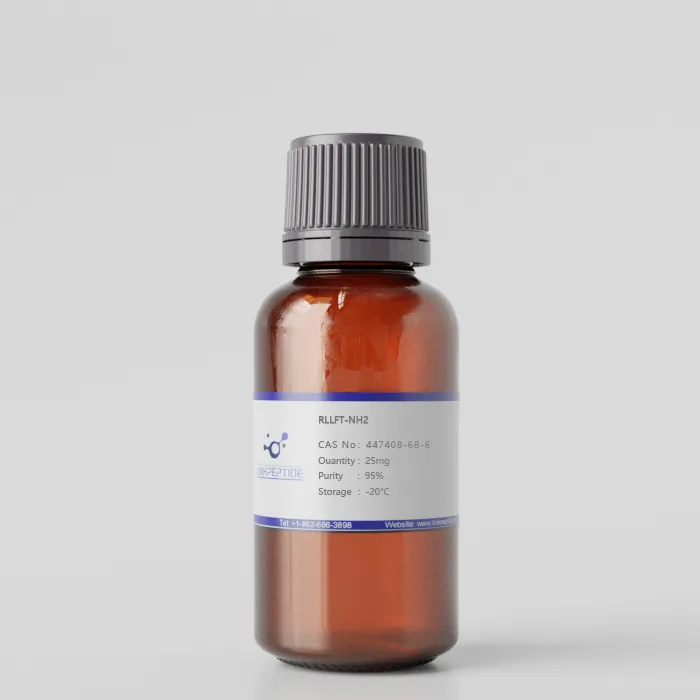
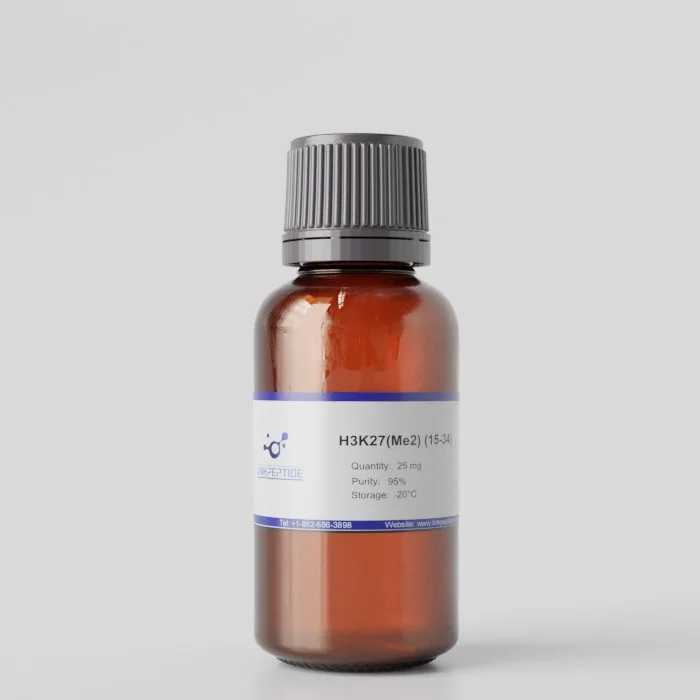
Product Name:RLLFT-NH2
CAS No:447408-68-6
Purity:95%
Molar Mass:647.82
Chemical Formula:C31H53N9O6
Storage:Store at -20 degrees Celsius
Sequence:RLLFT
Target:PAR1
Application:
RLLFT-NH2 is a synthetic peptide with the amino acid sequence Arg-Leu-Leu-Phe-Thr, followed by an amidated C-terminus (NH2). This peptide is often used in research to study its biological activity, particularly in relation to its receptor interactions and potential physiological effects. The amidation at the C-terminus typically improves the peptide’s stability and receptor binding affinity. RLLFT-NH2 may be employed in studies focusing on peptide-receptor interactions, cellular signaling pathways, or as a ligand in biochemical assays to understand its role in various biological processes.
Current Research:
RLLFT-NH₂ is a synthetic pentapeptide (Arg-Leu-Leu-Phe-Thr-NH₂) commonly used as a reversed-sequence control for TFLLR-NH₂, a well-known agonist of protease-activated receptor 1 (PAR₁). With its inert nature, RLLFT-NH₂ plays a critical role in validating the specificity of PAR₁-mediated biological effects, ensuring experimental reliability in receptor pharmacology research.
Biological Properties
RLLFT-NH₂ does not activate PAR₁ or elicit downstream signaling events associated with this receptor, such as intracellular calcium mobilization or activation of MAPK pathways. This inactivity makes it an ideal negative control to distinguish specific PAR₁-related effects from nonspecific responses in cellular and molecular assays. In studies utilizing TFLLR-NH₂ to probe PAR₁ function, the inclusion of RLLFT-NH₂ provides a baseline for comparison, ensuring that observed effects are receptor-specific.
Applications in Research
The use of RLLFT-NH₂ spans several areas of receptor biology and drug development:
Validation of PAR₁ Activation: RLLFT-NH₂ is integral in experiments exploring PAR₁ signaling, helping to confirm that TFLLR-NH₂-induced effects are specifically mediated by PAR₁.
Receptor Pharmacology: It assists in characterizing the roles of PAR₁ in processes such as coagulation, inflammation, and cancer progression.
Therapeutic Development: As a control peptide, RLLFT-NH₂ supports the evaluation of novel PAR₁-targeted therapeutics by ensuring specificity in drug-receptor interactions.
Significance in PAR₁ Research
Protease-activated receptor 1 (PAR₁) is a G protein-coupled receptor activated by thrombin, with critical roles in hemostasis, vascular biology, and inflammatory responses. Dysregulated PAR₁ activity has been implicated in conditions such as thrombosis, sepsis, and cancer metastasis. RLLFT-NH₂ facilitates accurate investigations into these pathways by serving as a robust control.
Conclusion
RLLFT-NH₂ is indispensable in PAR₁-focused research, providing critical validation for receptor-specific findings. Its use ensures experimental accuracy, advancing our understanding of PAR₁ biology and its therapeutic potential in managing complex diseases.
Reference:
Get a Quote
 LinkPeptide