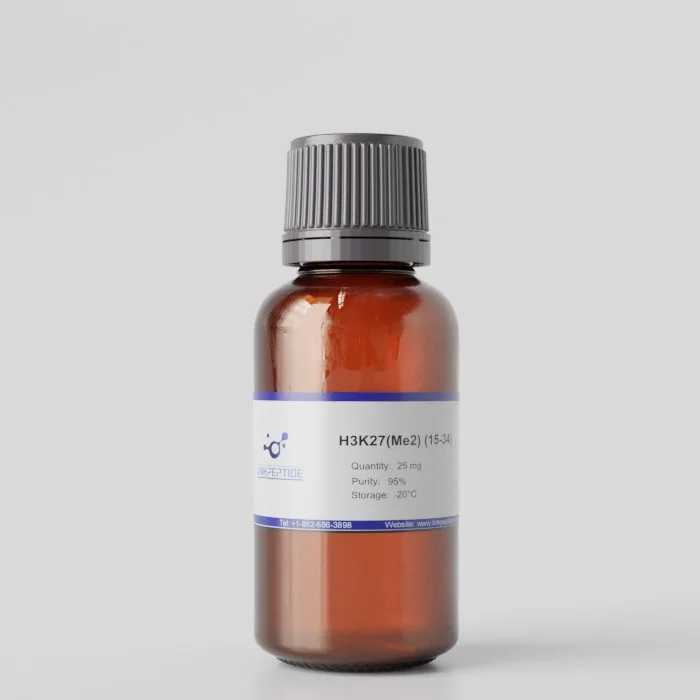
Product Name: H3K27(Me2) (15-34)
Purity: 95%
Molar Mass: 2008.3
Chemical Formula: C86H154N30O25
Storage: Store at -20??
Sequence: APRKQLATKAARKSAPATGG
Application:
H3K27(Me2) (15-34) is a synthetic peptide corresponding to amino acids 15-34 of histone H3, dimethylated at the lysine 27 (K27) residue. This specific post-translational modification is critical in the regulation of gene expression by promoting the formation of repressive chromatin structures. Dimethylation of H3K27 is facilitated by the Polycomb Repressive Complex 2 (PRC2) and is integral to maintaining gene silencing during development and differentiation. It is also implicated in the progression of various cancers. The H3K27(Me2) (15-34) peptide serves as an essential tool in epigenetic research, aiding in the study of chromatin dynamics, gene regulation, and the exploration of targeted epigenetic therapies.
Current Research:
H3K27(Me2) (15-34) is a synthetic peptide encompassing amino acids 15 to 34 of histone H3, with dimethylation at lysine 27 (K27). This specific post-translational modification is associated with transcriptional repression and plays a crucial role in the regulation of gene expression. Role of H3K27 Dimethylation in Gene Regulation The dimethylation of H3K27 is catalyzed by the Polycomb Repressive Complex 2 (PRC2), a multiprotein complex that facilitates the addition of methyl groups to lysine residues on histone tails. This modification serves as a repressive chromatin mark, leading to the condensation of chromatin structure and subsequent gene silencing. H3K27me2 is frequently found in heterochromatin regions and is linked with the suppression of gene activity. Applications of H3K27(Me2) (15-34) in Research The H3K27(Me2) (15-34) peptide is utilized as a substrate in studies investigating the activity of histone methyltransferases and demethylases. By providing a defined sequence with a specific methylation state, researchers can examine how these enzymes interact with methylated histone tails, thereby enhancing our understanding of epigenetic regulation mechanisms. Implications in Disease and Therapeutics Aberrant methylation at H3K27 is implicated in various diseases, including cancer. Overexpression of PRC2 components can lead to excessive H3K27 methylation, resulting in the silencing of tumor suppressor genes. Conversely, loss of H3K27 methylation due to mutations in demethylases can activate oncogenes. Consequently, targeting the enzymes that modulate H3K27 methylation is being explored as a therapeutic strategy in oncology. Conclusion The H3K27(Me2) (15-34) peptide serves as a valuable tool in epigenetic research, facilitating the study of histone modifications and their impact on gene expression. Understanding the dynamics of H3K27 dimethylation is essential for developing novel therapeutic approaches for diseases associated with epigenetic dysregulation.
Get a Quote
 LinkPeptide