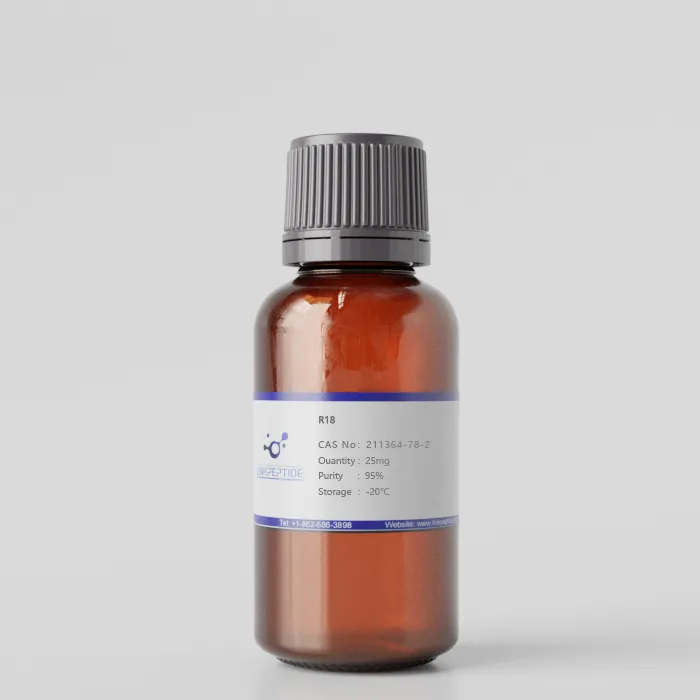
Product Name:R18
CAS No:211364-78-2
Purity:95%
Molar Mass:2309.69
Chemical Formula:C101H157N27O29S3
Storage:Store at -20 degrees Celsius
Sequence:PHCVPRDLSWLDLEANMCLP
Target:antagonists of 14-3-3
Application:
R18 is a synthetic peptide that acts as a potent inhibitor of the protein kinase C (PKC) family of enzymes. PKC is involved in various cellular processes, including cell proliferation, differentiation, and apoptosis. R18 specifically interacts with the regulatory domain of PKC, preventing its activation and subsequent signaling. This peptide is widely used in research to study the role of PKC in various physiological and pathological conditions, such as cancer, cardiovascular diseases, and neurological disorders. By inhibiting PKC activity, R18 helps researchers understand the implications of PKC signaling in disease progression and evaluate potential therapeutic strategies targeting this pathway.
Current Research:
R18 (CAS: 211364-78-2) is a synthetic peptide antagonist of 14-3-3 proteins, exhibiting a dissociation constant (KD) of approximately 70-90 nM. By competitively inhibiting the interaction between 14-3-3 proteins and their client proteins, R18 disrupts various cellular signaling pathways. Notably, it effectively blocks the binding of 14-3-3 to the kinase Raf-1, a physiological ligand, and abolishes the protective role of 14-3-3 against phosphatase-induced inactivation of Raf-1. Mechanism of Action 14-3-3 proteins are regulatory molecules that interact with numerous signaling proteins, influencing processes such as apoptosis, cell division, migration, stress responses, and malignant transformation. R18 binds to the general binding groove of 14-3-3 proteins, preventing their association with most or all client proteins. Research Applications Due to its ability to modulate 14-3-3 interactions, R18 is utilized in research to: Investigate the role of 14-3-3 proteins in cellular signaling pathways. Study the regulation of apoptosis and cell cycle progression. Explore therapeutic targets for diseases involving aberrant 14-3-3 activity. Handling and Storage R18 is typically supplied as a trifluoroacetate salt and should be stored at -20 degrees Celsius to maintain stability. It is soluble in water, facilitating its use in various experimental setups. Conclusion As a potent antagonist of 14-3-3 proteins, R18 serves as a valuable tool for dissecting the roles of these proteins in cellular processes and holds potential for developing therapeutic strategies targeting 14-3-3-mediated pathways.
Reference:
Get a Quote
 LinkPeptide