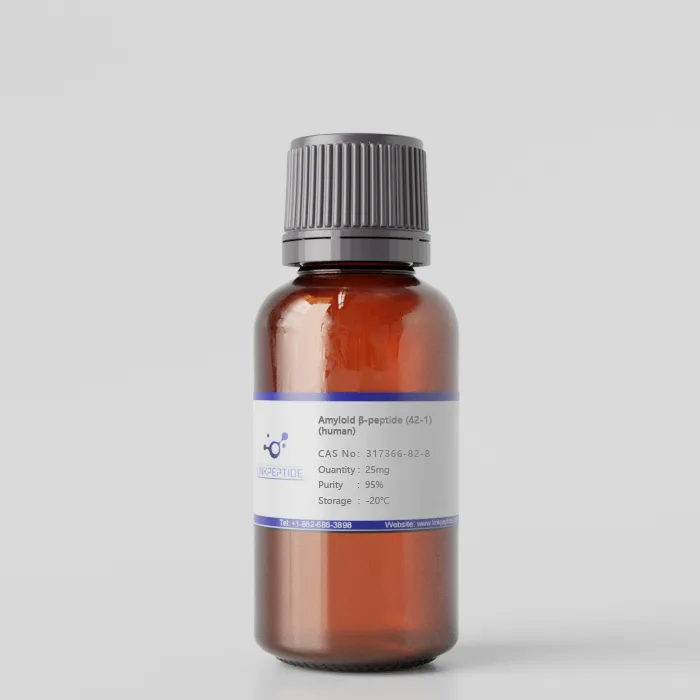
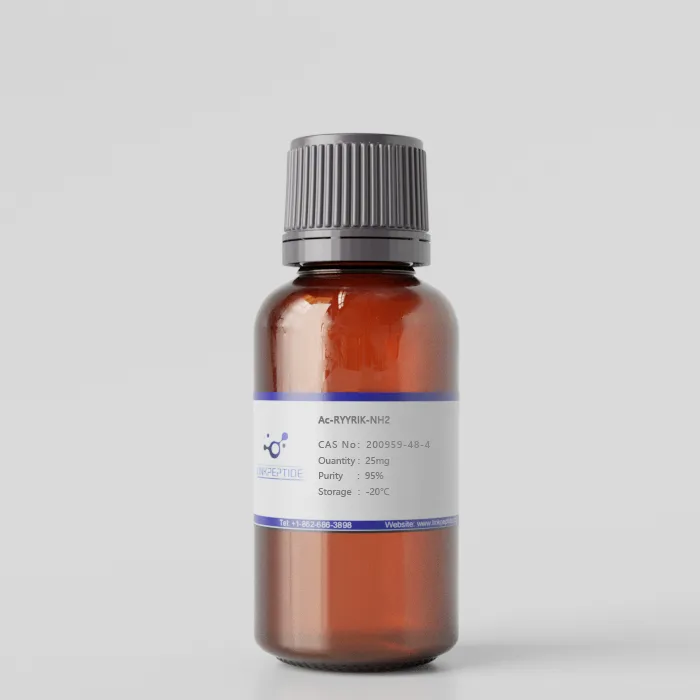
Product Name:Amyloid β-peptide (42-1) (human)
CAS No:317366-82-8
Purity:95%
Molar Mass:4514.08
Chemical Formula:C203H311N55O60S
Storage:Store at -20 degrees Celsius
Sequence:DAEFRHDSGYEVHHQKLVFFAEDVGSNKGAIIGLMVGGVVIA
Application:
Amyloid β-peptide (42-1), also known as Aβ(42), is a key fragment of the amyloid precursor protein (APP) and consists of 42 amino acids. This peptide is implicated in Alzheimer's disease (AD) due to its propensity to aggregate into neurotoxic plaques in the brain. Aβ(42) is considered more aggregation-prone and toxic than the shorter Aβ(40) variant. Research into Aβ(42) focuses on its role in the pathogenesis of AD, including its effects on neuronal health, synaptic function, and cognitive decline. It is widely used in studies investigating the mechanisms of Alzheimer's disease and potential therapeutic interventions.
Current Research:
Amyloid β-peptide (42-1) (human) is a synthetic peptide sequence that is the reverse of the naturally occurring Amyloid β-peptide (1-42). This reversed sequence is often used as an inactive control in research studies to assess the specificity of experimental conditions involving the native peptide.
Preparation and Handling
To prepare Amyloid β (42-1) for experimental use, it is recommended to dissolve the peptide at a concentration of 1 mg/mL in 100% hexafluoro-2-propanol (HFIP). This solution should be incubated at room temperature for one hour with occasional vortexing to ensure proper dissolution. Following incubation, the solution should be sonicated for 10 minutes in a water bath sonicator to further aid in solubilization. After these steps, the HFIP can be evaporated under a gentle stream of nitrogen gas, and the peptide can be re-suspended in 100% dimethyl sulfoxide (DMSO) for subsequent use.
Applications in Research
The reversed sequence of Amyloid β (42-1) serves as an inactive control in studies investigating the aggregation and neurotoxic properties of the native Amyloid β (1-42) peptide. By employing this control, researchers can differentiate between specific effects attributed to the native peptide and non-specific interactions that may occur during experiments.
Storage Conditions
For optimal stability, Amyloid β (42-1) should be stored desiccated at -20°C. Under these conditions, the peptide remains stable for up to 12 months.
Conclusion
Amyloid β-peptide (42-1) (human) is a valuable tool in Alzheimer's disease research, providing a means to control for non-specific effects in studies focused on the pathogenic role of Amyloid β (1-42). Proper preparation and handling of this peptide are crucial to ensure the reliability and reproducibility of experimental results.
Reference:
Get a Quote
 LinkPeptide