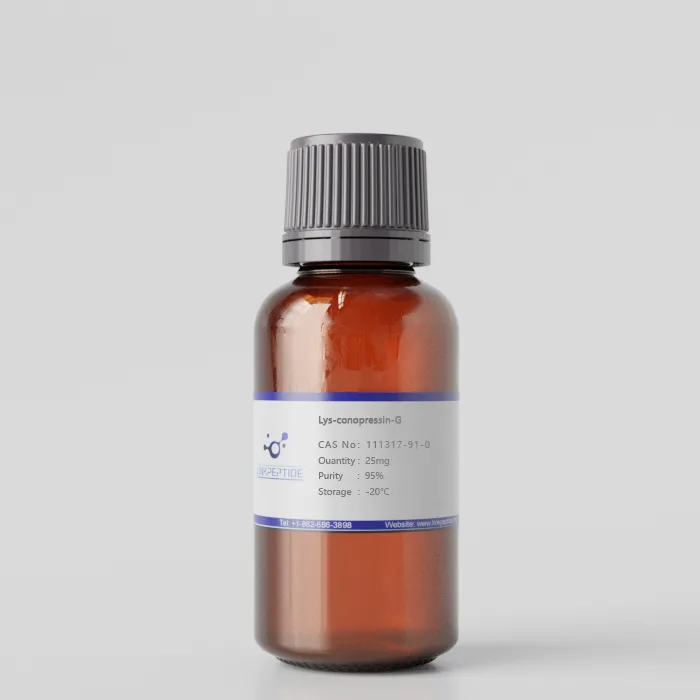
Product Name:Lys-conopressin-G
CAS No:111317-91-0
Purity:95%
Molar Mass:1034.26
Chemical Formula:C44H71N15O10S2
Storage:Store at -20 degrees Celsius
Sequence:CFIRNCPKG-NH2
Application:Lys-conopressin-G is a synthetic analog of the conopressin peptide, which is naturally found in the venom of marine cone snails. This peptide exhibits structural similarity to vasopressin and oxytocin, important neuropeptides in mammals. Lys-conopressin-G is commonly used in research to study neurophysiological and cardiovascular effects due to its interaction with vasopressin receptors. Researchers also explore its role in regulating water balance, social behavior, and smooth muscle contraction. Its unique structure and bioactivity make it an essential tool for understanding peptide-based signaling pathways in both invertebrates and vertebrates.
Current Research:
Lys-conopressin-G is a nonapeptide toxin derived from the venom of the marine cone snail Conus imperialis, known for its unique paralytic effects on prey. This peptide belongs to the conopressin family, analogous to neurohypophysial hormones such as oxytocin and vasopressin in vertebrates. The peptide sequence is Cys-Phe-Ile-Arg-Asn-Cys-Pro-Lys-Gly-NH?, with a disulfide bond between the first and sixth cysteine residues forming a cyclic structure. This conformation is essential for its receptor-binding affinity and biological activity.
Lys-conopressin-G exhibits vasotocin-like activity, influencing smooth muscle contraction, water balance, and other physiological functions. In invertebrates, it is believed to play a critical role in processes analogous to those regulated by oxytocin and vasopressin in vertebrates, such as reproduction, osmoregulation, and social behaviors. It specifically binds to receptors in target tissues, triggering intracellular signaling cascades that modulate these processes.
Research on Lys-conopressin-G provides critical insights into the evolution and conservation of neuropeptide signaling across species. Its structural similarity to vertebrate neuropeptides makes it a powerful model for studying receptor-ligand interactions and the evolutionary dynamics of peptide hormones. Furthermore, the peptide's pharmacological properties open avenues for drug development, particularly for disorders related to water balance, stress regulation, or social behaviors.
The peptide also serves as a tool for comparative endocrinology, helping researchers explore how structural differences influence hormone-receptor interactions across species. With increasing interest in neuropeptide analogs, Lys-conopressin-G holds potential for therapeutic applications by inspiring synthetic analogs that mimic its effects.
In conclusion, Lys-conopressin-G is a significant peptide for understanding neuropeptide function in invertebrates and vertebrates alike. Its unique properties offer valuable insights into the mechanisms underlying hormone-driven behaviors and physiological processes, paving the way for innovative approaches in neuropharmacology and endocrinology.
Reference:
Get a Quote
 LinkPeptide