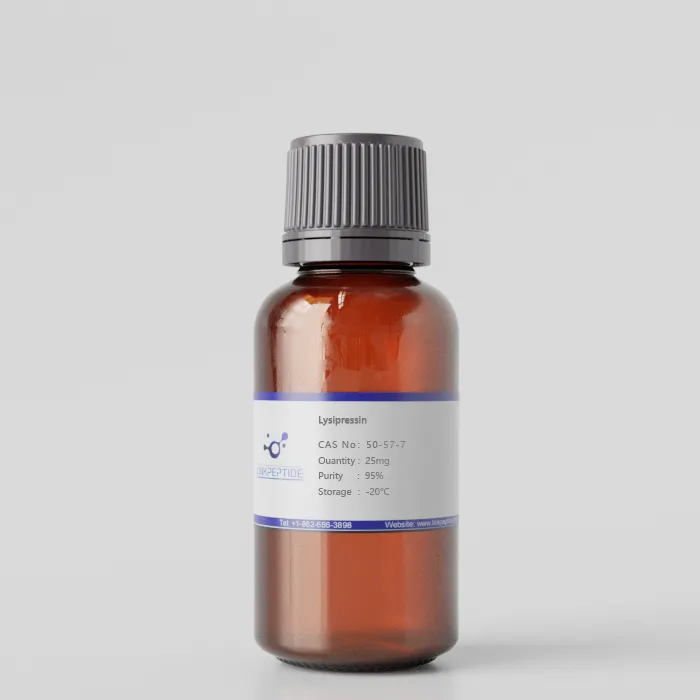
Product Name:Lysipressin
Form:Acetate salt
Purity:95%
Storage:-20oC
Cas No:50-57-7
Molar Mass:1056.2
Chemical Formula:C46H65N13O12S2
Synonyms:Lysine vasopressin; Syntopressin
IUPAC Name:(2S)-N-[(2S)-6-amino-1-[(2-amino-2-oxoethyl)amino]-1-oxohexan-2-yl]-1-[(4R,7S,10S,13S,16S,19R)-19-amino-7-(2-amino-2-oxoethyl)-10-(3-amino-3-oxopropyl)-13-benzyl-16-[(4-hydroxyphenyl)methyl]-6,9,12,15,18-pentaoxo-1,2-dithia-5,8,11,14,17-pentazacycloicosane-4-carbonyl]pyrrolidine-2-carboxamide
SMILES:C1C[C@H](N(C1)C(=O)[C@@H]2CSSC[C@@H](C(=O)N[C@H](C(=O)N[C@H](C(=O)N[C@H](C(=O)N[C@H](C(=O)N2)CC(=O)N)CCC(=O)N)CC3=CC=CC=C3)CC4=CC=C(C=C4)O)N)C(=O)N[C@@H](CCCCN)C(=O)NCC(=O)N
InChIKey:BJFIDCADFRDPIO-DZCXQCEKSA-N
InChI:InChI=1S/C46H65N13O12S2/c47-17-5-4-9-29(40(65)52-22-38(51)63)54-45(70)35-10-6-18-59(35)46(71)34-24-73-72-23-28(48)39(64)55-31(20-26-11-13-27(60)14-12-26)43(68)56-32(19-25-7-2-1-3-8-25)42(67)53-30(15-16-36(49)61)41(66)57-33(21-37(50)62)44(69)58-34/h1-3,7-8,11-14,28-35,60H,4-6,9-10,15-24,47-48H2,(H2,49,61)(H2,50,62)(H2,51,63)(H,52,65)(H,53,67)(H,54,70)(H,55,64)(H,56,68)(H,57,66)(H,58,69)/t28-,29-,30-,31-,32-,33-,34-,35-/m0/s1
Sequence:CYFQNCPKG
Application:Lysipressin is a synthetic analog of vasopressin, primarily acting on V1 receptors to induce potent vasoconstriction. It is used for managing vasodilatory shock, gastrointestinal bleeding, and diabetes insipidus. By promoting vascular smooth muscle contraction, Lysipressin helps increase blood pressure and reduce portal hypertension, making it beneficial in esophageal variceal bleeding. Unlike vasopressin, it has a shorter duration of action, allowing for controlled therapeutic effects. Current research explores its role in septic shock, hepatorenal syndrome, and kidney protection, offering potential advantages over traditional vasopressors in critical care and emergency medicine.
Current Research:Lysipressin is a synthetic vasopressin analog with selective vasoconstrictive properties, making it a critical agent in circulatory shock, variceal hemorrhage, and renal function regulation. It primarily acts on vasopressin V1 receptors, leading to systemic vasoconstriction while preserving some renal and cardiovascular effects. Recent studies are evaluating its role in shock management, gastrointestinal disorders, and kidney protection. Vasodilatory Shock and Hemodynamic Support Lysipressin is being investigated as a vasopressor alternative in cases of septic shock and catecholamine-resistant hypotension. V1 receptor-mediated vasoconstriction: Unlike catecholamines (e.g., norepinephrine), Lysipressin acts directly on vascular smooth muscle, making it useful in patients with septic shock, neurogenic shock, or anaphylaxis. Catecholamine-sparing effects: Research suggests that Lysipressin can be used in combination with norepinephrine or dopamine to enhance blood pressure stabilization while reducing tachycardia and arrhythmic risks. Potential in cardiac surgery and organ transplantation: Some studies explore Lysipressin??s role in maintaining vascular tone and perfusion during cardiopulmonary bypass or post-transplant recovery. Gastrointestinal Bleeding and Portal Hypertension Lysipressin has demonstrated effectiveness in treating bleeding from esophageal varices, commonly associated with liver cirrhosis and portal hypertension. Splanchnic vasoconstriction: By constricting mesenteric arteries, Lysipressin reduces portal blood flow, helping control acute variceal hemorrhage. Adjunct to endoscopic therapies: Studies suggest that combining Lysipressin with endoscopic band ligation (EBL) or sclerotherapy improves hemorrhage management. Comparison with Terlipressin and Vasopressin: Current trials compare Lysipressin??s efficacy and safety against terlipressin, a longer-acting vasopressin analog, in managing cirrhotic complications. Renal Function and Hepatorenal Syndrome (HRS) Lysipressin is being explored for its renal-protective properties, particularly in hepatorenal syndrome (HRS) and acute kidney injury (AKI). Preserving renal perfusion: While vasopressors typically constrict renal vessels, Lysipressin selectively redirects blood flow to maintain kidney function. Therapeutic alternative in hepatorenal syndrome: Some clinical trials are evaluating Lysipressin as a therapy for HRS, particularly in cirrhotic patients with renal dysfunction and fluid retention. Potential in perioperative kidney protection: Research is assessing whether Lysipressin can help maintain renal function in high-risk surgical patients, including those undergoing liver transplantation and cardiac surgery. Emerging Research Areas Sepsis and inflammatory modulation: Given its effects on vascular tone and endothelial function, Lysipressin is being studied in sepsis-associated circulatory dysfunction. Pulmonary hypertension: Some preclinical models suggest Lysipressin may reduce pulmonary vascular resistance, making it a candidate for pulmonary hypertension treatment. Neurocritical care applications: Its role in traumatic brain injury (TBI) and cerebral autoregulation is an area of interest in neurovascular research. With continued research, Lysipressin is emerging as a potential alternative to traditional vasopressors, with promising applications in shock management, liver disease, and kidney protection.
Get a Quote
 LinkPeptide