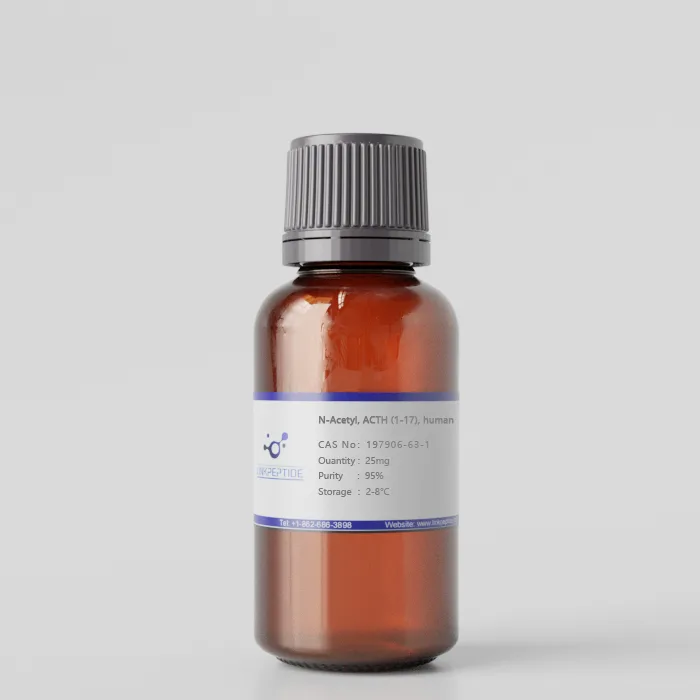
Product Name:N-Acetyl, ACTH (1-17), human
Form:TFA salt
Purity:95%
Storage:2-8 degree Celsius
Cas No:197906-63-1
Molar Mass:2135.5
Chemical Formula:C97H147N29O24S1
IUPAC Name:(4S)-4-[[(2S)-2-[[(2S)-2-[[(2S)-2-[[(2S)-2-acetamido-3-hydroxypropanoyl]amino]-3-(4-hydroxyphenyl)propanoyl]amino]-3-hydroxypropanoyl]amino]-4-methylsulfanylbutanoyl]amino]-5-[[(2S)-1-[[(2S)-1-[[(2S)-1-[[(2S)-1-[[2-[[(2S)-6-amino-1-[(2S)-2-[[(2S)-1-[[2-[[(2S)-6-amino-1-[[(2S)-6-amino-1-[[(1S)-4-carbamimidamido-1-carboxybutyl]amino]-1-oxohexan-2-yl]amino]-1-oxohexan-2-yl]amino]-2-oxoethyl]amino]-3-methyl-1-oxobutan-2-yl]carbamoyl]pyrrolidin-1-yl]-1-oxohexan-2-yl]amino]-2-oxoethyl]amino]-3-(1H-indol-3-yl)-1-oxopropan-2-yl]amino]-5-carbamimidamido-1-oxopentan-2-yl]amino]-1-oxo-3-phenylpropan-2-yl]amino]-3-(1H-imidazol-4-yl)-1-oxopropan-2-yl]amino]-5-oxopentanoic acid
SMILES:CC(C)[C@@H](C(=O)NCC(=O)N[C@@H](CCCCN)C(=O)N[C@@H](CCCCN)C(=O)N[C@@H](CCCNC(=N)N)C(=O)O)NC(=O)[C@@H]1CCCN1C(=O)[C@H](CCCCN)NC(=O)CNC(=O)[C@H](CC2=CNC3=CC=CC=C32)NC(=O)[C@H](CCCNC(=N)N)NC(=O)[C@H](CC4=CC=CC=C4)NC(=O)[C@H](CC5=CNC=N5)NC(=O)[C@H](CCC(=O)O)NC(=O)[C@H](CCSC)NC(=O)[C@H](CO)NC(=O)[C@H](CC6=CC=C(C=C6)O)NC(=O)[C@H](CO)NC(=O)C
InChIKey:SFSKMEKRGBAVMN-CQIJVBBXSA-N
InChI:InChI=1S/C97H147N29O24S/c1-54(2)80(93(147)110-50-77(131)113-63(23-10-13-36-98)82(136)115-64(24-11-14-37-99)83(137)119-69(95(149)150)27-17-40-107-97(103)104)125-92(146)76-28-18-41-126(76)94(148)68(25-12-15-38-100)114-78(132)49-109-81(135)72(45-58-47-108-62-22-9-8-21-61(58)62)122-84(138)65(26-16-39-106-96(101)102)116-87(141)70(43-56-19-6-5-7-20-56)120-89(143)73(46-59-48-105-53-111-59)123-85(139)66(33-34-79(133)134)117-86(140)67(35-42-151-4)118-91(145)75(52-128)124-88(142)71(44-57-29-31-60(130)32-30-57)121-90(144)74(51-127)112-55(3)129/h5-9,19-22,29-32,47-48,53-54,63-76,80,108,127-128,130H,10-18,23-28,33-46,49-52,98-100H2,1-4H3,(H,105,111)(H,109,135)(H,110,147)(H,112,129)(H,113,131)(H,114,132)(H,115,136)(H,116,141)(H,117,140)(H,118,145)(H,119,137)(H,120,143)(H,121,144)(H,122,138)(H,123,139)(H,124,142)(H,125,146)(H,133,134)(H,149,150)(H4,101,102,106)(H4,103,104,107)/t63-,64-,65-,66-,67-,68-,69-,70-,71-,72-,73-,74-,75-,76-,80-/m0/s1
Sequence:Ac-Ser-Tyr-Ser-Met-Glu-His-Phe-Arg-Trp-Gly-Lys-Pro-Val-Gly-Lys-Lys-Arg
Application:N-Acetyl ACTH (1-17), human is a modified fragment of adrenocorticotropic hormone (ACTH) featuring an N-acetylation at the amino terminus. This modification enhances peptide stability and bioavailability, influencing its interaction with melanocortin receptors. The ACTH (1-17) sequence retains significant biological activity related to adrenal steroidogenesis, neuroprotection, and immune modulation. Research indicates that this peptide plays a role in stress response, cognitive function, and inflammatory regulation. It is widely used in endocrinology, neurobiology, and immunology studies to investigate ACTH-related pathways in adrenal function, neurodegenerative diseases, and immune-mediated conditions, offering potential insights into novel therapeutic strategies.
Current Research:
Introduction
Adrenocorticotropic hormone (ACTH) is a key regulator of adrenal gland function, promoting glucocorticoid synthesis via melanocortin receptor activation. Shorter fragments of ACTH, including ACTH (1-17), retain bioactivity and are studied for their roles in neuroendocrine signaling, stress response, and immune modulation. The N-acetylation modification enhances the peptide’s stability and resistance to enzymatic degradation, making N-Acetyl ACTH (1-17), human a valuable tool for research in endocrinology, neuroscience, and immune-related disorders.
Endocrine and Adrenal Function Research
ACTH (1-17) contains the core functional domain necessary for adrenal cortex stimulation, facilitating the production of glucocorticoids such as cortisol. Research on N-Acetyl ACTH (1-17) focuses on its efficiency in activating melanocortin 2 receptors (MC2R) compared to full-length ACTH. Studies suggest that while truncated ACTH peptides may exhibit reduced potency, their stability and selective receptor binding make them useful for investigating adrenal function and related disorders, including adrenal insufficiency, Addison’s disease, and congenital adrenal hyperplasia.
Additionally, ACTH peptides are involved in metabolic regulation. Evidence suggests that melanocortin signaling affects energy balance, glucose metabolism, and lipid homeostasis, implicating ACTH derivatives in obesity and type 2 diabetes research.
Neurobiological and Cognitive Effects
ACTH fragments, including N-Acetyl ACTH (1-17), play an essential role in brain function through interactions with melanocortin receptors. These peptides influence neurotransmitter release, synaptic plasticity, and neuroprotection, leading researchers to investigate their effects on cognitive processes, learning, and memory. Studies suggest that ACTH-derived peptides may enhance cognitive performance and exhibit neuroprotective properties, making them potential candidates for research into Alzheimer’s disease, Parkinson’s disease, and cognitive impairment.
Additionally, ACTH fragments are implicated in stress regulation and mood disorders. The melanocortin system interacts with stress-related neurotransmitter pathways, such as dopamine and serotonin. Research indicates that ACTH derivatives, including N-Acetyl ACTH (1-17), may influence anxiety and depression-like behaviors, supporting their potential role in neuropsychiatric disorder research.
Immunological and Anti-Inflammatory Properties
Melanocortin peptides, including ACTH fragments, regulate immune responses through modulation of inflammatory cytokines and immune cell activity. Studies suggest that N-Acetyl ACTH (1-17) may have anti-inflammatory effects, contributing to research on autoimmune diseases, inflammatory disorders, and immune regulation. By modulating the release of cytokines such as IL-6 and TNF-α, ACTH peptides could play a role in controlling chronic inflammation in conditions like multiple sclerosis, rheumatoid arthritis, and inflammatory bowel disease.
Conclusion
N-Acetyl ACTH (1-17), human is a stable ACTH fragment with significant implications in adrenal function, neurobiology, and immunology research. Its enhanced stability and selective receptor activity make it a valuable tool for studying stress response, cognitive function, metabolic disorders, and immune regulation. Ongoing research continues to explore its potential therapeutic applications in neurodegenerative diseases, endocrine dysfunctions, and inflammatory conditions.
Get a Quote
 LinkPeptide