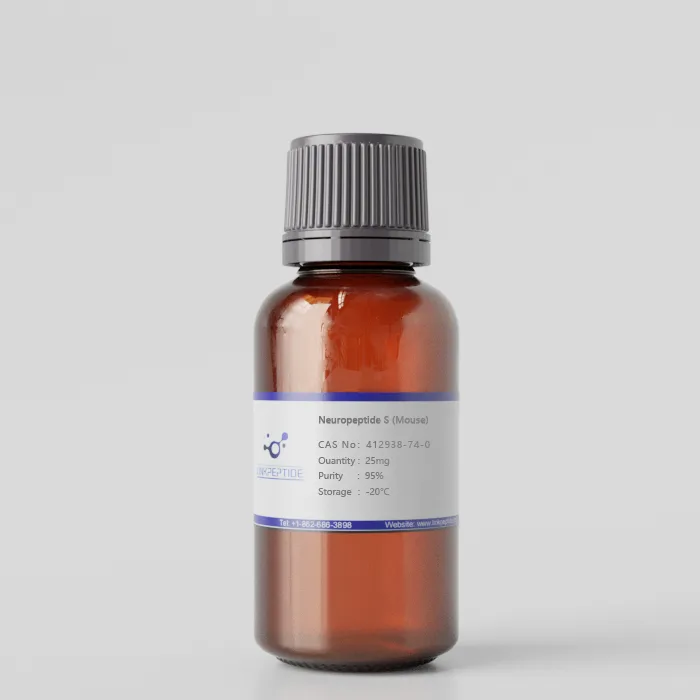
Product Name:Neuropeptide S (Mouse)
CAS No:412938-74-0
Purity:95%
Molar Mass:2182.45
Chemical Formula:C93H156N34O27
Storage:Store at -20 degrees Celsius
Sequence:SFRNGVGSGAKKTSFRRAKQ
Application:Neuropeptide S (Mouse) is a neuropeptide involved in regulating arousal, anxiety, and sleep-wake cycles. It acts through the Neuropeptide S receptor (NPSR), a G-protein-coupled receptor, and has been shown to promote wakefulness, reduce anxiety, and influence stress responses in various animal models. In research, Neuropeptide S (Mouse) is used to study its effects on behavior, particularly in the context of sleep disorders, anxiety, and stress-related conditions. Its ability to modulate these physiological processes makes it a valuable tool for exploring potential therapeutic applications in treating anxiety disorders, sleep disturbances, and neuropsychiatric conditions.
Current Research:
Neuropeptide S (NPS) is a 20-amino-acid peptide that functions as a neurotransmitter and neuromodulator in the central nervous system. In mice, NPS is primarily produced by neurons located between Barrington's nucleus and the locus coeruleus, with projections extending to various brain regions, including the amygdala.
Receptor Interaction
NPS exerts its effects by binding to the Neuropeptide S receptor (NPSR), a G protein-coupled receptor. This binding leads to intracellular calcium mobilization and activation of downstream signaling pathways. Mouse NPS acts as a potent agonist for NPSR, with an EC?? of approximately 3 nM.
Physiological Functions
Activation of NPSR by NPS in mice has been shown to:
Promote Arousal and Wakefulness: NPS increases locomotor activity and induces wakefulness, suggesting a role in regulating sleep-wake cycles.
Reduce Anxiety-Like Behavior: Administration of NPS leads to anxiolytic-like effects, indicating its involvement in modulating anxiety responses.
Influence Memory and Addiction: NPS has been implicated in the modulation of memory consolidation and addictive behaviors, although these effects are subject to ongoing research.
Research Applications
Due to its significant impact on arousal, anxiety, and other behaviors, mouse NPS is widely used in preclinical studies to:
Investigate Sleep Disorders: Explore potential therapeutic targets for conditions like insomnia and narcolepsy.
Develop Anxiolytic Agents: Aid in the creation of new treatments for anxiety disorders.
Study Addiction Mechanisms: Provide insights into the neural pathways involved in substance abuse and dependence.
Conclusion
Neuropeptide S in mice plays a crucial role in regulating various central nervous system functions, particularly those related to arousal and anxiety. Its interaction with NPSR makes it a valuable target for research aimed at understanding and treating neuropsychiatric conditions.
Reference:
Get a Quote
 LinkPeptide

![[Leu31,Pro34]-Neuropeptide Y (human, rat)](https://www.linkpeptide.com/wp-content/uploads/2024/10/Leu31Pro34-Neuropeptide-Y-human-rat-jpg-3.webp "[Leu31,Pro34]-Neuropeptide Y (human, rat)")