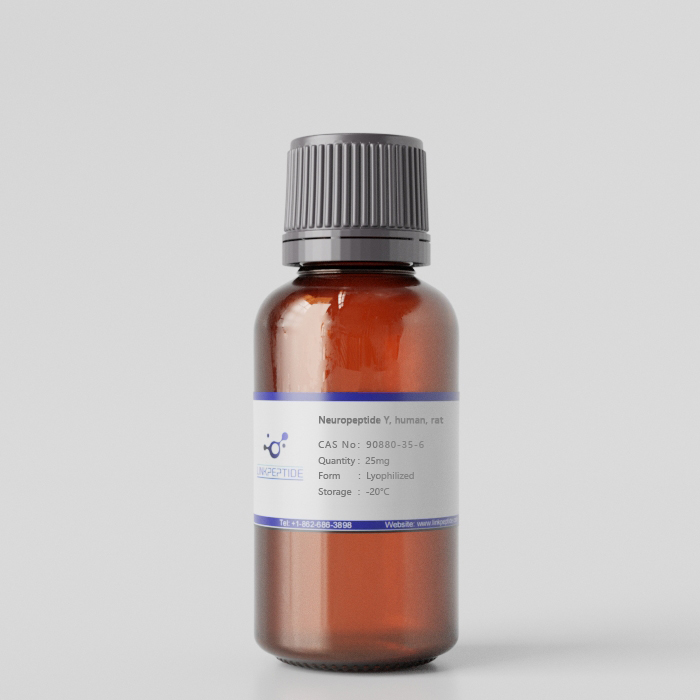
Product Name: Neuropeptide Y, human, rat
Sequence One Letter Code: YPSKPDNPGEDAPAEDMARYYSALRHYINLITRQRY-NH2
Sequence Three Letter Code: H-Tyr-Pro-Ser-Lys-Pro-Asp-Asn-Pro-Gly-Glu-Asp-Ala-Pro-Ala-Glu-Asp-Met-Ala-Arg-Tyr-Tyr-Ser-Ala-Leu-Arg-His-Tyr-Ile-Asn-Leu-Ile-Thr-Arg-Gln-Arg-Tyr-NH2
Cas No: 90880-35-6
Chemical Formula:C189H285N55O57S
Molecular Weight: 4272
Purity: ≥ 95%
Form: Lyophilized
Storage Conditions: - 20 °C
INCHI:
human
Source / Species: Unconjugated
Conjugation: Conjugation Type: NA.26
Code Nacres: Neuropeptide Y is a highly conserved 36-amino-acid neuropeptide widely expressed in the central and peripheral nervous systems. It regulates diverse physiological processes, including food intake, energy homeostasis, fat metabolism, stress responses, pain modulation, vasodilation, and neuroendocrine signaling. NPY acts through multiple G protein-coupled receptors with tissue-specific expression and signaling profiles. This peptide is widely used in neuroscience, metabolic, cardiovascular, and behavioral research to study appetite regulation, stress physiology, neurovascular control, obesity-related mechanisms, receptor pharmacology, and neuropeptide-mediated communication across central and peripheral systems.
Application: Neuropeptide Y, human, rat, is a highly conserved 36-amino-acid neuropeptide involved in feeding behavior, stress response, anxiety regulation, cardiovascular control, endocrine signaling, circadian biology, pain, immune regulation, and metabolism. NPY is one of the most abundant neuropeptides in the mammalian nervous system and acts through a family of G protein-coupled receptors, including Y1, Y2, Y4, Y5, and related receptor subtypes depending on species and tissue. A major application of NPY is appetite and energy balance research. In the hypothalamus, NPY is a potent orexigenic peptide that can stimulate food intake and influence body weight, energy expenditure, glucose metabolism, and hormonal regulation. It is frequently studied in models of fasting, obesity, leptin signaling, insulin resistance, diet-induced metabolic disease, and hypothalamic neurocircuit regulation. Researchers use NPY to stimulate receptor pathways in hypothalamic neurons, brain slices, primary cultures, and in vivo feeding studies. NPY is also central to stress and anxiety research. NPY signaling can modulate stress resilience, emotional behavior, fear responses, and anxiety-like phenotypes. In many experimental systems, NPY is studied as a counter-regulatory neuropeptide that buffers stress-related excitability and affects amygdala, hippocampal, hypothalamic, and brainstem circuits. Human/rat NPY is valuable because it can be used in cross-species research involving rodent models and human receptor systems. Cardiovascular research is another major field. NPY is co-released with norepinephrine from sympathetic neurons and can regulate vasoconstriction, vascular smooth muscle tone, cardiac function, angiogenesis, and sympathetic stress responses. NPY can potentiate adrenergic signaling in some vascular systems and influence blood pressure regulation. Researchers may use NPY in isolated vessel assays, cardiomyocyte studies, sympathetic neuron models, and vascular smooth muscle signaling experiments. NPY receptor pharmacology is a core application. NPY receptor subtypes have different tissue distributions and biological effects. Y1 receptors are often associated with feeding, anxiety, vasoconstriction, and postsynaptic signaling. Y2 receptors often function as presynaptic autoreceptors regulating neurotransmitter release and may influence satiety, anxiety, and pain. Y5 receptors are also implicated in feeding regulation. NPY can be used as a reference agonist in cAMP inhibition assays, calcium signaling, β-arrestin recruitment, receptor internalization, ligand competition, and antagonist testing. In neuroendocrine research, NPY interacts with hypothalamic-pituitary axes, reproductive signaling, growth hormone regulation, adrenal stress responses, and metabolic hormones. It can influence gonadotropin-releasing hormone neurons, corticotropin-releasing systems, and pancreatic endocrine function depending on tissue and receptor context. Pain research is another application. NPY and Y receptors are studied in neuropathic pain, inflammatory pain, spinal cord signaling, sensory neuron regulation, and injury-induced plasticity. NPY may modulate nociceptive transmission and neuroimmune communication. Researchers may use NPY in dorsal root ganglion cultures, spinal cord slices, pain models, and receptor-selective pharmacology assays. NPY is also relevant to immune and inflammatory biology. NPY receptors are expressed in selected immune cells and can influence macrophage activity, T cell responses, cytokine production, and neuroimmune interactions. This makes NPY useful in studies of stress-inflammation coupling, metabolic inflammation, and tissue injury. In cancer and angiogenesis research, NPY signaling has been explored in tumor growth, vascular remodeling, neuroendocrine tumors, stress-associated tumor biology, and tumor innervation. Effects are receptor- and context-dependent, so experiments should include receptor subtype validation. Controls should include vehicle, receptor-selective antagonists, receptor knockdown or knockout, receptor-negative cells, dose-response analysis, peptide stability controls, and comparison with related peptides such as PYY or pancreatic polypeptide where appropriate. Because NPY is amidated and conformationally structured, storage and handling conditions can affect activity. Overall, Neuropeptide Y, human, rat, is a versatile neuropeptide for GPCR and physiological research. It supports studies of feeding behavior, stress resilience, anxiety, cardiovascular regulation, sympathetic signaling, metabolism, neuroendocrine pathways, pain biology, immune modulation, and NPY receptor pharmacology.
Current Research: ACTH (7–38), also known as corticotropin-inhibiting peptide (CIP), represents a truncated fragment of full-length ACTH (1–39) that retains receptor-binding capacity while lacking intrinsic steroidogenic activity. This unique pharmacological profile has made ACTH (7–38) an important tool for dissecting melanocortin 2 receptor (MC2R) signaling and the regulation of adrenal glucocorticoid production. By competitively antagonizing ACTH binding to MC2R, the peptide enables selective suppression of ACTH-dependent cAMP generation and downstream steroid biosynthesis without directly activating cortisol secretion. Current research increasingly focuses on precise modulation of the hypothalamic–pituitary–adrenal (HPA) axis, particularly in stress-related disorders, Cushing’s disease, adrenal hyperplasia, and inflammatory conditions influenced by glucocorticoid signaling. ACTH (7–38) is widely used in in vitro adrenal cell models and receptor-transfected systems to characterize ligand–receptor interactions, evaluate MC2R coupling to Gs proteins, and quantify cAMP-dependent signaling responses. Competitive binding assays incorporating ACTH (7–38) provide insight into receptor affinity, antagonist potency, and structure–activity relationships within melanocortin peptides. Beyond classical adrenal steroidogenesis, emerging evidence suggests that ACTH and melanocortin receptors participate in immune modulation, metabolic regulation, and central nervous system signaling. ACTH (7–38) supports mechanistic studies aimed at distinguishing ACTH-driven endocrine effects from extra-adrenal melanocortin receptor activity. This distinction is particularly relevant in inflammatory and autoimmune research, where melanocortin pathways influence cytokine production and immune cell behavior. Pharmacological investigations also utilize ACTH (7–38) to model partial blockade of stress hormone signaling. In experimental systems examining stress-induced metabolic dysregulation, chronic inflammation, or neuroendocrine adaptation, the peptide provides a controlled means of attenuating ACTH-mediated cortisol release. This approach enables researchers to probe feedback mechanisms within the HPA axis, including glucocorticoid receptor–mediated suppression of hypothalamic corticotropin-releasing hormone (CRH) and pituitary ACTH synthesis. In translational endocrinology, defined ACTH fragments are valuable for validating receptor assays and screening compounds targeting MC2R or related melanocortin receptors. ACTH (7–38) serves as a reference antagonist in assay development platforms measuring receptor activation, second messenger production, or steroid output. These standardized systems are increasingly important for therapeutic discovery efforts focused on modulating adrenal function without inducing systemic hypercortisolism. Collectively, current research highlights ACTH (7–38) as a functionally selective antagonist that enables detailed investigation of ACTH receptor pharmacology and HPA axis regulation. Its ability to block ACTH-mediated signaling without triggering corticosteroid production makes it a versatile tool for endocrine research, stress biology studies, and development of targeted interventions in adrenal and neuroendocrine disorders.
Get a Quote
 LinkPeptide