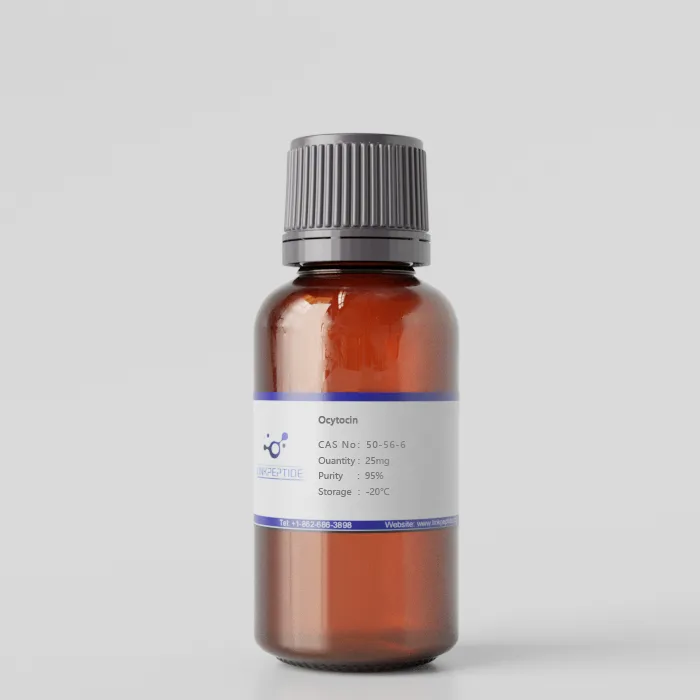
Product Name:Ocytocin
Form:Acetate salt
Purity:95%
Storage:-20oC
Cas No:50-56-6
Molar Mass:1007.2
Chemical Formula: C43H66N12O12S2
Synonyms:Pitocin; Endopituitrina; Ocytocin
IUPAC Name:(2S)-1-[(4R,7S,10S,13S,16S,19R)-19-amino-7-(2-amino-2-oxoethyl)-10-(3-amino-3-oxopropyl)-13-[(2S)-butan-2-yl]-16-[(4-hydroxyphenyl)methyl]-6,9,12,15,18-pentaoxo-1,2-dithia-5,8,11,14,17-pentazacycloicosane-4-carbonyl]-N-[(2S)-1-[(2-amino-2-oxoethyl)amino]-4-methyl-1-oxopentan-2-yl]pyrrolidine-2-carboxamide
SMILES:CC[C@H](C)[C@H]1C(=O)N[C@H](C(=O)N[C@H](C(=O)N[C@@H](CSSC[C@@H](C(=O)N[C@H](C(=O)N1)CC2=CC=C(C=C2)O)N)C(=O)N3CCC[C@H]3C(=O)N[C@@H](CC(C)C)C(=O)NCC(=O)N)CC(=O)N)CCC(=O)N
InChIKey:XNOPRXBHLZRZKH-DSZYJQQASA-N
InChI:InChI=1S/C43H66N12O12S2/c1-5-22(4)35-42(66)49-26(12-13-32(45)57)38(62)51-29(17-33(46)58)39(63)53-30(20-69-68-19-25(44)36(60)50-28(40(64)54-35)16-23-8-10-24(56)11-9-23)43(67)55-14-6-7-31(55)41(65)52-27(15-21(2)3)37(61)48-18-34(47)59/h8-11,21-22,25-31,35,56H,5-7,12-20,44H2,1-4H3,(H2,45,57)(H2,46,58)(H2,47,59)(H,48,61)(H,49,66)(H,50,60)(H,51,62)(H,52,65)(H,53,63)(H,54,64)/t22-,25-,26-,27-,28-,29-,30-,31-,35-/m0/s1
Sequence:CYIQNCPLG
Application:Oxytocin is a naturally occurring peptide hormone and neuropeptide primarily involved in uterine contractions during childbirth and milk ejection during lactation. It is widely used in obstetrics to induce labor, prevent postpartum hemorrhage, and facilitate breastfeeding. Beyond its reproductive roles, oxytocin is gaining attention for its impact on social bonding, emotional regulation, and stress response. Research explores its potential therapeutic applications in psychiatric disorders (such as autism and anxiety), metabolic regulation, and pain management. Additionally, oxytocin??s role in cardiovascular health and neuroprotection is being investigated, making it a promising candidate for expanding medical applications beyond labor and lactation.
Current Research:Oxytocin is a peptide hormone and neurotransmitter that plays a crucial role in labor, lactation, social bonding, and emotional regulation. While its primary clinical use is in obstetrics, recent research has expanded its potential applications in psychiatry, neurology, cardiovascular health, and pain modulation. Obstetric and Gynecological Applications Oxytocin remains a first-line treatment in labor and postpartum care due to its role in uterine contractions. Labor induction and augmentation: Oxytocin is routinely used to induce or enhance uterine contractions in cases of prolonged labor or fetal distress. Postpartum hemorrhage (PPH) prevention: As a potent uterotonic, oxytocin is administered to prevent excessive bleeding after childbirth, reducing maternal mortality. Breastfeeding support: It facilitates milk ejection during lactation by stimulating smooth muscle contractions in the mammary glands. Psychiatric and Neurological Research Oxytocin is widely studied for its role in social behavior, emotional regulation, and mental health disorders. Autism spectrum disorder (ASD): Studies suggest that oxytocin may enhance social interaction, communication, and emotional recognition in individuals with ASD. Anxiety and depression: Oxytocin has anxiolytic and antidepressant properties, with research focusing on its effects in stress reduction and mood stabilization. Post-traumatic stress disorder (PTSD): Some clinical trials indicate that intranasal oxytocin may help reduce PTSD symptoms by improving emotional processing and social cognition. Neuroprotection in neurodegenerative diseases: Preliminary studies suggest oxytocin may have protective effects against neuroinflammation and oxidative stress, making it a potential therapeutic target in Alzheimer??s and Parkinson??s disease. Cardiovascular and Metabolic Research Beyond its neurological effects, oxytocin is being investigated for its impact on cardiovascular and metabolic health. Blood pressure regulation: Oxytocin has vasodilatory effects, which may help in the management of hypertension and heart failure. Metabolic syndrome and obesity: Research suggests oxytocin may influence glucose metabolism, insulin sensitivity, and fat storage, making it a candidate for treating obesity and type 2 diabetes. Pain Modulation and Anti-Inflammatory Effects Oxytocin has emerging applications in pain management and inflammation control. Chronic pain and fibromyalgia: Some studies indicate that oxytocin can modulate pain perception by interacting with opioid pathways. Inflammatory conditions: Oxytocin has shown anti-inflammatory effects, with potential applications in autoimmune diseases and chronic inflammatory disorders. Emerging Research Areas Gut-brain axis regulation: Oxytocin is being explored for its role in gut motility, microbiome interactions, and gastrointestinal disorders. Sexual function and reproductive health: Research is investigating its potential in erectile dysfunction, sexual arousal, and fertility treatments. Longevity and aging research: Some studies suggest oxytocin may contribute to healthy aging by preserving muscle function and cognitive abilities. With expanding research, oxytocin is emerging as a versatile therapeutic agent beyond its traditional roles in obstetrics and lactation, offering potential benefits in psychiatry, neurology, cardiology, and metabolic disorders.
Get a Quote
 LinkPeptide