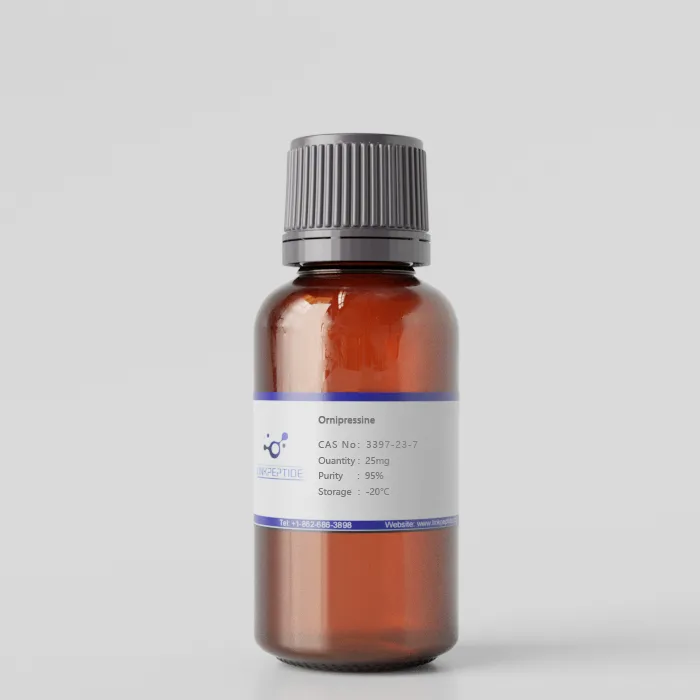
Product Name:Ornipressine
Form:Acetate salt
Purity:95%
Storage:-20oC
Cas No:3397-23-7
Molar Mass:1042.2
Chemical Formula:C45H63N13O12S2
Synonyms:Ornipresina
IUPAC Name:(2S)-N-[(2S)-5-amino-1-[(2-amino-2-oxoethyl)amino]-1-oxopentan-2-yl]-1-[(4R,7S,10S,13S,16S,19R)-19-amino-7-(2-amino-2-oxoethyl)-10-(3-amino-3-oxopropyl)-13-benzyl-16-[(4-hydroxyphenyl)methyl]-6,9,12,15,18-pentaoxo-1,2-dithia-5,8,11,14,17-pentazacycloicosane-4-carbonyl]pyrrolidine-2-carboxamide
SMILES: C1C[C@H](N(C1)C(=O)[C@@H]2CSSC[C@@H](C(=O)N[C@H](C(=O)N[C@H](C(=O)N[C@H](C(=O)N[C@H](C(=O)N2)CC(=O)N)CCC(=O)N)CC3=CC=CC=C3)CC4=CC=C(C=C4)O)N)C(=O)N[C@@H](CCCN)C(=O)NCC(=O)N
InChIKey:MUNMIGOEDGHVLE-LGYYRGKSSA-N
InChI:InChI=1S/C45H63N13O12S2/c46-16-4-8-28(39(64)51-21-37(50)62)53-44(69)34-9-5-17-58(34)45(70)33-23-72-71-22-27(47)38(63)54-30(19-25-10-12-26(59)13-11-25)42(67)55-31(18-24-6-2-1-3-7-24)41(66)52-29(14-15-35(48)60)40(65)56-32(20-36(49)61)43(68)57-33/h1-3,6-7,10-13,27-34,59H,4-5,8-9,14-23,46-47H2,(H2,48,60)(H2,49,61)(H2,50,62)(H,51,64)(H,52,66)(H,53,69)(H,54,63)(H,55,67)(H,56,65)(H,57,68)/t27-,28-,29-,30-,31-,32-,33-,34-/m0/s1
Sequence:CYFQNCPXG
Application:Ornipressin is a synthetic vasopressin analog with potent vasoconstrictive properties, primarily used in shock management, gastrointestinal bleeding, and vasodilatory hypotension. It acts on vasopressin V1 receptors to induce systemic vasoconstriction, effectively increasing blood pressure and organ perfusion in critical care settings. Ornipressin has been explored as an alternative to catecholamines in septic shock and hepatorenal syndrome, reducing the risk of excessive cardiac stimulation. Current research investigates its role in cirrhotic patients, renal protection, and cardiovascular function, positioning it as a promising therapeutic agent in intensive care medicine and emergency settings.
Current Research:Ornipressin is a synthetic analog of vasopressin, primarily recognized for its vasoconstrictive and hemodynamic stabilizing effects. By acting on V1 receptors in vascular smooth muscle, it induces systemic vasoconstriction, making it valuable in managing vasodilatory shock, hepatorenal syndrome, and gastrointestinal bleeding. Recent research has focused on its advantages over catecholamine-based vasopressors, organ-protective effects, and potential applications in cardiovascular and renal medicine. Vasodilatory Shock and Septic Shock Management Ornipressin has been investigated as a vasopressor in septic shock, where catecholamine-resistant hypotension is common. Catecholamine-sparing effects: Unlike norepinephrine or epinephrine, Ornipressin induces vasoconstriction without significant beta-adrenergic stimulation, reducing the risk of tachycardia and arrhythmias. Improved microcirculation: Studies suggest that Ornipressin helps preserve organ perfusion better than traditional vasopressors, particularly in the kidneys and splanchnic circulation. Combination therapies: Research is evaluating the co-administration of Ornipressin with norepinephrine to optimize hemodynamic support while minimizing cardiovascular side effects. Hepatorenal Syndrome (HRS) and Cirrhotic Hypotension One of Ornipressin??s key applications is in hepatorenal syndrome (HRS), a life-threatening complication of liver cirrhosis characterized by renal failure due to splanchnic vasodilation. Renal perfusion improvement: Studies show that Ornipressin reduces splanchnic pooling and increases renal perfusion, improving kidney function in cirrhotic patients. Alternative to terlipressin: Ornipressin is being compared to terlipressin in HRS treatment, with some studies suggesting a better safety profile and fewer ischemic complications. Impact on ascites and portal hypertension: Research indicates that Ornipressin may reduce portal hypertension and help manage refractory ascites in liver disease. Gastrointestinal Bleeding and Variceal Hemorrhage Ornipressin is commonly used in acute gastrointestinal (GI) bleeding, particularly esophageal variceal hemorrhage (EVH) in cirrhotic patients. Splanchnic vasoconstriction: By constricting mesenteric arteries, Ornipressin reduces portal pressure, decreasing the risk of ongoing variceal bleeding. Adjunct to endoscopic therapy: It is frequently used alongside endoscopic band ligation (EBL) or sclerotherapy to enhance bleeding control. Cardiovascular and Renal Protective Effects Research has expanded into Ornipressin??s potential cardioprotective and renoprotective roles: Heart failure management: Some studies suggest Ornipressin may have benefits in managing low-output heart failure by improving vascular tone and organ perfusion. Acute kidney injury (AKI): Due to its effects on renal vasculature, Ornipressin is being explored in acute kidney injury (AKI) and perioperative kidney protection strategies. Emerging Research Areas Ischemia-reperfusion injury: Studies are investigating Ornipressin??s role in reducing ischemia-reperfusion damage in transplant surgery and critical illness. Post-cardiac arrest management: Research explores Ornipressin??s potential in improving hemodynamics and organ recovery following cardiac arrest. Neurocritical care: Preliminary findings suggest Ornipressin may help regulate cerebral blood flow in traumatic brain injury and stroke. As research progresses, Ornipressin??s potential as a safer and more targeted vasopressor is gaining attention, particularly in critical care, hepatology, and cardiovascular medicine.
Get a Quote
 LinkPeptide