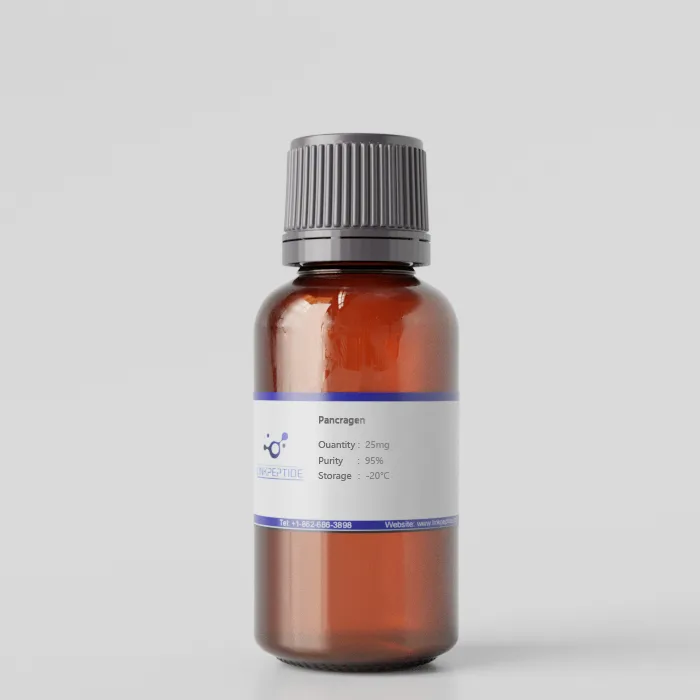
Product Name:Pancragen
Purity:95%
Chemical Formula:C26H36N6O9
Molar Mass:576.6
Synonyms:SCHEMBL2946041
IUPAC Name:(4S)-5-[[(2S)-3-carboxy-1-[[(1S)-1-carboxy-2-(1H-indol-3-yl)ethyl]amino]-1-oxopropan-2-yl]amino]-4-[[(2S)-2,6-diaminohexanoyl]amino]-5-oxopentanoic acid
SMILES:C1=CC=C2C(=C1)C(=CN2)C[C@@H](C(=O)O)NC(=O)[C@H](CC(=O)O)NC(=O)[C@H](CCC(=O)O)NC(=O)[C@H](CCCCN)N
InChIKey:PIGJHNNSOMRLST-LEAZDLGRSA-N
InChI:InChI=1S/C26H36N6O9/c27-10-4-3-6-16(28)23(37)30-18(8-9-21(33)34)24(38)31-19(12-22(35)36)25(39)32-20(26(40)41)11-14-13-29-17-7-2-1-5-15(14)17/h1-2,5,7,13,16,18-20,29H,3-4,6,8-12,27-28H2,(H,30,37)(H,31,38)(H,32,39)(H,33,34)(H,35,36)(H,40,41)/t16-,18-,19-,20-/m0/s1
Storage:-20 degree Celsius
Sequence:KEDW
Application:Pancragen is a short peptide bioregulator derived from pancreatic tissue, designed to support the restoration of pancreatic endocrine function and glucose metabolism regulation. It modulates gene expression in pancreatic cells, promoting insulin secretion, β-cell maintenance, and anti-inflammatory balance in metabolic tissue. Pancragen has been studied in models of type 2 diabetes, metabolic syndrome, and pancreatic aging, where it improves glycemic control, protects against islet damage, and supports tissue regeneration. It is especially valuable in research on age-associated endocrine dysfunction and peptide-based metabolic therapies.
Current Research:
Introduction: What Is Pancragen? Pancragen is a cytogenetic peptide—a short synthetic peptide derived from extracts of pancreatic tissue. It belongs to a class of organ-specific bioregulators originally developed in Russia, aimed at restoring organ function at the epigenetic level. These peptides act by interacting with specific DNA sequences in the nucleus of target cells, regulating gene expression and reactivating cellular repair mechanisms. Pancragen is particularly aimed at endocrine pancreatic cells, including β-cells, which are responsible for insulin secretion and glucose homeostasis. Mechanism of Action: Gene Expression and β-Cell Support Pancragen works through epigenetic modulation by binding to specific DNA regions in pancreatic cells, thus influencing the transcription of genes involved in: Insulin biosynthesis and secretion Glucose transporter expression (e.g., GLUT2) Oxidative stress resistance and mitochondrial health Anti-inflammatory cytokine regulation (e.g., IL-10 upregulation, TNF-α downregulation) These actions contribute to enhanced pancreatic endocrine function, particularly in models of insulin resistance, β-cell stress, and age-related metabolic decline. Applications in Diabetes and Glucose Metabolism Pancragen has been studied extensively in type 2 diabetes models, where it exhibits several favorable effects: Improved fasting blood glucose levels Enhanced insulin sensitivity Increased C-peptide levels, indicating endogenous insulin production Protection of islet architecture and reduction of β-cell apoptosis In combination with standard antidiabetic agents (e.g., metformin or sulfonylureas), Pancragen improves glycemic control without inducing hypoglycemia, suggesting it may act through restorative—not overstimulatory—mechanisms. Metabolic Syndrome and Pancreatic Aging In models of metabolic syndrome, Pancragen helps normalize: Glucose tolerance Lipid profiles (reducing LDL and triglycerides) Inflammatory biomarkers associated with insulin resistance Its antioxidant and anti-inflammatory actions are especially beneficial in metabolically inflamed states where pancreatic tissues are exposed to chronic stress, such as in obesity, aging, or lipotoxicity. Studies in aging animals show Pancragen restores age-depressed gene expression in pancreatic tissue, increases antioxidant enzyme levels, and supports long-term preservation of insulin-producing cells. Immunomodulatory Effects in Autoimmune Diabetes Models In autoimmune settings, such as early-stage type 1 diabetes or immune-mediated β-cell damage, Pancragen may help preserve β-cell mass by: Suppressing pro-inflammatory cytokines Enhancing regulatory T-cell function Improving pancreatic tissue regeneration These findings have made it an area of interest in peptide immunotherapy for early intervention or adjunctive strategies in autoimmune-mediated diabetes. Synergy with Other Peptides Pancragen is often combined in multi-organ peptide protocols with: Vladonix (for thymic and immune support) Ventfort (for vascular health, improving blood supply to pancreatic islets) Glandokort (adrenal peptide for stress-response modulation) These combinations aim to address the multi-systemic nature of metabolic disease, supporting endocrine, vascular, and immune function concurrently. Conclusion: A Peptide-Based Approach to Endocrine Restoration Pancragen represents a novel, epigenetically active peptide for restoring pancreatic endocrine function, particularly in the context of diabetes, metabolic syndrome, and pancreatic aging. By enhancing gene expression related to insulin secretion, reducing inflammatory and oxidative stress, and supporting β-cell regeneration, Pancragen is a versatile research tool for exploring non-pharmaceutical metabolic modulation. As interest in peptide-based metabolic therapies grows, Pancragen continues to offer insight into the potential of organ-specific peptides for endocrine rejuvenation and long-term glycemic health.
Reference:
Get a Quote
 LinkPeptide