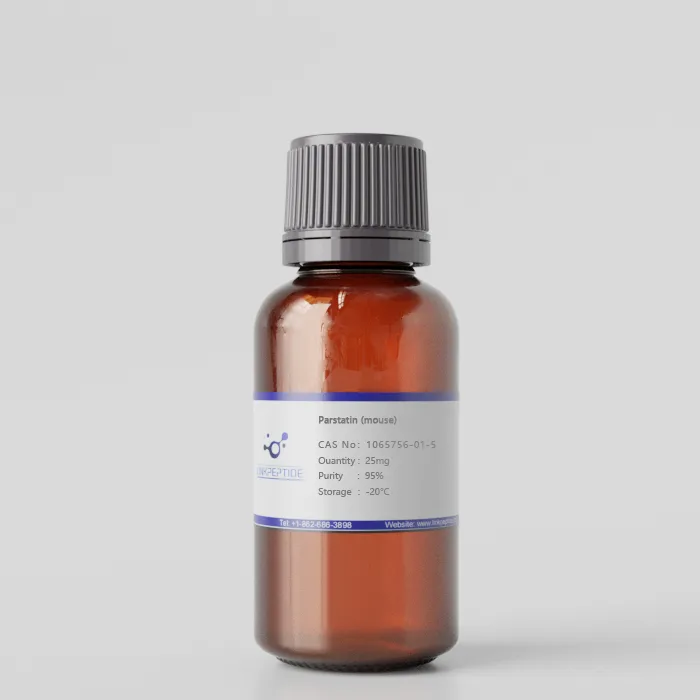
Product Name:Parstatin (mouse)
CAS No:1065756-01-5
Purity:95%
Molar Mass:4419.19
Chemical Formula:C189H326N58O57S3
Storage:Store at -20 degrees Celsius
Sequence:MGPRRLLIVALGLSLCGPLLSSRVPMSQPESERTDATVNPR
Application:Parstatin (mouse) is a peptide derived from the mouse parathyroid hormone (PTH) precursor protein. Similar to its human counterpart, it acts as an antagonist of the PTH receptor, modulating the effects of parathyroid hormone on bone metabolism and calcium homeostasis. In mouse models, parstatin is used to study its role in bone health and disorders, such as osteoporosis and hyperparathyroidism. Research into mouse parstatin helps in understanding the physiological functions of PTH and developing potential therapies for calcium and bone-related conditions in humans.
Current Research:
Parstatin is a 41-amino acid peptide generated from the proteolytic cleavage of protease-activated receptor 1 (PAR1) upon thrombin activation. This N-terminal fragment has garnered significant interest due to its diverse biological activities, particularly its anti-angiogenic and cardioprotective properties.
Biological Activities
Anti-Angiogenic Effects: Parstatin effectively inhibits endothelial cell migration and proliferation, with an IC?? of approximately 3 ??M. It induces cell cycle arrest and promotes caspase-3 activation, leading to apoptosis in vitro. These actions contribute to its capacity to suppress angiogenesis, the formation of new blood vessels, which is crucial in processes like tumor growth and wound healing.
Cardioprotective Effects: In vivo studies have demonstrated that parstatin administration prior to ischemic events confers immediate cardioprotection. This effect is mediated through the activation of Gi-protein pathways, including p38 MAPK, ERK1/2, nitric oxide synthase (NOS), and ATP-sensitive potassium (K_ATP) channels. Parstatin exerts its protective effects on both cardiomyocytes and the coronary circulation, suggesting potential therapeutic applications in ischemia-reperfusion injuries.
Mechanism of Action
Upon thrombin activation, PAR1 undergoes cleavage, releasing parstatin. This peptide can penetrate cells and modulate various signaling pathways. Its anti-angiogenic activity is attributed to the inhibition of endothelial cell functions essential for new vessel formation. The cardioprotective effects involve the recruitment of intracellular signaling cascades that enhance cell survival and function during ischemic stress.
Research Applications
Parstatin serves as a valuable tool in biomedical research, particularly in:
Angiogenesis Studies: Investigating the mechanisms underlying blood vessel formation and identifying potential therapeutic targets for diseases characterized by abnormal angiogenesis, such as cancer and diabetic retinopathy.
Cardiovascular Research: Exploring protective strategies against ischemic heart diseases and understanding the molecular pathways involved in cardioprotection.
Conclusion
Parstatin, derived from PAR1 activation, exhibits significant anti-angiogenic and cardioprotective properties. Its ability to modulate critical cellular processes positions it as a promising candidate for therapeutic development in conditions involving aberrant angiogenesis and ischemic injuries. Ongoing research continues to elucidate its mechanisms of action and potential clinical applications.
Reference:
Get a Quote
 LinkPeptide

![Lys-[Des-Arg9]Bradykinin](https://www.linkpeptide.com/wp-content/uploads/2024/10/Lys-Des-Arg9Bradykinin-jpg-3.webp "Lys-[Des-Arg9]Bradykinin")
![[Pyr1]-Apelin-13](https://www.linkpeptide.com/wp-content/uploads/2024/10/Pyr1-Apelin-13-jpg-3.webp "[Pyr1]-Apelin-13")