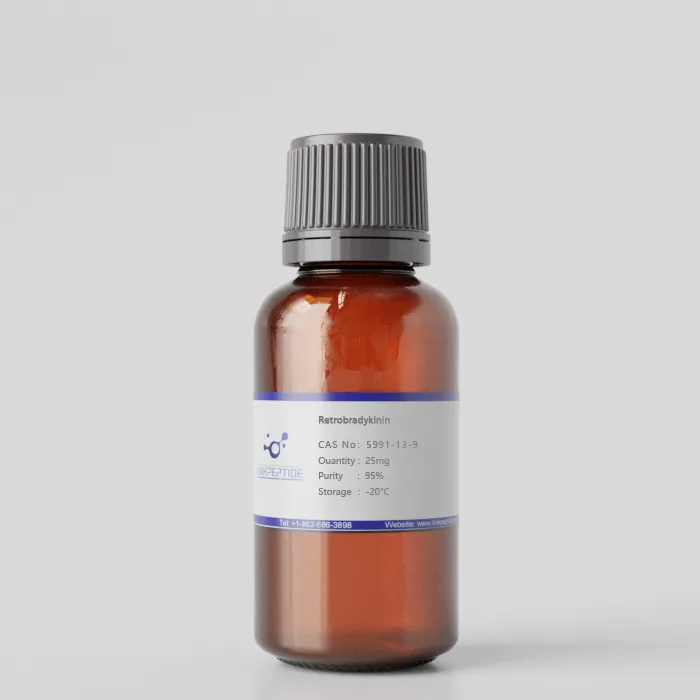
Product Name:Retrobradykinin
CAS No:5991-13-9
Purity:95%
Molar Mass:1060.21
Chemical Formula:C50H73N15O11
Storage:Store at -20 degrees Celsius
Sequence:RFPSFGPPR
Application:
Retrobradykinin is a synthetic peptide that is a reversed sequence analog of the naturally occurring bradykinin, a peptide involved in inflammation and vasodilation. While bradykinin plays a role in mediating pain, blood pressure regulation, and vascular permeability, retrobradykinin may be used to study bradykinin receptor interactions and its biological effects in experimental settings. By mimicking or inhibiting certain pathways, Retrobradykinin serves as a tool for investigating bradykinin-related physiological processes, particularly in inflammation and cardiovascular research. It holds potential for exploring therapeutic strategies aimed at controlling bradykinin-related pathways.
Current Research:
Retrobradykinin is a synthetic nonapeptide with the sequence Arg-Phe-Pro-Ser-Phe-Gly-Pro-Pro-Arg, which is the reverse sequence of the naturally occurring peptide bradykinin. Unlike bradykinin, which is a potent vasodilator involved in inflammation and blood pressure regulation, retrobradykinin exhibits no significant kinin activity. Due to this lack of biological activity, it is commonly used as a negative control in experiments studying bradykinin's physiological and pharmacological effects. Applications in Research In experimental settings, retrobradykinin serves as a valuable tool for: Negative Control: Providing a baseline to compare the specific effects of bradykinin, ensuring that observed outcomes are due to bradykinin's activity and not other variables. Structural Studies: Investigating the importance of amino acid sequence orientation in peptide-receptor interactions, aiding in the understanding of structure-activity relationships. Handling and Storage Retrobradykinin is typically supplied as a lyophilized powder. For optimal stability, it should be stored at 2-8 degree Celsius. Upon reconstitution, it is recommended to prepare aliquots to avoid repeated freeze-thaw cycles, which can degrade the peptide. Conclusion As the reverse sequence analog of bradykinin, retrobradykinin is an essential tool in biomedical research. Its lack of kinin activity makes it ideal for use as a negative control, facilitating accurate assessment of bradykinin's specific biological functions.
Reference:
Get a Quote
 LinkPeptide