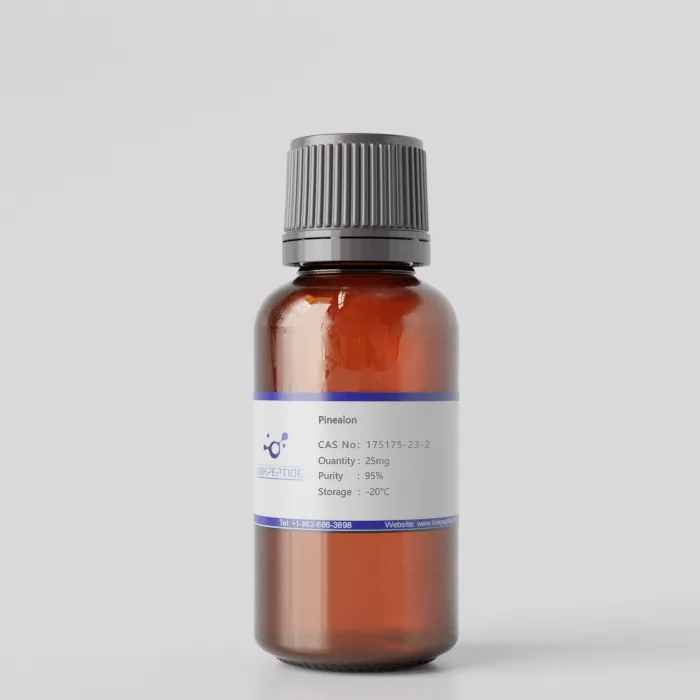
Product Name:Pinealon
Cas No:175175-23-2
Purity:95%
Chemical Formula:C15H26N6O8
Molar Mass:418.4
Synonyms:pinealon; Glu-Asp-Arg; H-Glu-Asp-Arg-OH; L-Glu-L-Asp-L-Arg; E-D-R
IUPAC Name:(4S)-4-amino-5-[[(2S)-3-carboxy-1-[[(1S)-1-carboxy-4-(diaminomethylideneamino)butyl]amino]-1-oxopropan-2-yl]amino]-5-oxopentanoic acid
SMILES:C(C[C@@H](C(=O)O)NC(=O)[C@H](CC(=O)O)NC(=O)[C@H](CCC(=O)O)N)CN=C(N)N
InChIKey:QPRZKNOOOBWXSU-CIUDSAMLSA-N
InChI:InChI=1S/C15H26N6O8/c16-7(3-4-10(22)23)12(26)21-9(6-11(24)25)13(27)20-8(14(28)29)2-1-5-19-15(17)18/h7-9H,1-6,16H2,(H,20,27)(H,21,26)(H,22,23)(H,24,25)(H,28,29)(H4,17,18,19)/t7-,8-,9-/m0/s1
Storage:-20 degree Celsius
Sequence:EDR
Application:Pinealon is a synthetic tripeptide (Glu-Asp-Arg) developed as a nootropic and neuroprotective peptide bioregulator, designed to support brain function, memory retention, and resistance to neurodegenerative stress. Originally derived from pineal gland peptide research, Pinealon regulates gene expression involved in neuronal plasticity, apoptosis inhibition, and oxidative defense. It has been studied in animal models of hypoxia, aging, cognitive decline, and prenatal brain injury, showing the ability to improve learning performance, neuronal survival, and synaptic integrity. Pinealon is ideal for research into brain aging, cognitive resilience, neurodevelopmental disorders, and epigenetic peptide-based neuroprotection.
Current Research:
Introduction: Origins and Classification
Pinealon is a short, synthetic cytogenetic peptide composed of three amino acids: glutamic acid, aspartic acid, and arginine (Glu-Asp-Arg). It was developed through research conducted at the St. Petersburg Institute of Bioregulation and Gerontology, with the goal of mimicking the biological activity of pineal gland-derived regulatory peptides. Like other cytogenetic peptides, Pinealon is designed to interact with DNA and histones, modulating gene expression in a tissue-specific and age-dependent manner.
Pinealon targets the central nervous system, and its effects are primarily expressed in neuronal cells, making it a promising compound in gerontology, neurobiology, and regenerative neuroscience.
Mechanism of Action: Epigenetic Modulation and Cellular Protection
Pinealon exerts its effects by:
Binding to specific regions of DNA and chromatin, modulating transcription of genes involved in:
Neurotrophic factor expression
Cell cycle regulation
Apoptosis inhibition
Stress response proteins (e.g., heat shock proteins)
Restoring gene activity suppressed by aging or oxidative stress
Stimulating protein synthesis in neuronal tissues
Normalizing mitochondrial energy metabolism, which is critical in neurons due to their high energy demand
These actions make Pinealon a multifunctional neuroprotective peptide capable of supporting neural function and cellular longevity.
Applications in Aging and Cognitive Function
Pinealon has been shown to improve cognitive performance and enhance memory in multiple rodent models. In aging animals, it:
Improved learning and memory retention
Reduced oxidative stress markers (e.g., malondialdehyde)
Preserved neuronal ultrastructure
Upregulated BDNF and NGF, neurotrophins essential for synaptic plasticity
By restoring youthful gene expression profiles in the hippocampus and cortex, Pinealon enhances both short-term and long-term memory functions, making it particularly useful in research on mild cognitive impairment (MCI), Alzheimer’s disease, and cognitive decline due to aging.
Neuroprotection in Hypoxia and Brain Injury
Pinealon has demonstrated potent protective effects in acute brain stress models, particularly:
Prenatal and neonatal hypoxia
Stroke and ischemia
Oxidative and inflammatory stress
In these models, Pinealon:
Reduced neuronal apoptosis in the cerebral cortex and hippocampus
Lowered levels of caspase-3 and pro-inflammatory cytokines
Enhanced neurogenesis and neuronal differentiation
Improved functional outcomes, such as coordination and memory
These results suggest potential utility in perinatal brain injury, stroke rehabilitation, and traumatic brain injury (TBI) recovery models.
Antioxidant and Mitochondrial Function Support
Oxidative stress is a major driver of brain aging and neurodegeneration. Pinealon has shown:
Increased activity of antioxidant enzymes (e.g., superoxide dismutase, glutathione peroxidase)
Reduction in lipid peroxidation
Stabilization of mitochondrial membrane potential
Protection of neuronal DNA and mitochondrial integrity under stress
This positions Pinealon as a candidate for research into Parkinson’s disease, ALS, and age-related cognitive disorders where oxidative stress plays a central role.
Synergistic Use with Other Peptides
Pinealon is often paired with other brain- or pineal-targeted peptides, such as:
Epitalon – for pineal gland and circadian rhythm regulation
Cortexin – for broader neuroprotection and plasticity
Thymogen or Livagen – for immune-neuroendocrine modulation
These combinations are used in experimental protocols for systemic anti-aging and neuroendocrine balance strategies.
Conclusion: A Targeted Peptide for Brain Longevity and Protection
Pinealon is a unique tripeptide with high specificity for neuronal DNA regulation, offering promising effects in cognitive enhancement, neuronal protection, and neurogenesis. Its epigenetic activity allows it to restore impaired brain function, making it an exceptional candidate for studying age-related brain disorders, early-life neurodevelopmental injury, and peptide-based brain rejuvenation.
Reference:
Get a Quote
 LinkPeptide