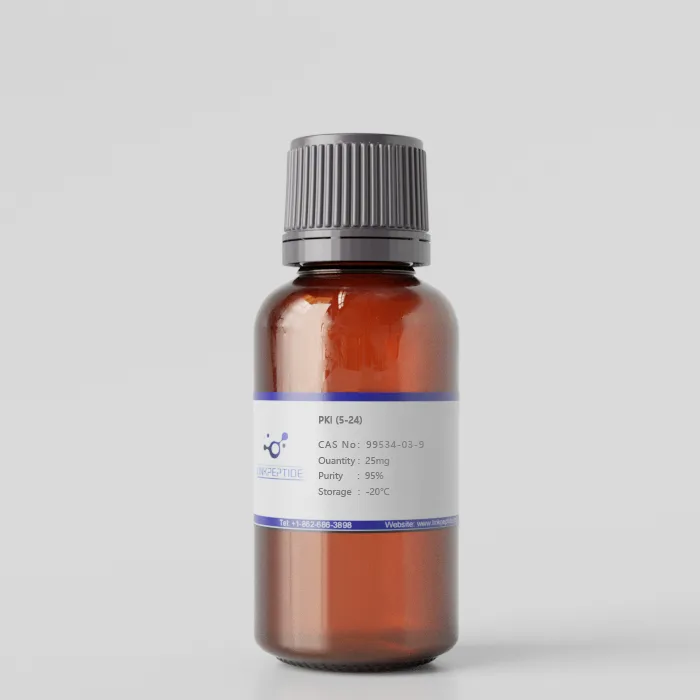
Product Name:PKI (5-24)
CAS No:99534-03-9
Purity:95%
Molar Mass:2222.38
Chemical Formula:C94H148N32O31
Storage:Store at -20 degrees Celsius
Sequence:TTYADFIASGRTGRRNAIHD
Target:PKA
Application:PKI (5-24) is a peptide fragment derived from the Protein Kinase Inhibitor (PKI), encompassing amino acids 5 to 24. This peptide is a potent and selective inhibitor of cyclic AMP-dependent protein kinase (PKA), which plays a crucial role in regulating cellular processes such as metabolism, gene expression, and cell proliferation. By binding to the catalytic subunit of PKA, PKI (5-24) effectively inhibits its kinase activity, making it a valuable tool in research studies focused on signal transduction pathways mediated by PKA. This peptide is commonly used to explore the mechanisms of PKA-related cellular processes and potential therapeutic targets in diseases linked to PKA dysregulation.
Current Research:
PKI (5-24) is a synthetic peptide that functions as a potent and selective inhibitor of cAMP-dependent protein kinase (PKA). Derived from the active domain of the naturally occurring heat-stable protein kinase inhibitor (PKI), this peptide corresponds to amino acid residues 5 through 24 of the native inhibitor. It exhibits a high affinity for PKA, with an inhibition constant (Kᵢ) of approximately 2.3 nM.
Mechanism of Action
PKI (5-24) operates as a competitive inhibitor by mimicking the substrate's binding motif. It binds to the catalytic subunit of PKA, effectively blocking substrate access and subsequent phosphorylation events. This binding is facilitated by a cluster of arginine residues within the peptide, which interact with the catalytic site of PKA, thereby inhibiting its kinase activity.
Research Applications
Due to its specificity and potency, PKI (5-24) is extensively utilized in biochemical and cellular studies to dissect PKA-mediated signaling pathways. It serves as a valuable tool for:
Investigating PKA Functions: By selectively inhibiting PKA, researchers can delineate its role in various cellular processes, including metabolism, gene expression, and cell proliferation.
Elucidating cAMP Signaling: PKI (5-24) aids in understanding how cAMP levels regulate PKA activity and downstream effects, providing insights into cellular responses to hormonal stimulation.
Developing Therapeutic Strategies: The peptide's inhibitory properties are instrumental in exploring potential treatments for diseases where dysregulated PKA activity is implicated, such as certain cancers and cardiovascular conditions.
Handling and Storage
PKI (5-24) is typically supplied as a lyophilized powder. For optimal stability, it should be stored at -20°C, protected from light and moisture. Upon reconstitution, aliquots should be prepared to avoid repeated freeze-thaw cycles, which can degrade the peptide.
Conclusion
As a highly effective and specific inhibitor of PKA, PKI (5-24) is an indispensable tool in molecular and cellular biology research. Its application facilitates a deeper understanding of PKA's role in health and disease, contributing to the advancement of targeted therapeutic interventions.
Reference:
Get a Quote
 LinkPeptide