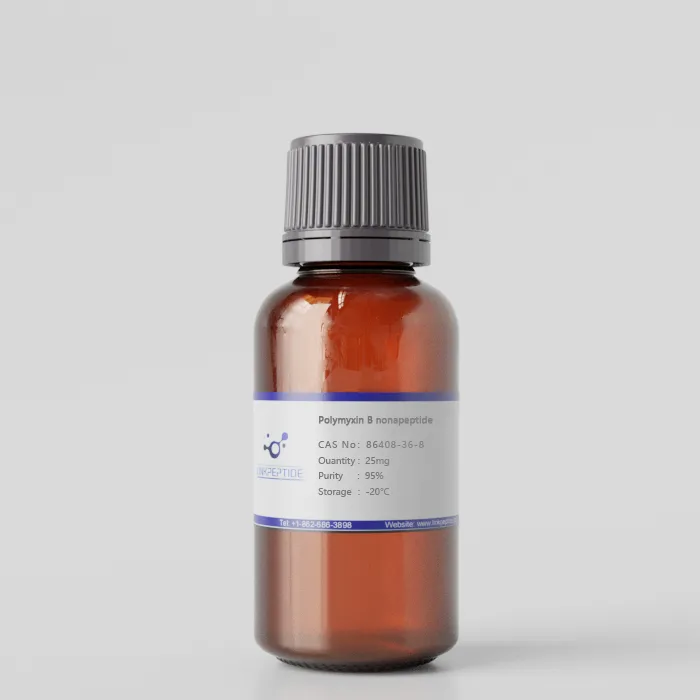
Product Name:Polymyxin B nonapeptide
Synonyms:PMBN
CAS No:86408-36-8
Purity:95%
Molar Mass:963.1
Chemical Formula:C43H74N14O11
Storage:Store at -20 degrees Celsius
Sequence:H-Thr-Dab-Dab(1)-Dab-D-Phe-Leu-Dab-Dab-Thr
Application:
Polymyxin B Nonapeptide is a derivative of the antibiotic polymyxin B, lacking the fatty acid tail and a key amino acid, which reduces its toxicity while retaining its antimicrobial activity. This peptide is primarily used in research to study bacterial membrane permeability and to inhibit endotoxin activity in Gram-negative bacteria. By disrupting the outer membrane of bacteria, Polymyxin B Nonapeptide enhances the efficacy of other antibiotics and is often employed in combination therapies. Additionally, it serves as a tool in investigating bacterial resistance mechanisms and as an agent in assays designed to neutralize lipopolysaccharides (LPS) in experimental settings.
Current Research:
Polymyxin B Nonapeptide (PMBN) is a derivative of the antibiotic polymyxin B, generated by enzymatic cleavage of its fatty acid tail. This modification retains the peptide's ability to interact with lipopolysaccharides (LPS) in the outer membrane of Gram-negative bacteria but eliminates its antimicrobial activity. As a result, PMBN is widely used in research to study bacterial membrane permeability and as a tool to enhance the efficacy of other antibiotics.
Mechanism of Action
PMBN binds to the negatively charged LPS molecules in the outer membrane of Gram-negative bacteria. This interaction destabilizes the membrane, increasing its permeability and facilitating the entry of hydrophobic molecules, including antibiotics that typically have limited penetration. Unlike polymyxin B, PMBN lacks significant cytotoxicity, making it a safer option for studying bacterial membrane dynamics.
Research Applications
Antibiotic Potentiation:
PMBN is extensively used in combination studies to enhance the activity of antibiotics such as ??-lactams and macrolides against resistant Gram-negative bacteria. It bypasses the permeability barrier of the bacterial outer membrane, allowing antibiotics to reach their intracellular targets.
LPS Neutralization:
PMBN serves as a valuable tool in immunology research for neutralizing LPS and reducing endotoxin-induced inflammatory responses. This application is particularly useful in studies involving septic shock and endotoxemia.
Membrane Studies:
Its ability to modulate membrane permeability makes PMBN an ideal agent for exploring the structure-function relationships of bacterial membranes and investigating the mechanisms of membrane-targeting drugs.
Drug Delivery Research:
PMBN is also used to study strategies for enhancing the delivery of hydrophobic drugs to Gram-negative bacteria, aiding in the development of novel therapeutic approaches.
Conclusion
Polymyxin B Nonapeptide is an indispensable tool in microbiological and pharmaceutical research. Its role in modulating bacterial membrane permeability and neutralizing LPS offers critical insights into bacterial physiology and therapeutic innovations targeting Gram-negative pathogens.
Reference:
Get a Quote
 LinkPeptide