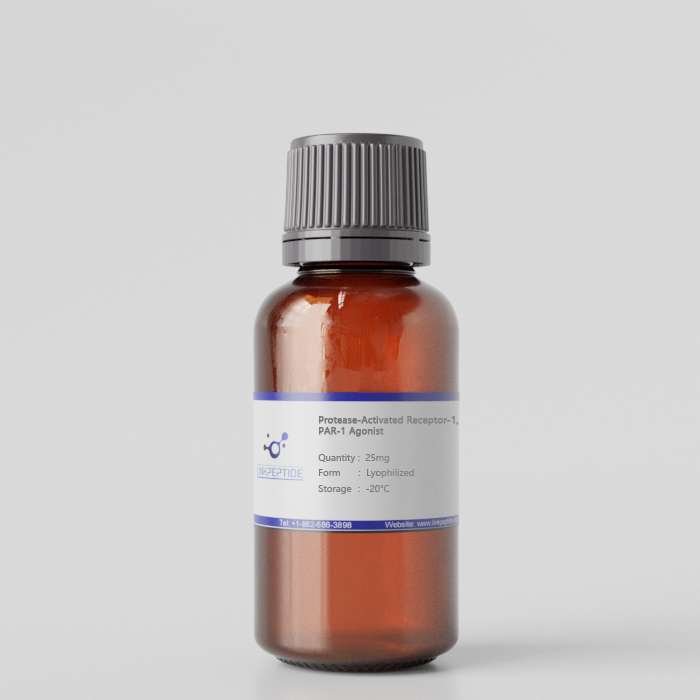
Product Name: Protease-Activated Receptor-1, PAR-1 Agonist
Sequence One Letter Code: TFLLRN
Sequence Three Letter Code: H-Thr-Phe-Leu-Leu-Arg-Asn-OH
Chemical Formula:C35H58N10O9
Molecular Weight: 762.9
Purity: 95%
Form: Lyophilized
Storage Conditions: - 20 °C
Research Area: Inflammation and Immunology Research
Source / Species: human
Conjugation: Unconjugated
Code Nacres: NA.26
Application: Protease-Activated Receptor-1 (PAR-1) Agonist is a selective synthetic peptide that activates PAR-1, a G protein–coupled receptor mediating many cellular responses to thrombin. PAR-1 activation triggers intracellular signaling cascades involved in inflammation, vascular tone regulation, and endothelial function. In human endothelial cells, this agonist induces cyclooxygenase-2 (COX-2) mRNA and protein expression, underscoring its role in inflammatory and vascular signaling pathways. In vivo studies have shown that intratracheal administration of PAR-1–specific agonist peptides exacerbates lung edema during high-tidal-volume ventilation, highlighting its relevance in acute lung injury models. This peptide is widely used to investigate thrombin receptor signaling, endothelial activation, vascular permeability, and mechanisms underlying inflammatory and ventilator-induced lung injury.
Current Research: Protease-Activated Receptor-1 (PAR-1) Agonist is a selective synthetic peptide designed to activate PAR-1, a thrombin-responsive G protein–coupled receptor (GPCR) that mediates diverse cellular responses in platelets, endothelial cells, smooth muscle cells, and inflammatory cell populations. PAR-1 is physiologically activated when thrombin cleaves its N-terminal extracellular domain, exposing a new tethered ligand sequence that binds intramolecularly to initiate receptor signaling. Synthetic agonist peptides mimic this tethered ligand sequence, enabling controlled activation of PAR-1 independent of proteolytic cleavage. Upon activation, PAR-1 couples to multiple heterotrimeric G proteins, including G_q, G_i, and G_12/13, initiating downstream signaling cascades. These pathways lead to phospholipase C activation, intracellular calcium mobilization, RhoA-dependent cytoskeletal remodeling, MAPK pathway engagement, and modulation of cAMP levels. The integrated signaling output influences cellular processes such as gene transcription, barrier function, contractility, and inflammatory mediator production. In vascular endothelial cells, PAR-1 activation plays a critical role in regulating endothelial function and vascular tone. Stimulation with PAR-1 agonist peptides induces expression of pro-inflammatory genes, including cyclooxygenase-2 (COX-2), at both mRNA and protein levels. COX-2 upregulation contributes to prostaglandin synthesis, thereby linking thrombin receptor activation to inflammatory amplification and vascular reactivity. Additionally, PAR-1 signaling promotes expression of adhesion molecules and cytokines, facilitating leukocyte recruitment and endothelial activation during inflammatory responses. PAR-1 agonist peptides are also widely used to study vascular permeability. Activation of G_12/13 and RhoA pathways induces cytoskeletal contraction and junctional rearrangement in endothelial monolayers, increasing paracellular permeability. This mechanism is particularly relevant in pathophysiological contexts such as sepsis, thrombosis-associated inflammation, and acute lung injury. Experimental models demonstrate that intratracheal administration of PAR-1–specific agonist peptides exacerbates pulmonary edema under high-tidal-volume mechanical ventilation, implicating PAR-1 signaling in ventilator-induced lung injury (VILI). These findings underscore the receptor’s contribution to barrier dysfunction and inflammatory lung pathology. In inflammation research, PAR-1 agonists are used to dissect thrombin-dependent signaling mechanisms without confounding protease activity. Because thrombin can activate multiple substrates and receptors, synthetic agonist peptides provide receptor specificity, allowing precise evaluation of PAR-1–mediated pathways. This is particularly valuable when distinguishing PAR-1 signaling from that of PAR-4 or other protease-activated receptors. Beyond endothelial systems, PAR-1 activation influences smooth muscle contraction, fibroblast proliferation, and immune cell behavior. In vascular smooth muscle cells, receptor engagement contributes to vasomotor regulation and remodeling. In immune contexts, PAR-1 signaling can modulate cytokine production and inflammatory cell migration, linking coagulation cascades to immune activation. Methodologically, PAR-1 agonist peptides are employed in calcium flux assays, ERK phosphorylation studies, gene expression analysis, endothelial permeability assays (e.g., transendothelial electrical resistance), and in vivo inflammatory models. Their defined structure and receptor selectivity allow reproducible activation kinetics and dose-response characterization in both cell-based and animal experiments. Overall, PAR-1 Agonist peptides serve as essential tools for investigating thrombin receptor signaling in vascular biology and inflammation. By selectively activating PAR-1, they enable detailed analysis of endothelial activation, COX-2 induction, vascular permeability changes, and mechanisms underlying inflammatory and ventilator-induced lung injury. These applications make them valuable reagents in studies of thrombosis, acute lung injury, cardiovascular dysfunction, and coagulation–inflammation crosstalk.
Get a Quote
 LinkPeptide