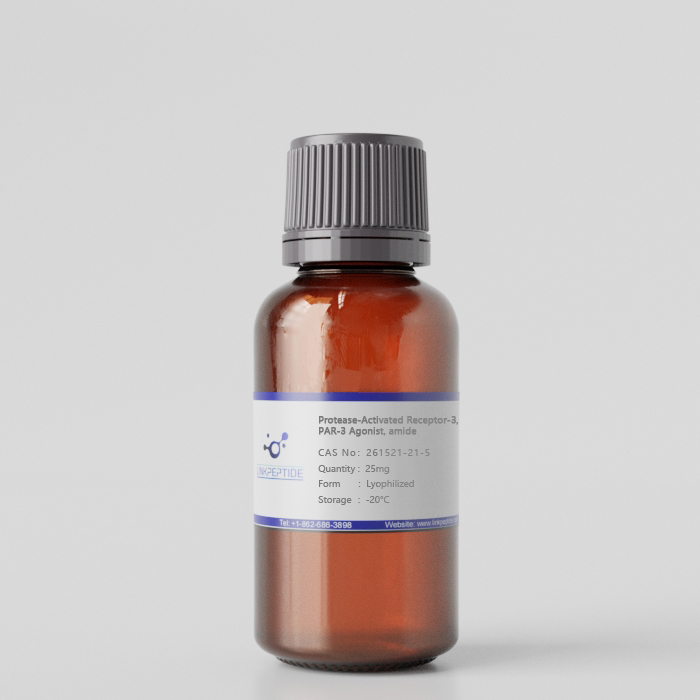
Product Name: Protease-Activated Receptor-3, PAR-3 Agonist, amide
Sequence One Letter Code: SFNGGP-NH2
Sequence Three Letter Code: H-Ser-Phe-Asn-Gly-Gly-Pro-NH2
Cas No: 261521-21-5
Chemical Formula:C25H36N8O8
Molecular Weight: 576.6
Purity: 95%
Form: Lyophilized
Storage Conditions: - 20 °C
Research Area: Inflammation and Immunology Research
SMILES: C1C[C@H](N(C1)C(=O)CNC(=O)CNC(=O)[C@H](CC(=O)N)NC(=O)[C@H](CC2=CC=CC=C2)NC(=O)[C@H](CO)N)C(=O)N
IUPAC: (2S)-2-[[(2S)-2-[[(2S)-2-amino-3-hydroxypropanoyl]amino]-3-phenylpropanoyl]amino]-N-[2-[[2-[(2S)-2-carbamoylpyrrolidin-1-yl]-2-oxoethyl]amino]-2-oxoethyl]butanediamide
INCHIKEY: PFUDDJZDHHDVLA-XSLAGTTESA-N
INCHI:
InChI=1S/C25H36N8O8/c26-15(13-34)23(39)31-16(9-14-5-2-1-3-6-14)25(41)32-17(10-19(27)35)24(40)30-11-20(36)29-12-21(37)33-8-4-7-18(33)22(28)38/h1-3,5-6,15-18,34H,4,7-13,26H2,(H2,27,35)(H2,28,38)(H,29,36)(H,30,40)(H,31,39)(H,32,41)/t15-,16-,17-,18-/m0/s1
Source / Species: human
Conjugation: Unconjugated
Code Nacres: NA.26
Application: This peptide functions as an agonist of Protease-Activated Receptor-3 (PAR-3), a high-affinity thrombin receptor expressed in various cell types, including human cutaneous mast cells. PAR-3 does not independently generate strong transmembrane signaling but acts as a cofactor that enhances PAR-4 activation. It has been implicated in thrombin-mediated signaling, inflammatory responses, and itch pathways. This peptide is widely used to investigate protease-activated receptor cooperation, mast cell activation, and thrombin-dependent signaling cascades. It supports research into inflammatory regulation and histamine-dependent and independent itch mechanisms.
Current Research: Protease-activated receptors (PARs) are a family of G protein–coupled receptors that are uniquely activated through proteolytic cleavage of their extracellular domains. Instead of binding a soluble ligand, these receptors are activated when a protease exposes an internal tethered ligand sequence, which subsequently binds intramolecularly to initiate signaling. Among the four members of this receptor family, Protease-Activated Receptor-3 (PAR-3) plays a distinctive regulatory role in thrombin signaling. Synthetic peptides that mimic the PAR-3 tethered ligand sequence are widely used as experimental tools to activate this receptor and study its functional interactions with other PAR family members. Protease-Activated Receptors and Thrombin Signaling Protease-activated receptors mediate many of the cellular responses triggered by extracellular proteases, particularly thrombin, a central enzyme in the coagulation cascade. When thrombin cleaves the N-terminal domain of a PAR receptor, a previously hidden peptide sequence becomes exposed and acts as a tethered ligand that activates the receptor. The PAR family includes four receptors—PAR-1, PAR-2, PAR-3, and PAR-4—each with distinct expression patterns and functional roles. PAR-1 and PAR-4 are well known for their involvement in platelet activation and vascular responses, while PAR-2 responds to other proteases such as trypsin. PAR-3 occupies a somewhat unique position within this system, functioning primarily as a modulatory receptor rather than a strong signaling receptor. Synthetic agonist peptides that reproduce the tethered ligand sequence of PAR-3 allow researchers to examine how this receptor contributes to thrombin-dependent signaling pathways. Unique Role of PAR-3 in Receptor Cooperation Unlike PAR-1 or PAR-4, PAR-3 does not typically generate strong independent intracellular signaling when activated. Instead, it functions as a cofactor receptor that facilitates signaling through other PAR family members, particularly PAR-4. In many cell types, PAR-3 binds thrombin with high affinity, effectively presenting the protease to PAR-4 and promoting its activation. This cooperative interaction enhances PAR-4–mediated signaling, which can then trigger downstream cellular responses such as calcium mobilization, cytoskeletal changes, and secretion of inflammatory mediators. The cooperative relationship between PAR-3 and PAR-4 has become an important area of study in receptor pharmacology and signaling biology. Using selective PAR-3 agonist peptides allows researchers to investigate how receptor cross-talk regulates cellular responses to proteases. Expression in Mast Cells and Other Cell Types PAR-3 is expressed in several cell types involved in immune and inflammatory responses, including human cutaneous mast cells. Mast cells are key effector cells in allergic reactions, inflammation, and host defense. They contain granules filled with histamine and other inflammatory mediators that are released upon activation. Activation of protease-activated receptors in mast cells can influence degranulation, cytokine production, and other cellular responses that contribute to inflammatory signaling. PAR-3 agonist peptides provide a useful tool for exploring how protease signaling influences mast cell activity. Through these experimental systems, researchers can examine how thrombin and other proteases participate in immune regulation and inflammatory signaling pathways. Role in Inflammatory Responses Protease-activated receptors are increasingly recognized as important mediators linking coagulation pathways with inflammation. Thrombin generated during tissue injury or vascular damage can activate PAR receptors on endothelial cells, immune cells, and other tissues. Through these interactions, PAR signaling can regulate vascular permeability, cytokine production, and recruitment of immune cells to sites of inflammation. PAR-3 contributes to these processes by modulating activation of other PAR receptors and amplifying thrombin-dependent signaling. Synthetic PAR-3 agonist peptides enable researchers to examine how receptor cooperation influences inflammatory pathways and how protease signaling contributes to immune responses. PAR-3 and Itch Signaling Pathways Recent research has also implicated PAR receptors in itch signaling, particularly in skin and sensory neuron pathways. Protease activity in the skin can activate PAR receptors on mast cells and sensory neurons, triggering pruritic signaling. PAR-3 has been associated with mechanisms that contribute to both histamine-dependent and histamine-independent itch pathways. Mast cell activation can release histamine, while other signaling pathways may stimulate sensory neurons directly through protease-activated receptor signaling. Using PAR-3 agonist peptides, researchers can investigate how protease signaling contributes to itch sensations and how different PAR receptors cooperate in these pathways. Applications in Protease-Activated Receptor Research PAR-3 agonist peptides are widely used in receptor pharmacology and signaling studies. Because they mimic the tethered ligand sequence exposed after proteolytic cleavage, these peptides allow investigators to activate PAR-3 without introducing active proteases into the system. This approach provides several experimental advantages. It enables controlled receptor activation, avoids nonspecific proteolytic effects, and allows researchers to study receptor cooperation, signaling specificity, and downstream signaling cascades. These peptides are particularly valuable in studies examining interactions between PAR-3 and PAR-4, as well as in experiments exploring protease signaling in immune cells and vascular tissues. Investigating Thrombin-Dependent Signaling Cascades Thrombin signaling plays important roles in coagulation, inflammation, vascular function, and tissue repair. PAR-3 agonist peptides help researchers dissect how thrombin interacts with different receptor systems and how these interactions influence cellular responses. By selectively activating PAR-3, scientists can explore how thrombin-mediated signaling cascades are regulated by receptor cooperation and modulation, providing insights into the complex signaling networks that connect coagulation and immune pathways. Conclusion PAR-3 agonist peptides serve as valuable tools for studying the biology of Protease-Activated Receptor-3, a receptor that plays a regulatory role in thrombin signaling and receptor cooperation. Although PAR-3 does not typically generate strong independent signaling, it enhances activation of other PAR receptors such as PAR-4 and contributes to protease-mediated cellular responses. Through applications in mast cell activation studies, inflammatory signaling research, itch pathway investigations, and receptor pharmacology, these peptides help illuminate the complex interactions between protease signaling, immune regulation, and thrombin-dependent pathways.
Get a Quote
 LinkPeptide