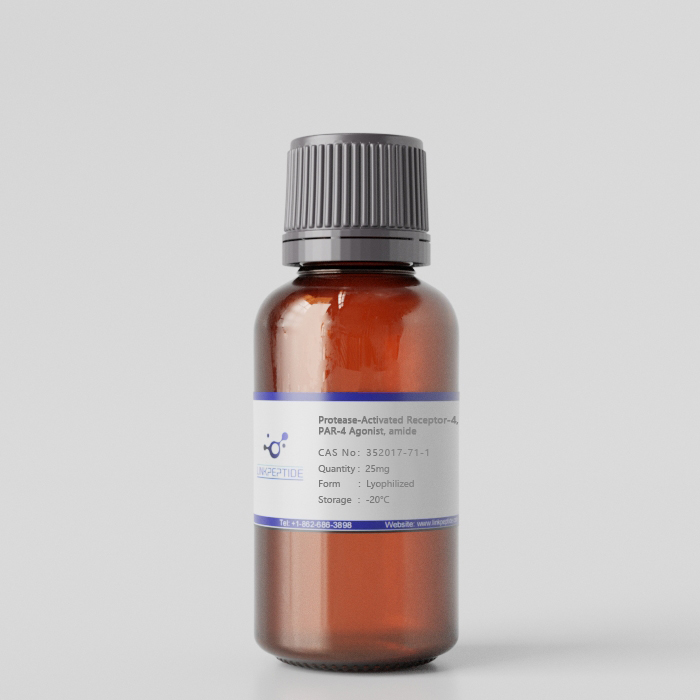
Product Name: Protease-Activated Receptor-4, PAR-4 Agonist, amide
Sequence One Letter Code: AYPGKF-NH2
Sequence Three Letter Code: H-Ala-Tyr-Pro-Gly-Lys-Phe-NH2
Cas No: 352017-71-1
Chemical Formula:C34H48N8O7
Molecular Weight: 680.8
Purity: 95%
Form: Lyophilized
Storage Conditions: - 20 °C
Research Area: Cardiovascular Disease Research
SMILES: C[C@@H](C(=O)N[C@@H](CC1=CC=C(C=C1)O)C(=O)N2CCC[C@H]2C(=O)NCC(=O)N[C@@H](CCCCN)C(=O)N[C@@H](CC3=CC=CC=C3)C(=O)N)N
IUPAC: (2S)-N-[2-[[(2S)-6-amino-1-[[(2S)-1-amino-1-oxo-3-phenylpropan-2-yl]amino]-1-oxohexan-2-yl]amino]-2-oxoethyl]-1-[(2S)-2-[[(2S)-2-aminopropanoyl]amino]-3-(4-hydroxyphenyl)propanoyl]pyrrolidine-2-carboxamide
INCHIKEY: BBAOHIALRKLBRD-OZDPOCAXSA-N
InChI=1S/C34H48N8O7/c1-21(36)31(46)41-27(19-23-12-14-24(43)15-13-23)34(49)42-17-7-11-28(42)33(48)38-20-29(44)39-25(10-5-6-16-35)32(47)40-26(30(37)45)18-22-8-3-2-4-9-22/h2-4,8-9,12-15,21,25-28,43H,5-7,10-11,16-20,35-36H2,1H3,(H2,37,45)(H,38,48)(H,39,44)(H,40,47)(H,41,46)/t21-,25-,26-,27-,28-/m0/s1
Source / Species: human
Conjugation: Unconjugated
Code Nacres: NA.26
Application: PAR-4 Agonist Peptide is a synthetic peptide designed to selectively activate protease-activated receptor-4 (PAR-4), a G protein–coupled receptor expressed on human platelets. PAR-4 plays a key role in thrombin-mediated platelet activation and hemostasis. This agonist peptide induces thromboxane production and platelet responses reaching approximately 50% of maximal thrombin activity. It is widely used to investigate platelet signaling pathways, receptor-specific activation, and differences among protease-activated receptors. The peptide supports studies in thrombosis, hemostasis, and cardiovascular research, providing a targeted tool for analyzing PAR-4–mediated cellular responses.
Current Research: PAR-4 Agonist Peptide is a synthetic ligand designed to selectively activate protease-activated receptor-4 (PAR-4), a member of the G protein–coupled receptor (GPCR) family expressed on human platelets. PAR-4 is one of the key receptors mediating thrombin-induced platelet activation, playing a critical role in hemostasis and thrombosis. This peptide provides a controlled and receptor-specific means to study platelet signaling pathways and protease-activated receptor biology. PAR-4 and Protease-Activated Receptors Protease-activated receptors (PARs) are a unique class of GPCRs that are activated through proteolytic cleavage, exposing a tethered ligand that binds intramolecularly to initiate signaling. In human platelets, the primary thrombin-responsive receptors are: PAR-1 – responsible for rapid, high-affinity responses PAR-4 – mediates slower, sustained platelet activation PAR-4 activation contributes to prolonged platelet signaling and stabilization of thrombus formation, making it an important target in cardiovascular research. Mechanism of Action The PAR-4 Agonist Peptide mimics the tethered ligand sequence generated upon thrombin cleavage of the receptor. By directly binding and activating PAR-4, the peptide bypasses the need for proteolytic activation and induces downstream signaling events. Upon activation, PAR-4 triggers: G protein–mediated signaling cascades Intracellular calcium mobilization Activation of phospholipase C (PLC) Platelet shape change and granule secretion These signaling events lead to functional platelet responses associated with clot formation. Induction of Platelet Activation PAR-4 Agonist Peptide stimulates platelet activity, including: Thromboxane A₂ production, amplifying platelet activation Platelet aggregation and secretion responses Activation of integrins and adhesion pathways The peptide typically induces responses reaching approximately 50% of maximal thrombin activity, reflecting the specific contribution of PAR-4 relative to other thrombin receptors. Applications in Platelet and Cardiovascular Research This peptide is widely used to dissect receptor-specific signaling mechanisms in platelet biology. Its selectivity allows researchers to isolate PAR-4–mediated effects from those of PAR-1 and other receptors. Common applications include: Studies of platelet activation pathways and signaling dynamics Comparison of PAR-1 and PAR-4 functional roles Investigation of thromboxane production and secretion mechanisms Analysis of intracellular calcium signaling in platelets Evaluation of receptor-specific pharmacological inhibitors These studies are essential for understanding how platelet responses are regulated under physiological and pathological conditions. Role in Thrombosis and Hemostasis Studies PAR-4 plays a significant role in thrombus formation and stability, particularly in later stages of platelet activation. The PAR-4 Agonist Peptide is therefore used to investigate: Mechanisms of clot formation and stabilization Platelet contributions to vascular injury responses Differences in thrombin signaling under varying conditions Such research is critical for understanding diseases involving abnormal clotting, including thrombosis and cardiovascular disorders. Advantages as a Research Tool The PAR-4 Agonist Peptide offers several experimental advantages: Selective activation of PAR-4 without proteolysis Controlled and reproducible stimulation of platelet responses Ability to dissect receptor-specific signaling pathways Compatibility with in vitro platelet assays and functional studies These properties make it an effective tool for mechanistic and pharmacological investigations. A Targeted Approach to Studying Platelet Signaling PAR-4 Agonist Peptide provides a precise and reliable method for activating PAR-4 and analyzing its role in platelet biology. By enabling selective investigation of thrombin receptor signaling, it supports detailed studies of hemostasis, thrombosis, and GPCR-mediated cellular responses. Its use continues to advance understanding of platelet function, receptor signaling specificity, and cardiovascular disease mechanisms, contributing to the development of targeted therapeutic strategies.
Get a Quote

 LinkPeptide