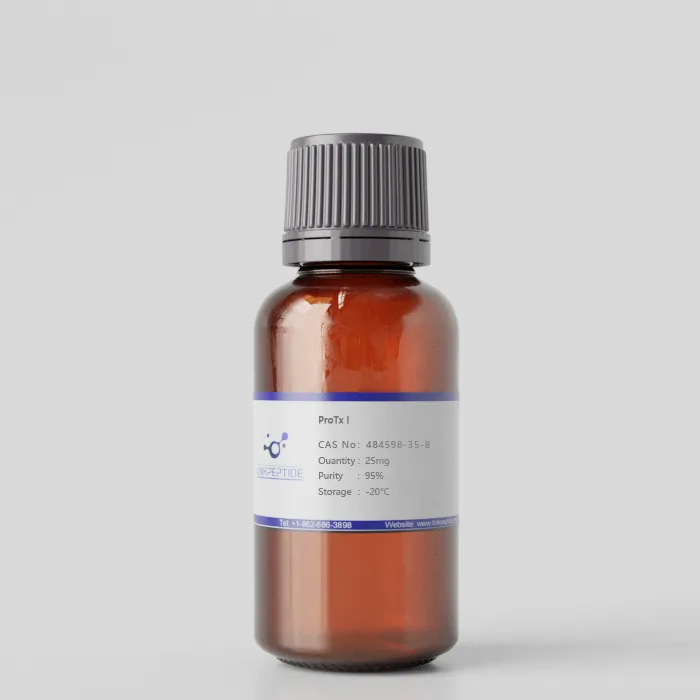
Product Name:ProTx-I
Synonyms:β-theraphotoxin-Tp1a, Beta-theraphotoxin-Tp1a, Protoxin-I, ProTx-1, Protoxin-1, ProTx I
CAS No:484598-35-8
Purity:95%
Molar Mass:3988
Chemical Formula:C171H245N53O47S6
Storage:Store at -20 degrees Celsius
Sequence:ECRYWLGGCSAGQTCCKHLVCSRRHGWCVWDGTFS
Target:NaV, CaV3.1, KV2.1, TRPA1 channels
Application:
ProTx-I is a peptide toxin derived from the venom of the tarantula Thrixopelma pruriens. It acts as a potent inhibitor of voltage-gated sodium channels, particularly Nav1.2 and Nav1.5, as well as voltage-gated calcium channels. ProTx-I works by shifting the voltage dependence of activation for these channels, thereby inhibiting the influx of sodium or calcium ions and preventing the initiation of action potentials. This makes it a valuable tool for studying the physiological and pharmacological properties of sodium and calcium channels in excitable cells, including neurons and cardiac tissues. ProTx-I is used in research on conditions such as chronic pain, cardiac arrhythmias, and other neurological or cardiovascular disorders associated with ion channel dysfunction.
Current Research:
ProTx-I, also known as Protoxin-I or β/ω-theraphotoxin-Tp1a, is a 35-amino-acid peptide neurotoxin derived from the venom of the Peruvian green velvet tarantula (Thrixopelma pruriens). It belongs to the inhibitory cystine knot (ICK) family of peptide toxins, recognized for their potent inhibition of voltage-gated ion channels.
Structural Characteristics
ProTx-I's structure comprises 35 amino acids with three disulfide bridges: Cys2–Cys16, Cys9–Cys21, and Cys15–Cys28. This configuration forms a compact and stable structure typical of ICK peptides. The molecule features a hydrophobic patch surrounded by charged residues, facilitating its interaction with lipid membranes and ion channel voltage-sensor domains.
Mechanism of Action
ProTx-I modulates ion channel activity by interacting with their voltage-sensor domains:
Voltage-Gated Sodium Channels (Naᵥ): ProTx-I inhibits multiple Naᵥ channel subtypes, including Naᵥ1.2, Naᵥ1.6, Naᵥ1.7, and Naᵥ1.8. It shifts the voltage dependence of activation to more positive potentials, reducing channel activity. The toxin primarily targets the voltage-sensor domains of domains II and IV.
T-Type Calcium Channels (Caᵥ3.1): ProTx-I selectively blocks Caᵥ3.1 channels with an IC₅₀ of approximately 0.2 μM, while exhibiting less potency against Caᵥ3.2 channels (IC₅₀ ~31.8 μM).
Transient Receptor Potential Ankyrin 1 (TRPA1) Channels: ProTx-I inhibits TRPA1 channels with an IC₅₀ of 0.39 μM, implicating its potential in modulating nociceptive pathways.
Research Applications
Due to its broad activity profile, ProTx-I serves as a valuable tool in neurophysiological research:
Ion Channel Characterization: ProTx-I aids in elucidating the gating mechanisms and structural dynamics of various ion channels.
Pharmacological Studies: Its ability to modulate multiple ion channels makes it useful in developing therapeutic agents targeting conditions like pain, epilepsy, and cardiac arrhythmias.
Clinical Implications
The potent inhibition of Naᵥ1.7 and TRPA1 channels by ProTx-I suggests potential therapeutic applications in pain management. However, its lack of selectivity across ion channel subtypes necessitates further modification to minimize off-target effects before clinical use.
Conclusion
ProTx-I is a multifaceted peptide toxin that modulates various voltage-gated ion channels. Its unique structural and functional properties make it a significant subject of study in understanding ion channel physiology and in the pursuit of novel therapeutic interventions.
Reference:
Get a Quote
 LinkPeptide

![LEIUROTOXIN I [R7]-](https://www.linkpeptide.com/wp-content/uploads/2024/10/LEIUROTOXIN-I-R7-jpg-2.webp "LEIUROTOXIN I [R7]-")