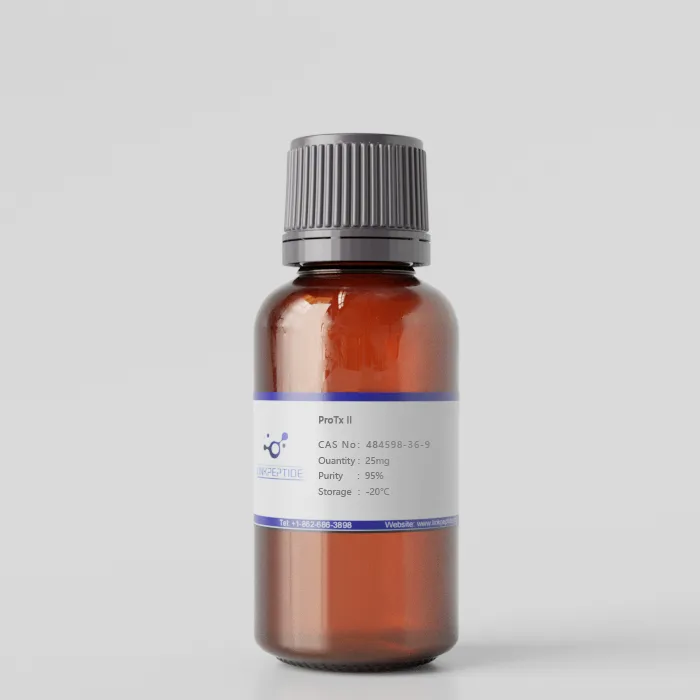
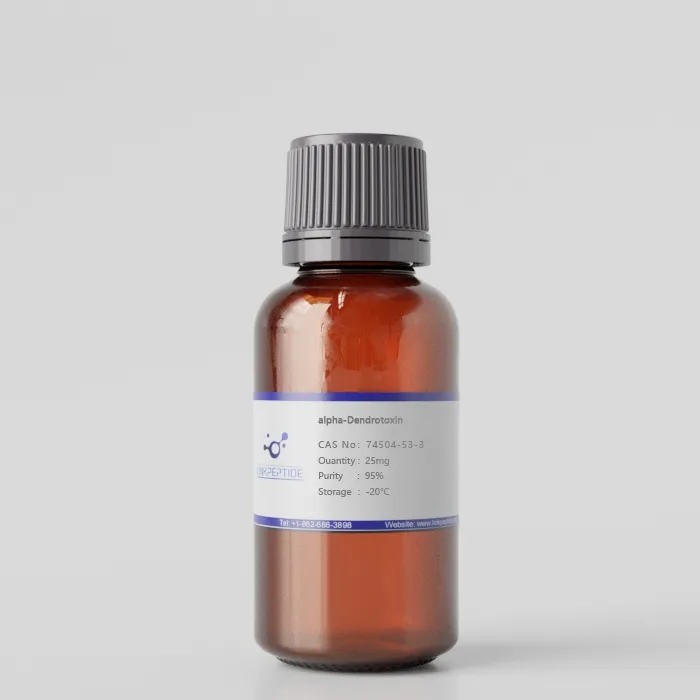
Product Name:ProTx II
CAS No:484598-36-9
Purity:95%
Molar Mass:3826.58
Chemical Formula:C168H250N46O41S8
Storage:Store at -20 degrees Celsius
Sequence:YCQKWMWTCDSERKCCEGMVCRLWCKKKLW
Target:NaV1.7 channel blocker
Application:ProTx II is a peptide toxin derived from the venom of the Peruvian green velvet tarantula (Thrixopelma pruriens). It functions as a potent and selective inhibitor of voltage-gated sodium channels, particularly Nav1.7, which is a critical target in pain signaling pathways. ProTx II binds to the voltage sensor domain of these channels, preventing their activation and thereby inhibiting the transmission of pain signals. This peptide is of particular interest in research focused on developing new pain therapies, especially for chronic pain conditions. Due to its specificity and effectiveness, ProTx II serves as a valuable tool in neurophysiological studies and drug development targeting ion channels.
Current Research:
ProTx-II, also known as Protoxin-II, is a 30-amino acid peptide neurotoxin derived from the venom of the Peruvian green velvet tarantula (Thrixopelma pruriens). It is recognized for its potent inhibition of voltage-gated sodium channels (Nav), particularly the Nav1.7 subtype, which is critically involved in pain signaling pathways.
Structural Characteristics
ProTx-II adopts an inhibitory cystine knot (ICK) motif, characterized by three disulfide bonds that confer exceptional stability and resistance to proteolytic degradation. This structural configuration is amphipathic, with hydrophobic residues predominantly on one face, facilitating its interaction with lipid membranes and ion channels.
Mechanism of Action
ProTx-II exerts its effects by targeting the voltage-sensor domain II (VSD-II) of Nav channels. It binds to the linker between the S3 and S4 segments of VSD-II, inhibiting channel activation by shifting the voltage dependence of activation to more positive potentials. This action effectively reduces sodium influx during neuronal depolarization, attenuating action potential propagation. Additionally, ProTx-II can inhibit fast inactivation of Nav channels by interacting with VSD-IV, though this effect is less pronounced and appears to be independent of its action on activation.
Selectivity and Potency
ProTx-II exhibits high selectivity for Nav1.7, with an IC?? of approximately 0.3 nM, making it at least 100-fold more potent against Nav1.7 than other Nav subtypes. This specificity is attributed to unique interactions between ProTx-II and the VSD-II of Nav1.7. Mutations in the DIIS3 segment of Nav1.7 can significantly reduce ProTx-II binding affinity, underscoring the importance of this region in toxin-channel interactions.
Therapeutic Potential
Given its potent inhibition of Nav1.7, ProTx-II has been investigated as a potential analgesic agent. In animal models, ProTx-II administration resulted in significant analgesic effects, reducing pain behaviors in response to noxious stimuli. However, its high affinity for other Nav subtypes, such as Nav1.4, raises concerns about off-target effects, including potential muscle toxicity. To address this, analogs of ProTx-II have been engineered to enhance selectivity for Nav1.7 over other subtypes, aiming to develop safer and more effective pain therapeutics.
Research Applications
ProTx-II serves as a valuable tool in neurophysiological research, aiding in the elucidation of Nav channel function and the development of Nav1.7-targeted therapies. Radiolabeled ProTx-II has been utilized in binding assays to characterize Nav1.7 pharmacology and screen for novel channel modulators.
Conclusion
ProTx-II is a potent and selective inhibitor of Nav1.7 channels, offering significant insights into pain mechanisms and potential therapeutic avenues. Ongoing research focuses on refining its selectivity and therapeutic profile to harness its analgesic potential while minimizing adverse effects.
Reference:
Get a Quote
 LinkPeptide