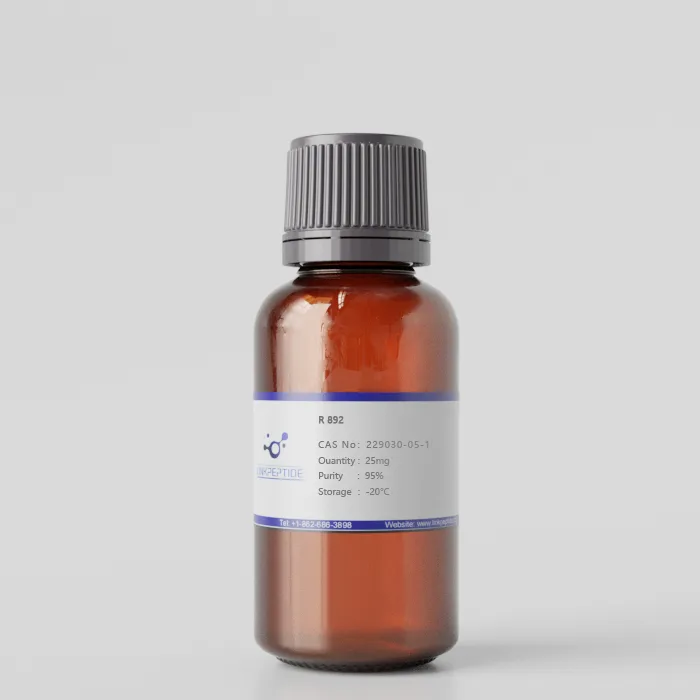
Product Name:R 892
CAS No:229030-05-1
Purity:95%
Molar Mass:1154.37
Chemical Formula:C58H83N13O12
Storage:Store at -20 degrees Celsius
Sequence:KRPPGFSXI
Target:bradykinin B1 receptor
Application:
R 892 is a selective antagonist of the bradykinin B1 receptor (B1R). It inhibits the activity of B1R, which is upregulated in inflammatory conditions and is involved in pain, inflammation, and immune responses. By blocking the B1R, R 892 helps in studying and modulating chronic inflammatory diseases where the B1 receptor plays a significant role. This peptide is useful in research focused on understanding the mechanisms of inflammation and developing treatments for diseases associated with excessive bradykinin signaling.
Current Research:
R 892 (CAS: 229030-05-1) is a synthetic and highly selective antagonist of the bradykinin B₁ receptor (B₁R), a G protein-coupled receptor implicated in inflammation, pain, and cardiovascular regulation. The peptide sequence of R 892, Ac-Lys-Arg-Pro-Pro-Gly-[MePhe]-Ser-D-2-Nal-Ile-OH, incorporates modifications such as a methylated phenylalanine ([MePhe]) and D-2-naphthylalanine (D-2-Nal), which enhance its stability and selectivity. It exhibits an ID₅₀ of 2.8 nM for B₁R, while demonstrating negligible activity at the bradykinin B₂ receptor (B₂R), making it an essential tool for dissecting the specific roles of B₁R.
Biological Activity and Mechanisms
Bradykinin B₁ receptors are minimally expressed under normal conditions but are rapidly upregulated in response to inflammation, tissue injury, or infection. R 892 acts as a competitive antagonist, effectively blocking B₁R activation by endogenous agonists such as Lys-[Des-Arg⁹]-bradykinin. This blockade interrupts downstream signaling cascades, including pro-inflammatory cytokine release and vasodilation, making R 892 a valuable candidate for research into inflammation-mediated pathologies.
Preclinical Applications
Recent studies utilizing R 892 in animal models have demonstrated its efficacy in reducing inflammatory pain and vascular permeability associated with B₁R activation. In cardiovascular research, R 892 has been shown to modulate blood pressure by inhibiting B₁R-mediated vasodilatory responses, offering insights into its potential therapeutic role in hypertensive disorders. Additionally, its metabolic stability allows for prolonged pharmacological activity in vivo, facilitating detailed investigations into B₁R function.
Therapeutic Implications
Given its potency and selectivity, R 892 has garnered interest as a lead compound for the development of novel anti-inflammatory and analgesic agents. Current research focuses on exploring its role in chronic inflammatory conditions, neuropathic pain, and cardiovascular diseases.
Conclusion
R 892 is a pivotal tool in the study of bradykinin-mediated pathways, providing critical insights into the therapeutic potential of targeting B₁R in inflammation and cardiovascular regulation.
Reference:
Get a Quote
 LinkPeptide

![SCYLLATOXIN [Tyr2]-](https://www.linkpeptide.com/wp-content/uploads/2024/10/SCYLLATOXIN-Tyr2-jpg-2.webp "SCYLLATOXIN [Tyr2]-")