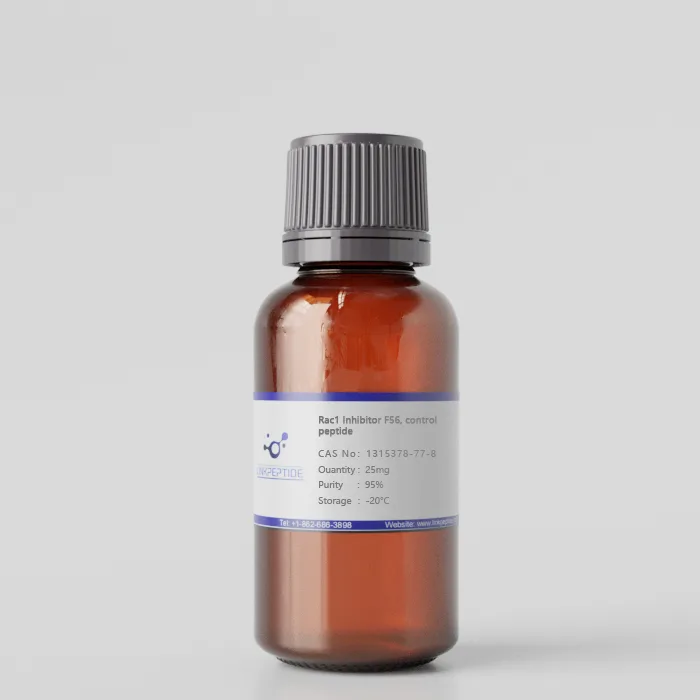
Product Name:Rac1 Inhibitor F56, control peptide
CAS No:1315378-77-8
Purity:95%
Molar Mass:1632.89
Chemical Formula:C72H116N18O23S
Storage:Store at -20 degrees Celsius
Sequence:MVDGKPVNLGLFDTAG
Target:Rac1
Application:
Rac1 Inhibitor F56, Control Peptide is a synthetic peptide used as a negative control in experiments involving the Rac1 Inhibitor F56. This control peptide is structurally similar to the active inhibitor but lacks the key functional groups necessary for inhibiting Rac1 activity. By using this control peptide, researchers can ensure that any observed effects in their experiments are specifically due to the inhibition of Rac1 by the active F56 peptide, rather than non-specific interactions or off-target effects. This control is essential for validating the specificity and efficacy of Rac1 inhibition in studies related to cell migration, cytoskeletal dynamics, and cancer metastasis.
Current Research:
The Rac1 Inhibitor F56 control peptide is a synthetic peptide encompassing residues 45 to 60 of the Rac1 protein, with a specific mutation where tryptophan at position 56 (Trp56) is substituted by phenylalanine (Phe56). This modification renders the peptide inactive in terms of interfering with Rac1's interactions with its guanine nucleotide exchange factors (GEFs), thereby serving as an ideal control in experimental settings. Structural Composition The sequence of the Rac1 Inhibitor F56 control peptide is: Met-Val-Asp-Gly-Lys-Pro-Val-Asn-Leu-Gly-Leu-Phe-Asp-Thr-Ala-Gly This sequence mirrors the region of Rac1 involved in GEF binding, with the critical Trp56 replaced by Phe56. Functional Characteristics Unlike the active Rac1 Inhibitor W56 peptide, which contains the native Trp56 and disrupts Rac1-GEF interactions, the F56 control peptide does not affect these interactions. This lack of activity is due to the Trp56 to Phe56 mutation, which alters the peptide's binding affinity for GEFs, making it ineffective in inhibiting Rac1 activation. Applications in Research The Rac1 Inhibitor F56 control peptide is utilized as a negative control in studies investigating the role of Rac1 and its interactions with GEFs. By comparing the effects of the active W56 peptide with the inactive F56 control peptide, researchers can validate the specificity and efficacy of Rac1 inhibition in various cellular processes, including cytoskeletal dynamics, cell migration, and proliferation. Handling and Storage For optimal stability, the Rac1 Inhibitor F56 control peptide should be stored at -20 degrees Celsius protected from light and moisture. It is soluble in water, facilitating its incorporation into various experimental protocols. Conclusion The Rac1 Inhibitor F56 control peptide serves as a crucial tool in molecular biology research, providing a baseline to assess the specific effects of Rac1 inhibition. Its design ensures that any observed cellular changes can be attributed to the active inhibition of Rac1 rather than nonspecific peptide interactions, thereby enhancing the reliability of experimental outcomes.
Reference:
Get a Quote
 LinkPeptide